Lopez-Anido Camila, Sun Guannan, Koenning Matthias, Srinivasan Rajini, Hung Holly A, Emery Ben, Keles Sunduz, Svaren John
Waisman Center, University of Wisconsin-Madison, Madison, Wisconsin, 53705.
Comparative Biomedical Sciences Graduate Program, University of Wisconsin-Madison, Madison, Wisconsin, 53705.
Glia. 2015 Nov;63(11):1897-1914. doi: 10.1002/glia.22855. Epub 2015 May 14.
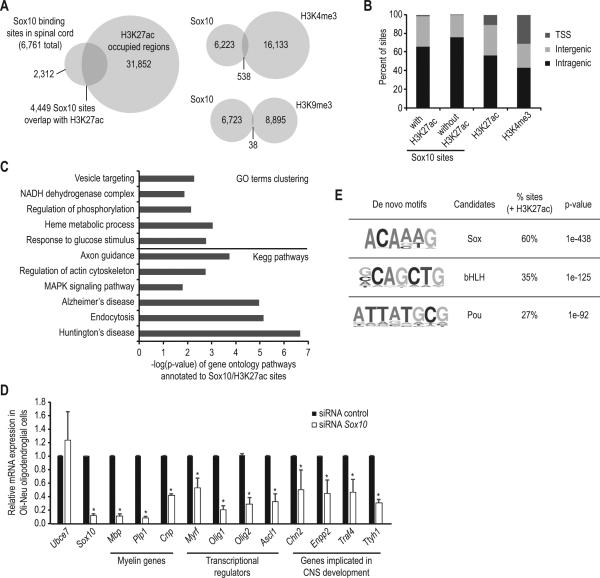
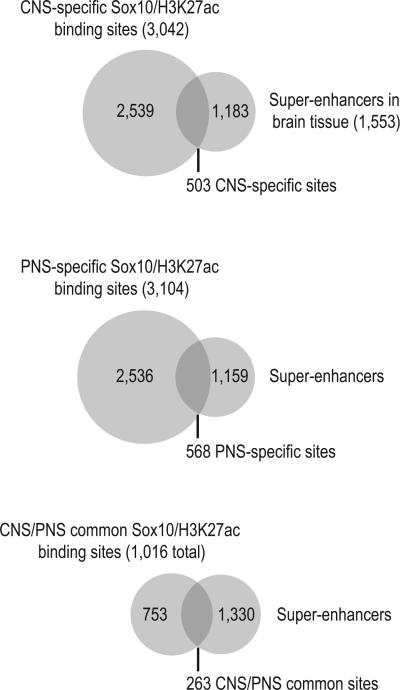
Myelin is formed by specialized myelinating glia: oligodendrocytes and Schwann cells in the central and peripheral nervous systems, respectively. While there are distinct developmental aspects and regulatory pathways in these two cell types, myelination in both systems requires the transcriptional activator Sox10. Sox10 interacts with cell type-specific transcription factors at some loci to induce myelin gene expression, but it is largely unknown how Sox10 transcriptional networks globally compare between oligodendrocytes and Schwann cells. We used in vivo ChIP-Seq analysis of spinal cord and peripheral nerve (sciatic nerve) to identify unique and shared Sox10 binding sites and assess their correlation with active enhancers and transcriptional profiles in oligodendrocytes and Schwann cells. Sox10 binding sites overlap with active enhancers and critical cell type-specific regulators of myelination, such as Olig2 and Myrf in oligodendrocytes, and Egr2/Krox20 in Schwann cells. Sox10 sites also associate with genes critical for myelination in both oligodendrocytes and Schwann cells and are found within super-enhancers previously defined in brain. In Schwann cells, Sox10 sites contain binding motifs of putative partners in the Sp/Klf, Tead, and nuclear receptor protein families. Specifically, siRNA analysis of nuclear receptors Nr2f1 and Nr2f2 revealed downregulation of myelin genes Mbp and Ndrg1 in primary Schwann cells. Our analysis highlights different mechanisms that establish cell type-specific genomic occupancy of Sox10, which reflects the unique characteristics of oligodendrocyte and Schwann cell differentiation. GLIA 2015;63:1897-1914.
分别是中枢神经系统中的少突胶质细胞和周围神经系统中的施万细胞。虽然这两种细胞类型存在不同的发育方面和调控途径,但两个系统中的髓鞘形成都需要转录激活因子Sox10。Sox10在某些基因座与细胞类型特异性转录因子相互作用以诱导髓磷脂基因表达,但在很大程度上尚不清楚少突胶质细胞和施万细胞之间Sox10转录网络在整体上如何比较。我们对脊髓和周围神经(坐骨神经)进行体内染色质免疫沉淀测序(ChIP-Seq)分析,以鉴定独特的和共享的Sox10结合位点,并评估它们与少突胶质细胞和施万细胞中活性增强子和转录谱的相关性。Sox10结合位点与活性增强子以及髓鞘形成的关键细胞类型特异性调节因子重叠,例如少突胶质细胞中的Olig2和Myrf,以及施万细胞中的Egr2/Krox20。Sox10位点还与少突胶质细胞和施万细胞中髓鞘形成关键的基因相关联,并且在先前在脑中定义的超级增强子内被发现。在施万细胞中,Sox10位点包含Sp/Klf、Tead和核受体蛋白家族中推定伙伴的结合基序。具体而言,对核受体Nr2f1和Nr2f2的小干扰RNA(siRNA)分析显示,原代施万细胞中髓磷脂基因Mbp和Ndrg1的表达下调。我们的分析突出了建立Sox10细胞类型特异性基因组占据的不同机制,这反映了少突胶质细胞和施万细胞分化的独特特征。《神经胶质》2015年;63:1897 - 1914。