Nobuta Hiroko, Cilio Maria Roberta, Danhaive Olivier, Tsai Hui-Hsin, Tupal Srinivasan, Chang Sandra M, Murnen Alice, Kreitzer Faith, Bravo Verenice, Czeisler Catherine, Gokozan Hamza Numan, Gygli Patrick, Bush Sean, Weese-Mayer Debra E, Conklin Bruce, Yee Siu-Pok, Huang Eric J, Gray Paul A, Rowitch David, Otero José Javier
Department of Pediatrics, University of California San Francisco, 35 Medical Center Way, San Francisco, CA, 94143, USA.
Acta Neuropathol. 2015 Aug;130(2):171-83. doi: 10.1007/s00401-015-1441-0. Epub 2015 May 15.
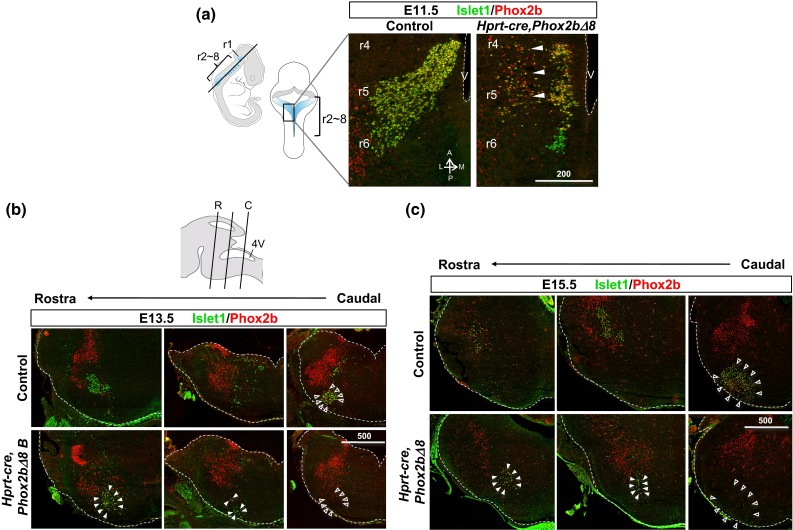
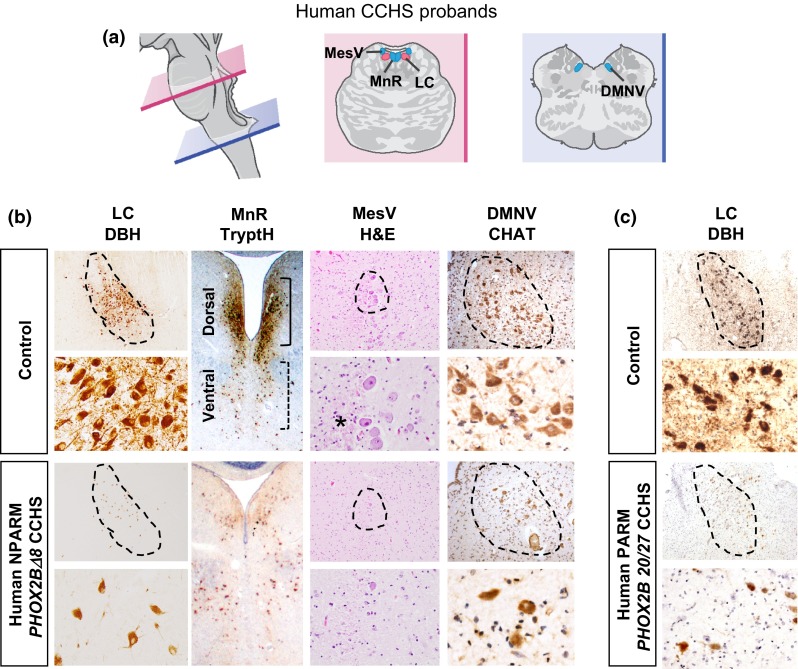
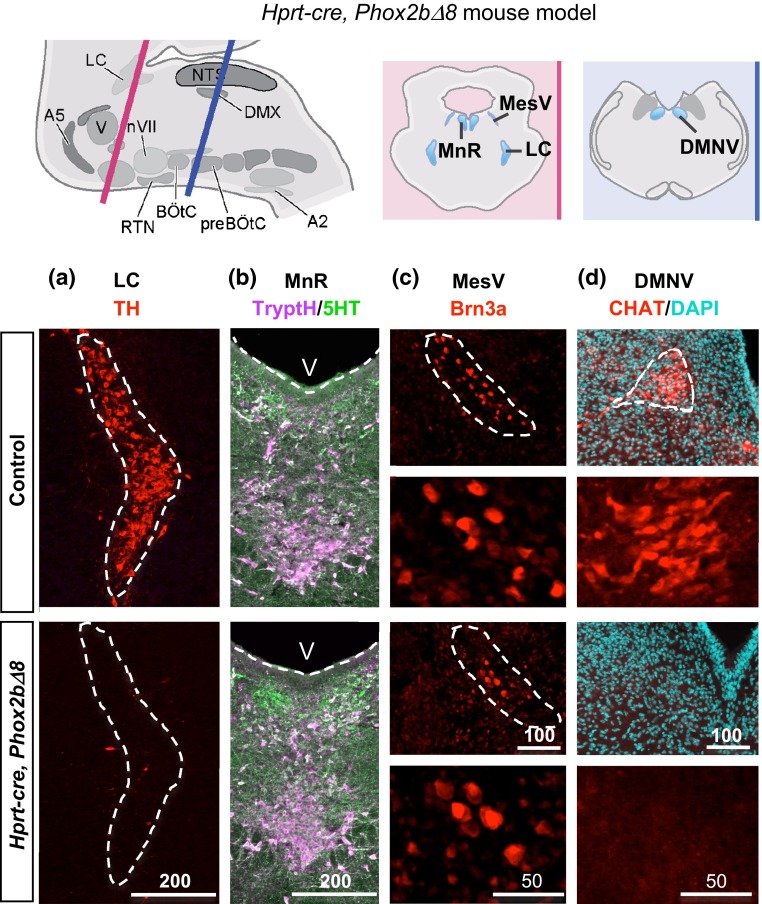
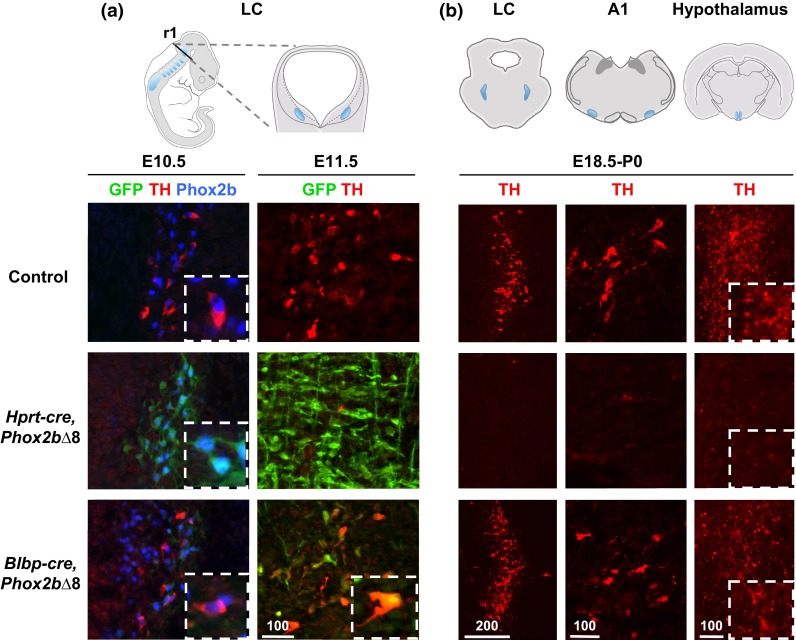
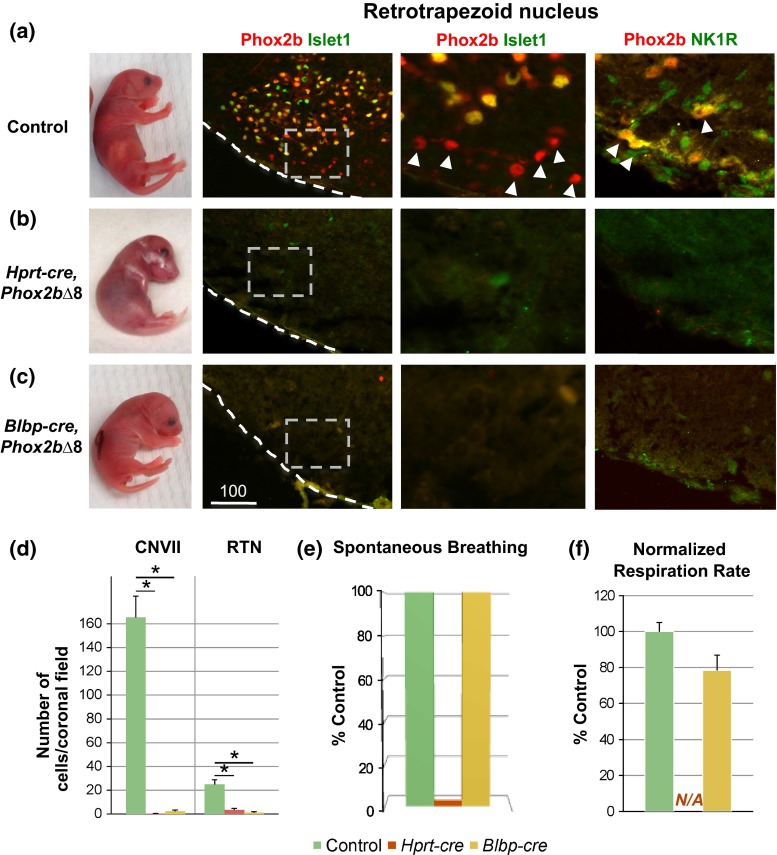
Human congenital central hypoventilation syndrome (CCHS), resulting from mutations in transcription factor PHOX2B, manifests with impaired responses to hypoxemia and hypercapnia especially during sleep. To identify brainstem structures developmentally affected in CCHS, we analyzed two postmortem neonatal-lethal cases with confirmed polyalanine repeat expansion (PARM) or Non-PARM (PHOX2B∆8) mutation of PHOX2B. Both human cases showed neuronal losses within the locus coeruleus (LC), which is important for central noradrenergic signaling. Using a conditionally active transgenic mouse model of the PHOX2B∆8 mutation, we found that early embryonic expression (<E10.5) caused failure of LC neuronal specification and perinatal respiratory lethality. In contrast, later onset (E11.5) of PHOX2B∆8 expression was not deleterious to LC development and perinatal respiratory lethality was rescued, despite failure of chemosensor retrotrapezoid nucleus formation. Our findings indicate that early-onset mutant PHOX2B expression inhibits LC neuronal development in CCHS. They further suggest that such mutations result in dysregulation of central noradrenergic signaling, and therefore, potential for early pharmacologic intervention in humans with CCHS.
人类先天性中枢性低通气综合征(CCHS)由转录因子PHOX2B的突变引起,表现为对低氧血症和高碳酸血症的反应受损,尤其是在睡眠期间。为了确定CCHS中发育受影响的脑干结构,我们分析了两例经确诊为PHOX2B多聚丙氨酸重复序列扩增(PARM)或非PARM(PHOX2B∆8)突变的新生儿致死性尸检病例。这两例人类病例均显示蓝斑(LC)内神经元丢失,而蓝斑对中枢去甲肾上腺素能信号传导很重要。使用PHOX2B∆8突变的条件性活性转基因小鼠模型,我们发现胚胎早期表达(<E10.5)导致LC神经元特化失败和围产期呼吸致死。相比之下,PHOX2B∆8表达的较晚起始(E11.5)对LC发育无害,并且尽管化学感受器后梯形核形成失败,但围产期呼吸致死得到挽救。我们的研究结果表明,早发性突变PHOX2B表达抑制CCHS中LC神经元的发育。它们进一步表明,此类突变导致中枢去甲肾上腺素能信号传导失调,因此,有可能对CCHS患者进行早期药物干预。