Hun Yeon Ju, Chan Karen Y T, Wong Ting-Chia, Chan Kelvin, Sutherland Michael R, Ismagilov Rustem F, Pryzdial Edward L G, Kastrup Christian J
Michael Smith Laboratories and Department of Biochemistry and Molecular Biology, University of British Columbia, Vancouver, BC, Canada.
1] Centre for Innovation, Canadian Blood Services, Vancouver, BC, Canada [2] Centre for Blood Research and Department of Pathology and Laboratory Medicine, University of British Columbia, Vancouver, BC, Canada.
Sci Rep. 2015 May 15;5:10274. doi: 10.1038/srep10274.
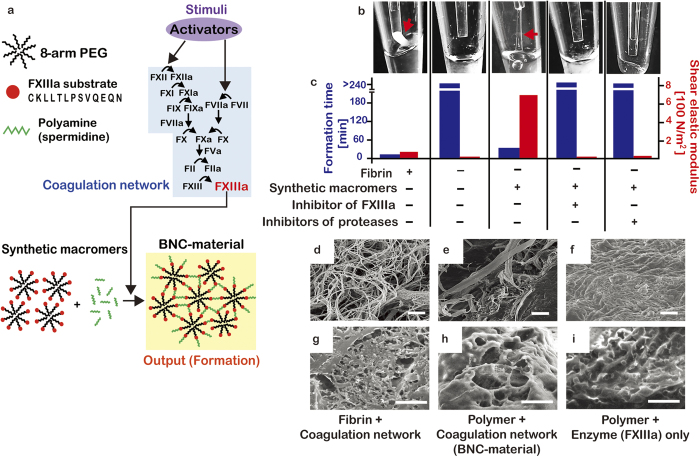
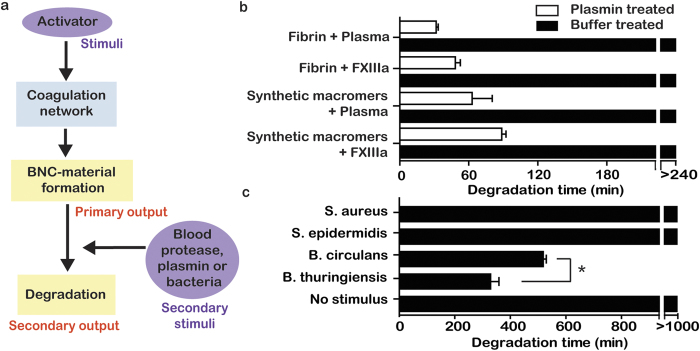
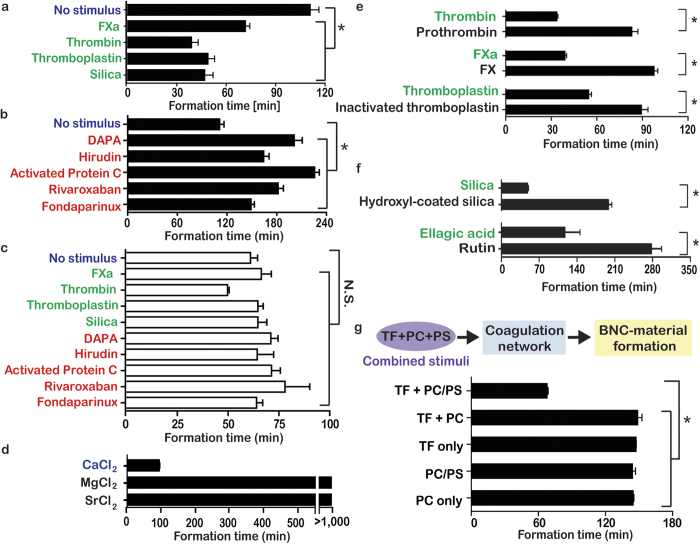
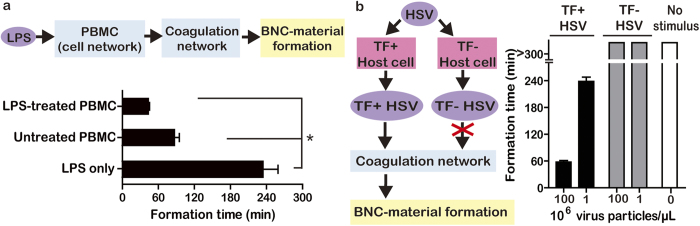
Developing bio-compatible smart materials that assemble in response to environmental cues requires strategies that can discriminate multiple specific stimuli in a complex milieu. Synthetic materials have yet to achieve this level of sensitivity, which would emulate the highly evolved and tailored reaction networks of complex biological systems. Here we show that the output of a naturally occurring network can be replaced with a synthetic material. Exploiting the blood coagulation system as an exquisite biological sensor, the fibrin clot end-product was replaced with a synthetic material under the biological control of a precisely regulated cross-linking enzyme. The functions of the coagulation network remained intact when the material was incorporated. Clot-like polymerization was induced in indirect response to distinct small molecules, phospholipids, enzymes, cells, viruses, an inorganic solid, a polyphenol, a polysaccharide, and a membrane protein. This strategy demonstrates for the first time that an existing stimulus-responsive biological network can be used to control the formation of a synthetic material by diverse classes of physiological triggers.
开发能够响应环境线索进行组装的生物相容性智能材料,需要能够在复杂环境中区分多种特定刺激的策略。合成材料尚未达到这种灵敏度水平,而这种灵敏度可模拟复杂生物系统中高度进化且经过定制的反应网络。在此,我们展示了天然存在的网络输出可以被合成材料取代。利用血液凝固系统作为一种精密的生物传感器,在精确调控的交联酶的生物控制下,纤维蛋白凝块终产物被合成材料所取代。当该材料被整合时,凝血网络的功能保持完整。对不同的小分子、磷脂、酶、细胞、病毒、无机固体、多酚、多糖和膜蛋白的间接反应会诱导类似凝块的聚合。这一策略首次证明,现有的刺激响应生物网络可被用于通过各类生理触发因素来控制合成材料的形成。