Gowin Joshua L, Ball Tali M, Wittmann Marc, Tapert Susan F, Paulus Martin P
Psychiatry, University of California San Diego, La Jolla, CA, United States; Section on Human Psychopharmacology, Laboratory of Clinical and Translational Studies, National Institute on Alcohol Abuse and Alcoholism, Bethesda, MD, United States.
Psychiatry, University of California San Diego, La Jolla, CA, United States.
Drug Alcohol Depend. 2015 Jul 1;152:93-101. doi: 10.1016/j.drugalcdep.2015.04.018. Epub 2015 Apr 30.
Nearly half of individuals with substance use disorders relapse in the year after treatment. A diagnostic tool to help clinicians make decisions regarding treatment does not exist for psychiatric conditions. Identifying individuals with high risk for relapse to substance use following abstinence has profound clinical consequences. This study aimed to develop neuroimaging as a robust tool to predict relapse.
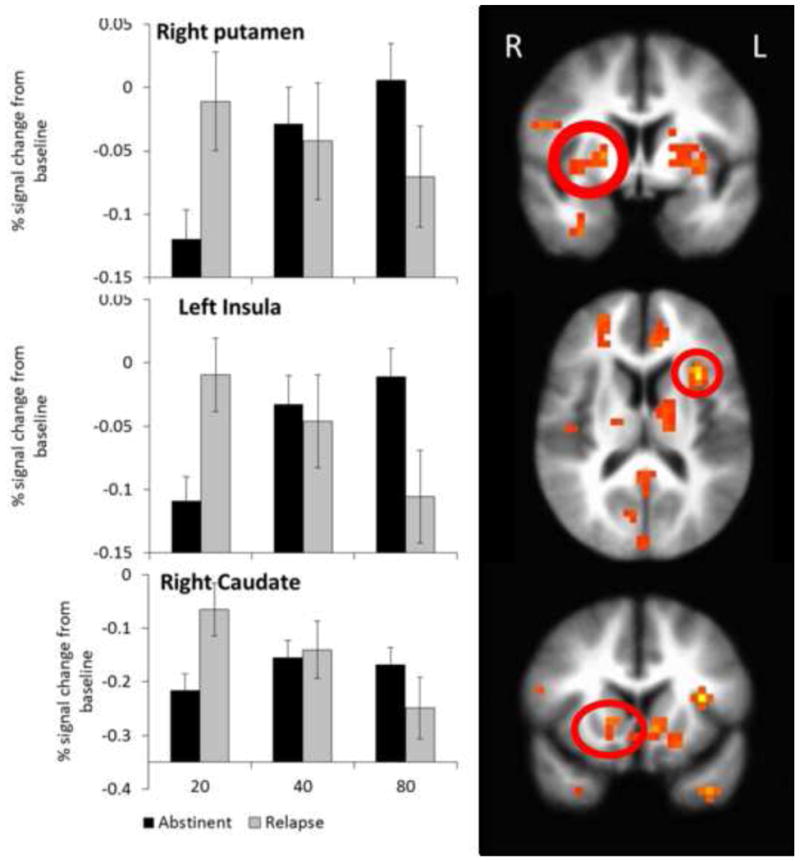
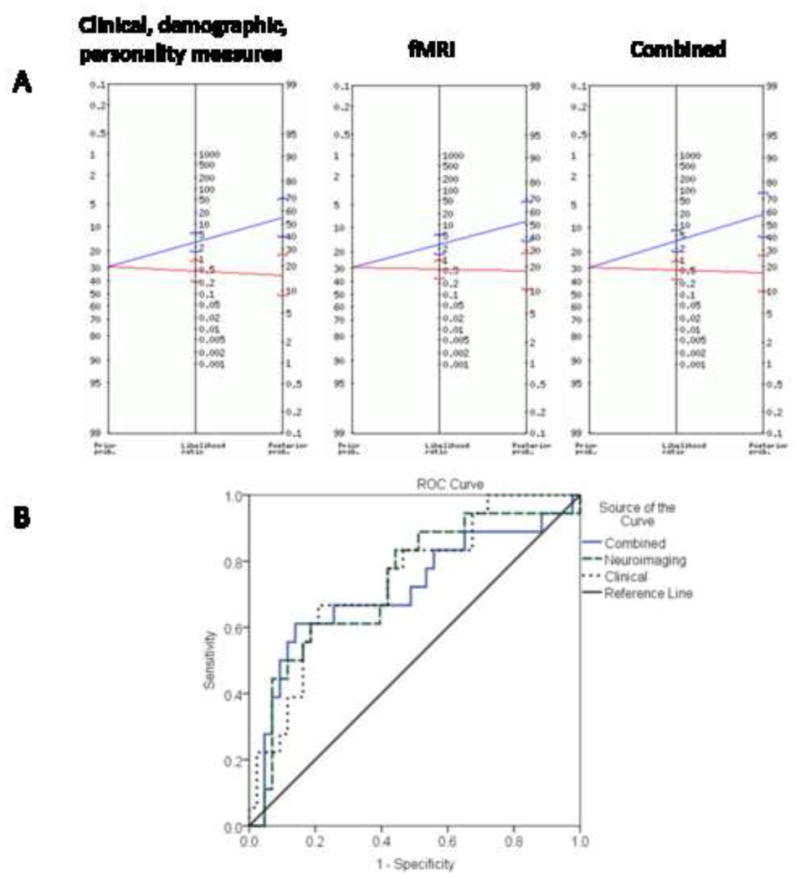
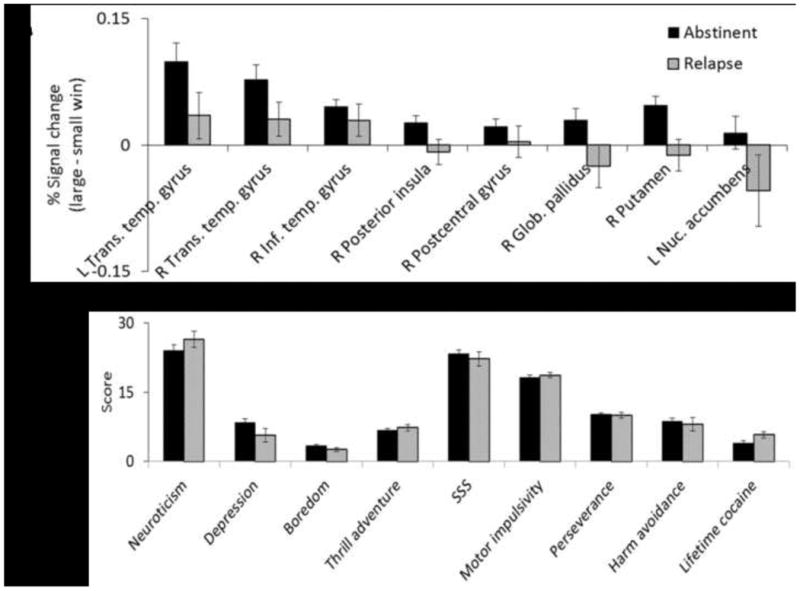
68 methamphetamine-dependent adults (15 female) were recruited from 28-day inpatient treatment. During treatment, participants completed a functional MRI scan that examined brain activation during reward processing. Patients were followed 1 year later to assess abstinence. We examined brain activation during reward processing between relapsing and abstaining individuals and employed three random forest prediction models (clinical and personality measures, neuroimaging measures, a combined model) to generate predictions for each participant regarding their relapse likelihood.
18 individuals relapsed. There were significant group by reward-size interactions for neural activation in the left insula and right striatum for rewards. Abstaining individuals showed increased activation for large, risky relative to small, safe rewards, whereas relapsing individuals failed to show differential activation between reward types. All three random forest models yielded good test characteristics such that a positive test for relapse yielded a likelihood ratio 2.63, whereas a negative test had a likelihood ratio of 0.48.
These findings suggest that neuroimaging can be developed in combination with other measures as an instrument to predict relapse, advancing tools providers can use to make decisions about individualized treatment of substance use disorders.
近一半患有物质使用障碍的个体在治疗后的一年内会复发。目前尚无一种诊断工具可帮助临床医生针对精神疾病做出治疗决策。识别禁欲后物质使用复发风险高的个体具有深远的临床意义。本研究旨在开发一种神经影像学方法作为预测复发的有力工具。
从28天的住院治疗中招募了68名甲基苯丙胺依赖的成年人(15名女性)。在治疗期间,参与者完成了一次功能磁共振成像扫描,该扫描检查了奖励处理过程中的大脑激活情况。一年后对患者进行随访以评估禁欲情况。我们检查了复发者和禁欲者在奖励处理过程中的大脑激活情况,并采用三种随机森林预测模型(临床和人格测量、神经影像学测量、联合模型)为每个参与者生成关于其复发可能性的预测。
18人复发。对于奖励,在左侧岛叶和右侧纹状体的神经激活方面,存在显著的奖励大小与组间交互作用。相对于小的、安全的奖励,禁欲者对大的、有风险的奖励表现出增强的激活,而复发者在不同奖励类型之间未表现出差异激活。所有三种随机森林模型都产生了良好的测试特征,即复发的阳性测试的似然比为2.63,而阴性测试的似然比为0.48。
这些发现表明,神经影像学可以与其他测量方法结合开发成一种预测复发的工具,推进提供者可用于做出关于物质使用障碍个体化治疗决策的工具。