Wang Zhenlei, Ma Bin, Ji Xiaopin, Deng Yang, Zhang Tao, Zhang Xiaojian, Gao Haoji, Sun Hanxing, Wu Haoxuan, Chen Xianze, Zhao Ren
Department of General Surgery, Rui Jin Hospital, Shanghai Jiao Tong University School of Medicine, 197 Rui Jin Er Road, Shanghai, 200025 P R China.
Department of Spine, Shanghai East Hospital, Tongji University School of Medicine, Shanghai, 200120 P R China.
Cancer Cell Int. 2015 Apr 15;15:40. doi: 10.1186/s12935-015-0192-2. eCollection 2015.
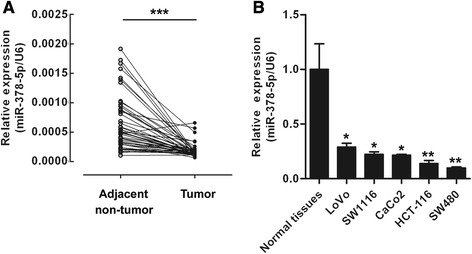
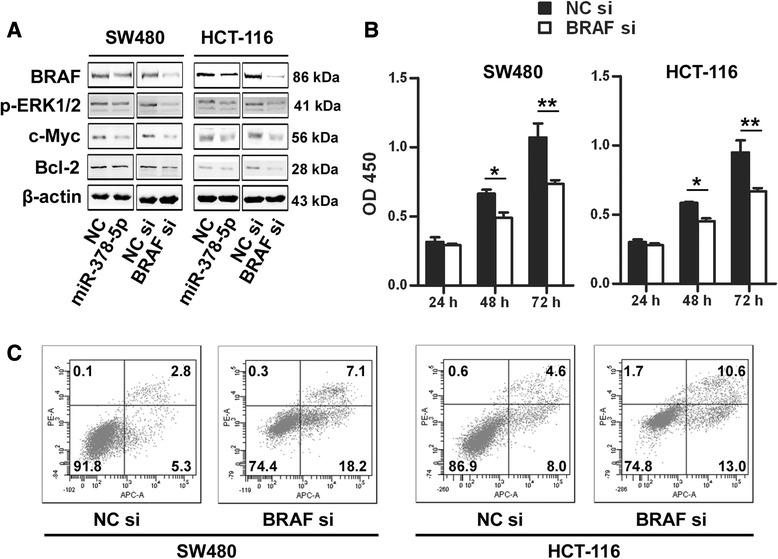
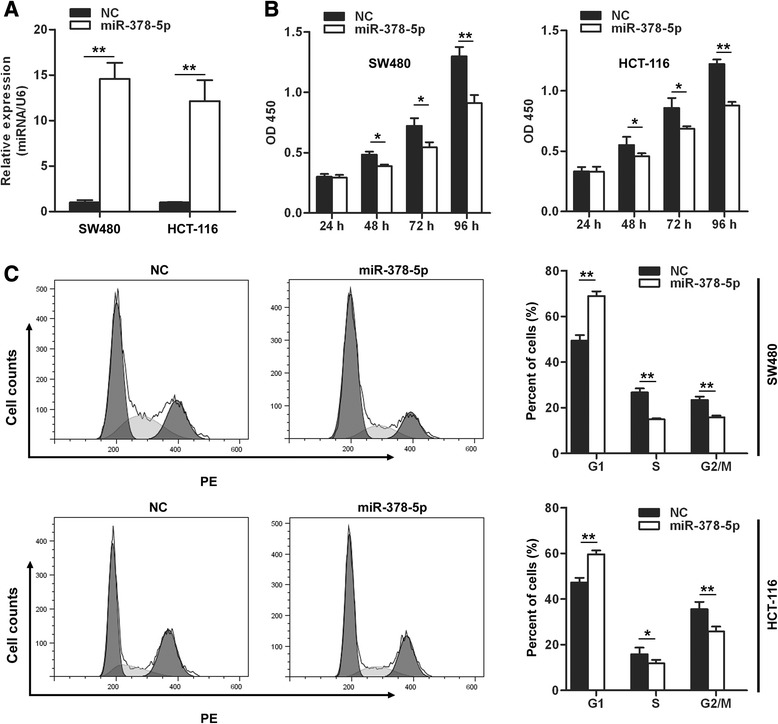
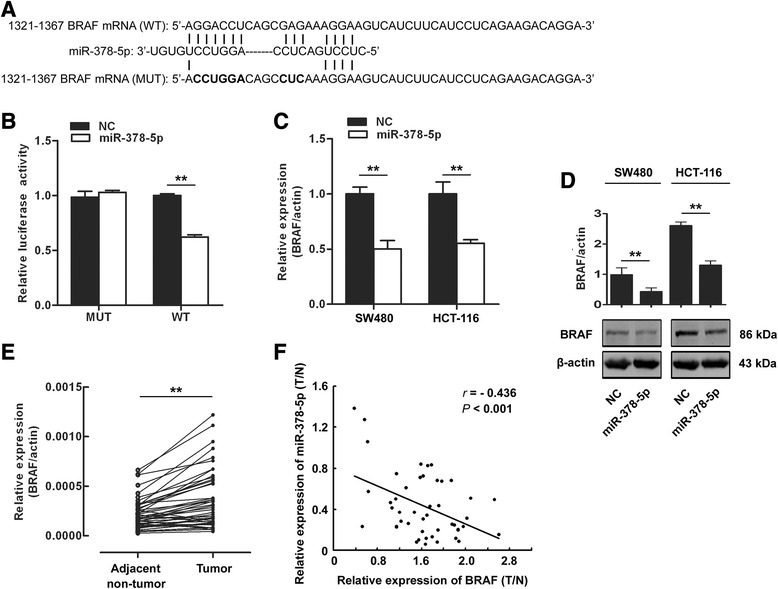
MicroRNAs (miRNAs) are a group of small non-coding RNA molecules that potentially play a critical role in tumorigenesis. Increasing evidences indicate that miR-378-5p is dysregulated in numerous human cancers including colorectal cancer (CRC) which hypothesizes that miR-378-5p may play an important role in tumorigenesis. However, its role in CRC carcinogenesis remains poorly defined because of lacking target genes information. In the present study, it was demonstrated that the expression of miR-378-5p was down-regulated in CRC tissues and cell lines as determined by quantitative reverse transcription-polymerase chain reaction (qRT-PCR). Furthermore, overexpression of miR-378-5p suppressed cell proliferation, as indicated by CCK-8 assay. Flow cytometric analysis demonstrated that overexpression of miR-378-5p induced cell cycle arrest and promoted apoptosis in CRC cells. A luciferase reporter assay indicated that BRAF was a direct target of miR-378-5p. Western blot and qRT-PCR analysis indicated that BRAF was significantly down-regulated by miR-378-5p in CRC cells. Moreover, miR-378-5p was negatively associated with BRAF in CRC tissues compared to adjacent non-tumor tissues. These results demonstrate that down-regulation of miR-378-5p promotes CRC cells growth by targeting BRAF and restoration of their levels is a potentially promising therapeutic in CRC.
微小RNA(miRNA)是一类小的非编码RNA分子,可能在肿瘤发生中起关键作用。越来越多的证据表明,miR-378-5p在包括结直肠癌(CRC)在内的多种人类癌症中表达失调,这提示miR-378-5p可能在肿瘤发生中发挥重要作用。然而,由于缺乏靶基因信息,其在CRC致癌作用中的作用仍不清楚。在本研究中,通过定量逆转录-聚合酶链反应(qRT-PCR)测定,结果表明miR-378-5p在CRC组织和细胞系中的表达下调。此外,CCK-8检测表明,miR-378-5p过表达抑制细胞增殖。流式细胞术分析表明,miR-378-5p过表达诱导CRC细胞周期停滞并促进其凋亡。荧光素酶报告基因检测表明,BRAF是miR-378-5p的直接靶点。蛋白质免疫印迹和qRT-PCR分析表明,miR-378-5p在CRC细胞中显著下调BRAF的表达。此外,与相邻的非肿瘤组织相比,CRC组织中miR-378-5p与BRAF呈负相关。这些结果表明,miR-378-5p的下调通过靶向BRAF促进CRC细胞生长,恢复其水平可能是CRC一种有前景的治疗方法。