Catterall Unit, Royal National Orthopaedic Hospital, Brockley Hill, Stanmore, Middlesex HA7 4LP UK.
Surgical Outcomes Research Centre, University College London Hospital, 235 Euston Road, Fitzrovia, London, NW1 2BU UK.
Perioper Med (Lond). 2015 Apr 30;4:5. doi: 10.1186/s13741-015-0015-y. eCollection 2015.
Appropriately timed patient discharge is essential for optimal patient care and efficient hospital functioning. The post-operative morbidity survey (POMS) is the only validated prospective method of measuring short-term post-operative morbidity. It has not previously been used as a bed utilisation tool.
We collected POMS data from 529 consecutive lower-limb arthroplasty patients over a 1-year period and recorded the number of patients remaining in the hospital without morbidity, together with alternative reasons for remaining in hospital. Data was collected on post-operative days (POD) 3, 5, 8 and 15.
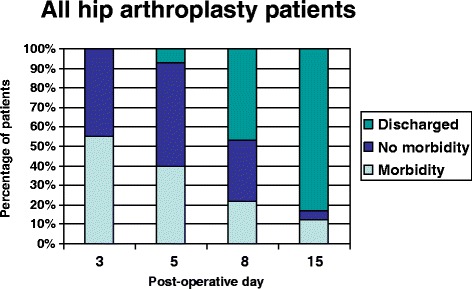
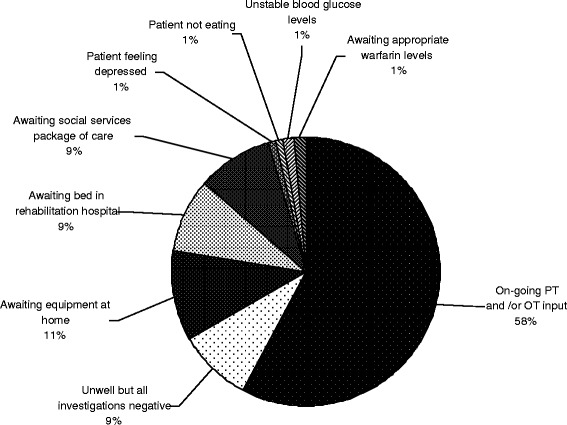
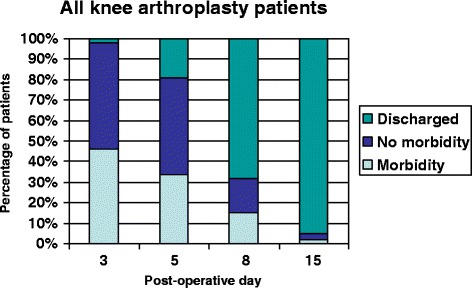
On POD 3, 45% of hip arthroplasty patients and 52% of knee arthroplasty patients remained in hospital with no identifiable morbidity. On POD 5, 53% of hip arthroplasty patients and 47% of knee arthroplasty patients remained in hospital with no identifiable morbidity. These figures declined by POD 8 and 15. The most common reason for inappropriate bed occupancy was ongoing physiotherapy and occupational therapy.
We believe POMS is able to identify patients remaining in hospital with no significant morbidity and has utility as a prospective bed utilisation tool. Addition of a mobility measure to POMS may improve its utility in detecting morbidity requiring hospitalisation, particularly following lower limb arthroplasty.
适当的患者出院时间对于提供最佳的患者护理和提高医院的工作效率至关重要。术后发病率调查(POMS)是唯一一种经过验证的前瞻性测量短期术后发病率的方法。它之前尚未被用作床位利用工具。
我们在一年的时间内收集了 529 例下肢关节置换术患者的 POMS 数据,并记录了没有发病率但仍留在医院的患者数量,以及留在医院的其他原因。数据在术后第 3、5、8 和 15 天收集。
在术后第 3 天,45%的髋关节置换术患者和 52%的膝关节置换术患者没有明显的发病率而留在医院。在术后第 5 天,53%的髋关节置换术患者和 47%的膝关节置换术患者没有明显的发病率而留在医院。这些数字在术后第 8 天和第 15 天下降。不合适床位占用的最常见原因是持续的物理治疗和职业治疗。
我们认为 POMS 能够识别出没有明显发病率但仍留在医院的患者,并且可以作为一种前瞻性床位利用工具使用。在 POMS 中添加一项移动性测量可能会提高其在检测需要住院治疗的发病率方面的实用性,特别是在下肢关节置换术后。