Krishnasamy Rathika, Isbel Nicole M, Hawley Carmel M, Pascoe Elaine M, Burrage Matthew, Leano Rodel, Haluska Brian A, Marwick Thomas H, Stanton Tony
Department of Renal Medicine, The University of Queensland at Princess Alexandra Hospital, Brisbane, Australia; School of Medicine, The University of Queensland, Brisbane Australia.
School of Medicine, The University of Queensland, Brisbane Australia.
PLoS One. 2015 May 15;10(5):e0127044. doi: 10.1371/journal.pone.0127044. eCollection 2015.
Echocardiographic global longitudinal strain (GLS) is increasingly recognised as a more effective technique than conventional ejection fraction (EF) in detecting subtle changes in left ventricular (LV) function. This study investigated the prognostic value of GLS over EF in patients with advanced Chronic Kidney Disease (CKD).
The study included 183 patients (57% male, 63% on dialysis) with CKD stage 4, 5 and 5Dialysis (D). 112 (61%) of patients died in a follow up of 7.8 ± 4.4 years and 41% of deaths were due to cardiovascular (CV) disease. GLS was calculated using 2-dimensional speckle tracking and EF was measured using Simpson's biplane method. Cox proportional hazard models were used to assess the association of measures of LV function and all- cause and CV mortality.
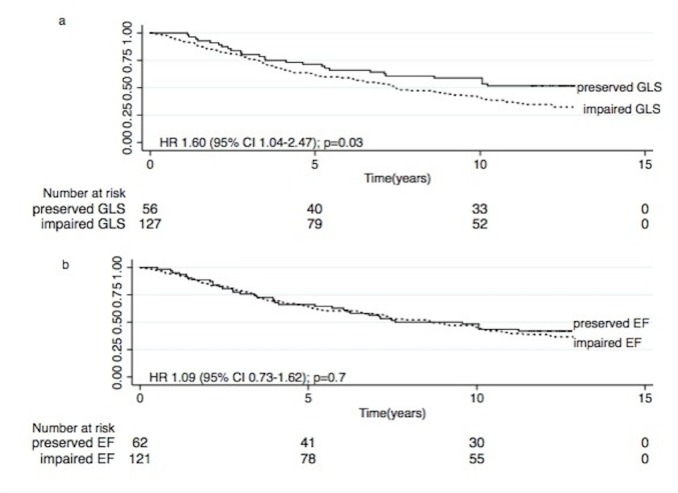
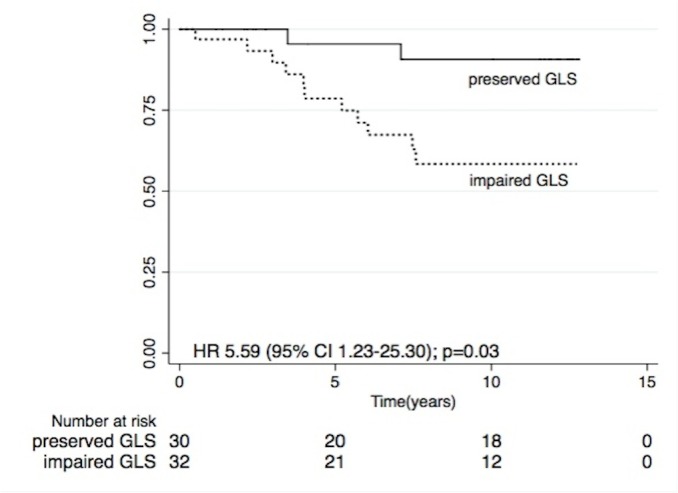
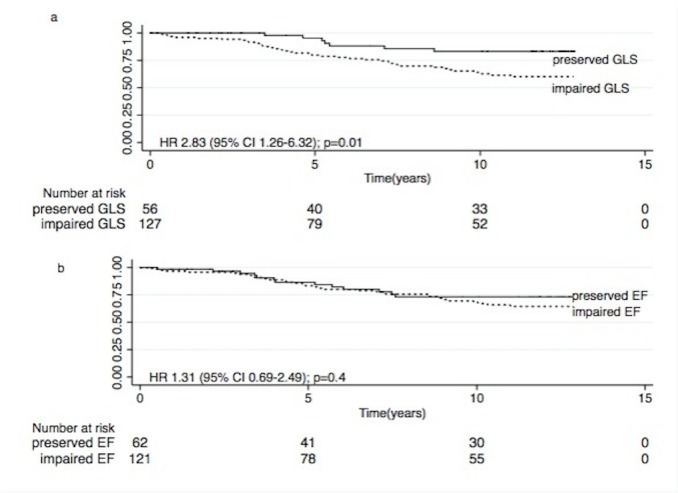
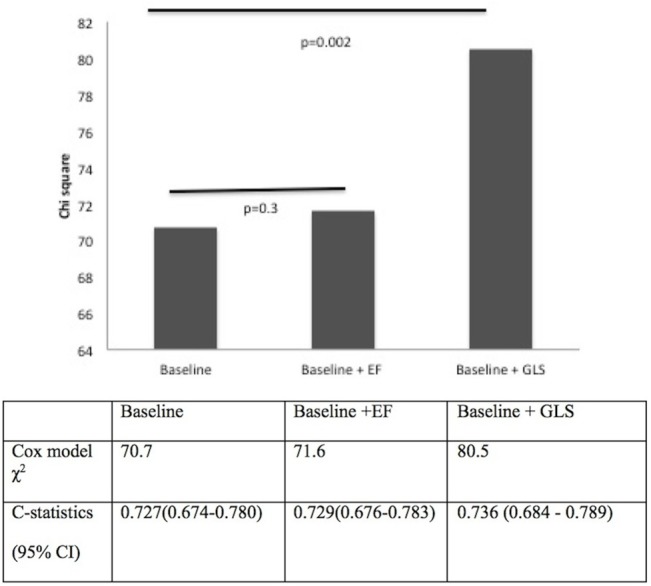
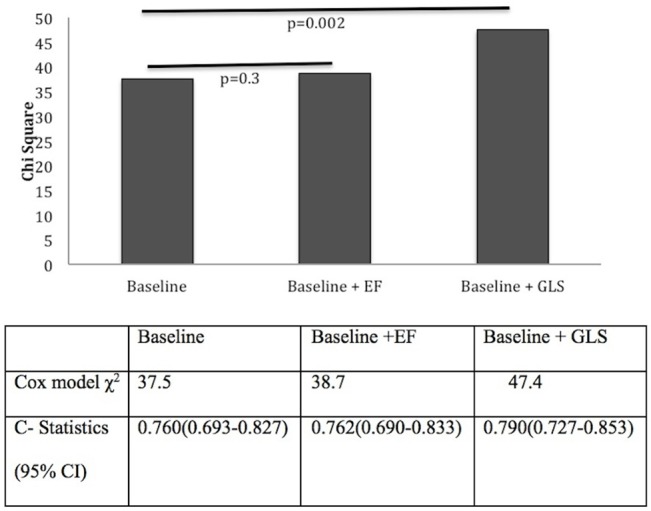
The mean GLS at baseline was -13.6 ± 4.3% and EF was 45 ± 11%. GLS was a significant predictor of all-cause [Hazard Ratio (HR) 1.09 95%; Confidence Interval (CI) 1.02-1.16; p = 0.01] and CV mortality (HR 1.16 95%; CI 1.04-1.30; p = 0.008) following adjustment for relevant clinical variables including LV mass index (LVMI) and EF. GLS also had greater predictive power for both all- cause and CV mortality compared to EF. Impaired GLS (>-16%) was associated with a 5.6-fold increased unadjusted risk of CV mortality in patients with preserved EF.
In this cohort of patients with advanced CKD, GLS is a more sensitive predictor of overall and CV mortality compared to EF. Studies of larger populations in CKD are required to confirm that GLS provides additive prognostic value in patients with preserved EF.
超声心动图整体纵向应变(GLS)在检测左心室(LV)功能的细微变化方面,越来越被认为是一种比传统射血分数(EF)更有效的技术。本研究调查了GLS相对于EF在晚期慢性肾脏病(CKD)患者中的预后价值。
该研究纳入了183例CKD 4期、5期和5期透析(D)患者(57%为男性,63%接受透析)。在7.8±4.4年的随访中,112例(61%)患者死亡,41%的死亡原因是心血管(CV)疾病。使用二维斑点追踪计算GLS,使用双平面辛普森法测量EF。采用Cox比例风险模型评估左心室功能指标与全因死亡率和心血管死亡率之间的关联。
基线时平均GLS为-13.6±4.3%,EF为45±11%。在对包括左心室质量指数(LVMI)和EF在内的相关临床变量进行调整后,GLS是全因死亡率[风险比(HR)1.09,95%;置信区间(CI)1.02 - 1.16;p = 0.01]和心血管死亡率(HR 1.16,95%;CI 1.04 - 1.30;p = 0.008)的显著预测指标。与EF相比,GLS对全因死亡率和心血管死亡率也具有更大的预测能力。在EF正常的患者中,GLS受损(>-16%)与未经调整的心血管死亡率风险增加5.6倍相关。
在这组晚期CKD患者中,与EF相比,GLS是总体死亡率和心血管死亡率更敏感的预测指标。需要对更大规模的CKD患者群体进行研究,以证实GLS在EF正常的患者中提供额外的预后价值。