Luu Minh, Ham Cal, Kamb Mary L, Caffe Sonja, Hoover Karen W, Perez Freddy
Division of STD Prevention, National Center for HIV/AIDS, Viral Hepatitis, STD and TB Prevention, Centers for Disease Control and Prevention (CDC), Atlanta, GA, USA.
Communicable Diseases and Health Analysis Department, HIV, Hepatitis, Tuberculosis and Sexually Transmitted Infections Unit, Pan American Health Organization, Washington DC, USA.
Int J Gynaecol Obstet. 2015 Jun;130 Suppl 1(Suppl 1):S37-42. doi: 10.1016/j.ijgo.2015.04.011. Epub 2015 Apr 25.
To asses laboratory syphilis testing policies and practices among laboratories in the Americas.
Laboratory directors or designees from PAHO member countries were invited to participate in a structured, electronically-delivered survey between March and August, 2014. Data on syphilis tests, algorithms, and quality control (QC) practices were analyzed, focusing on laboratories receiving specimens from antenatal clinics (ANCs).
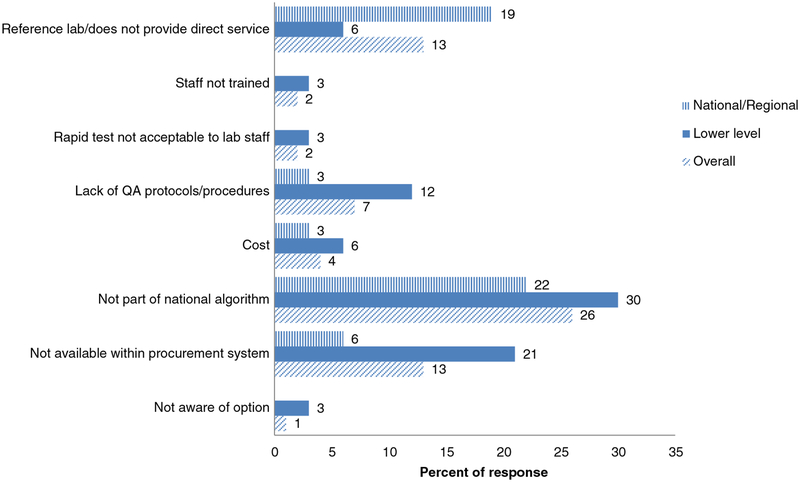
Surveys were completed by 69 laboratories representing 30 (86%) countries. Participating laboratories included 36 (52%) national or regional reference labs and 33 (48%) lower-level laboratories. Most (94%) were public sector facilities and 71% reported existence of a national algorithm for syphilis testing in pregnancy, usually involving both treponemal and non-treponemal testing (72%). Less than half (41%) used rapid syphilis tests (RSTs); and only seven laboratories representing five countries reported RSTs were included in the national algorithm for pregnant women. Most (83%) laboratories serving ANCs reported using some type of QC system; 68% of laboratories reported participation in external QC. Only 36% of laboratories reported data to national/local surveillance. Half of all laboratories serving ANC settings reported a stockout of one or more essential supplies during the previous year (median duration, 30days).
Updating laboratory algorithms, improving testing standards, integrating data into existing surveillance, and improved procurement and distribution of commodities may be needed to ensure elimination of MTCT of syphilis in the Americas.
评估美洲地区各实验室梅毒检测的政策和实践情况。
邀请泛美卫生组织成员国的实验室主任或指定人员参与2014年3月至8月期间通过电子方式开展的结构化调查。对梅毒检测、检测算法和质量控制(QC)实践的数据进行分析,重点关注接收产前诊所(ANC)标本的实验室。
69个实验室完成了调查,代表30个(86%)国家。参与调查的实验室包括36个(52%)国家或地区参考实验室和33个(48%)基层实验室。大多数(94%)为公共部门机构,71%报告存在国家孕期梅毒检测算法,通常同时涉及梅毒螺旋体检测和非梅毒螺旋体检测(72%)。不到一半(41%)的实验室使用快速梅毒检测(RST);只有代表五个国家的七个实验室报告RST被纳入国家孕妇检测算法。大多数为ANC服务的实验室(83%)报告使用某种类型的质量控制体系;68%的实验室报告参与了外部质量控制。只有36%的实验室向国家/地方监测部门报告数据。所有为ANC机构服务的实验室中有一半报告在前一年出现一种或多种基本物资短缺(中位持续时间为30天)。
可能需要更新实验室检测算法、提高检测标准、将数据纳入现有监测以及改善物资采购和分配,以确保在美洲消除梅毒母婴传播。