Yan Yu-Ling, Qiu Bo, Wang Jing, Deng Song-Bai, Wu Ling, Jing Xiao-Dong, Du Jian-Lin, Liu Ya-Jie, She Qiang
Department of Cardiology, The Second Affiliated Hospital of Chongqing Medical University, Chongqing, China.
BMJ Open. 2015 May 15;5(5):e006886. doi: 10.1136/bmjopen-2014-006886.
To evaluate the efficacy and safety of high-intensity statin therapy in patients with chronic kidney disease (CKD).
A systematic review and meta-analysis.
Randomised controlled trials (RCTs) comparing high-intensity statin therapy (atorvastatin 80 mg or rosuvastatin 20/40 mg) with moderate/mild statin treatment or placebo were derived from the databases (PubMed, Embase, Ovid, the Cochrane Central Register of Controlled Trials (CENTRAL) in the Cochrane Library, and ISI Web of Knowledge).
Primary end points: clinical events (all-cause mortality, stroke, myocardial infarction and heart failure); secondary end points: serum lipid, renal function changes and adverse events.
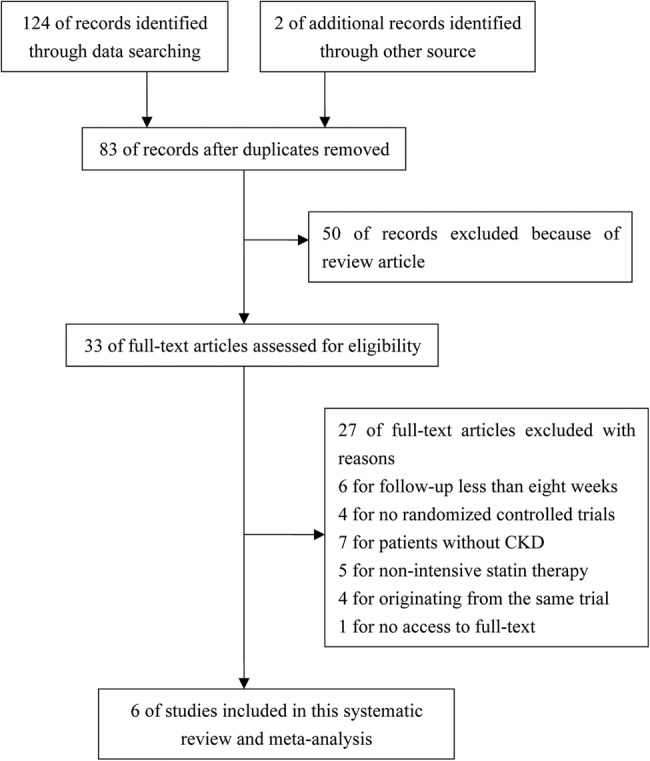
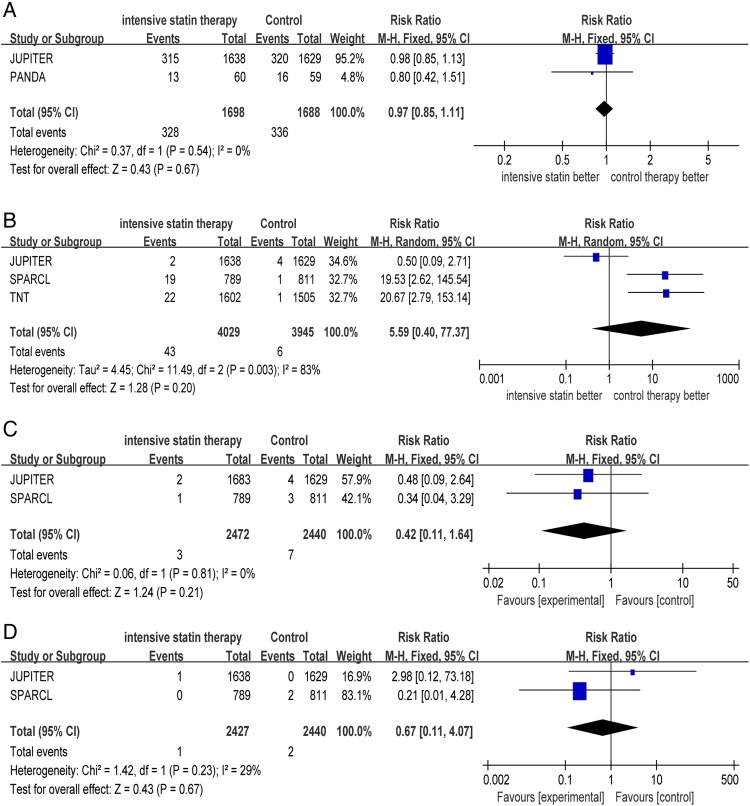
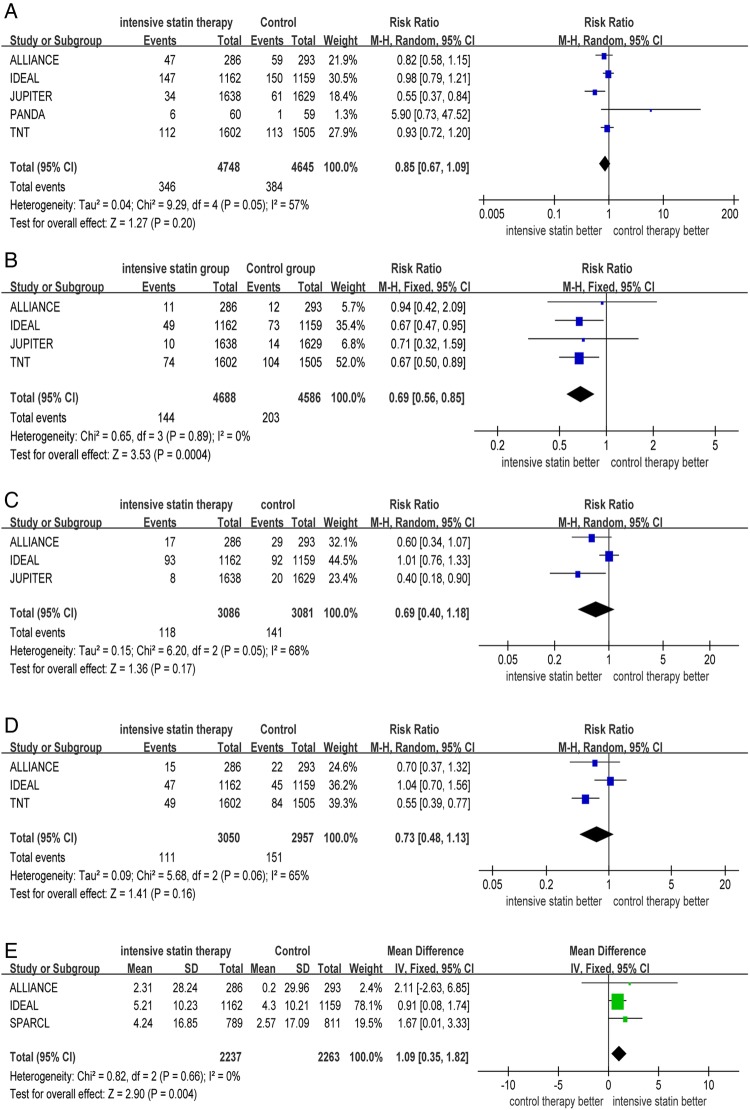
A total of six RCTs with 10,993 adult patients with CKD were included. A significant decrease in stroke was observed in the high-intensity statin therapy group (RR 0.69, 95% CI 0.56 to 0.85). However, the roles of high-intensity statin in decreasing all-cause mortality (RR 0.85, 95% CI 0.67 to 1.09), myocardial infarction (RR 0.69, 95% CI 0.40 to 1.18) and heart failure (RR 0.73, 95% CI 0.48 to 1.13) remain unclear with low evidence. High-intensity statin also had obvious effects on lowering the LDL-C level but no clear effects on renal protection. Although pooled results showed no significant difference between the intervention and control groups in adverse event occurrences, it was still insufficient to put off the doubts that high-intensity statin might increase adverse events because of limited data sources and low quality evidences.
High-intensity statin therapy could effectively reduce the risk of stroke in patients with CKD. However, its effects on all-cause mortality, myocardial infarction, heart failure and renal protection remain unclear. Moreover, it is hard to draw conclusions on the safety assessment of intensive statin treatment in this particular population. More studies are needed to credibly evaluate the effects of high-intensity statin therapy in patients with CKD.
评估高强度他汀类药物治疗慢性肾脏病(CKD)患者的疗效和安全性。
系统评价和荟萃分析。
比较高强度他汀类药物治疗(阿托伐他汀80毫克或瑞舒伐他汀20/40毫克)与中/低强度他汀治疗或安慰剂的随机对照试验(RCT),数据来源于以下数据库(PubMed、Embase、Ovid、Cochrane图书馆中的Cochrane对照试验中央登记库(CENTRAL)以及ISI科学网)。
主要终点:临床事件(全因死亡率、中风、心肌梗死和心力衰竭);次要终点:血脂、肾功能变化及不良事件。
共纳入6项RCT,涉及10993例成年CKD患者。高强度他汀治疗组中风发生率显著降低(风险比0.69,95%置信区间0.56至0.85)。然而,高强度他汀在降低全因死亡率(风险比0.85,95%置信区间0.67至1.09)、心肌梗死(风险比0.69,95%置信区间0.40至1.18)和心力衰竭(风险比0.73,95%置信区间0.48至1.13)方面的作用仍不明确,证据不足。高强度他汀对降低低密度脂蛋白胆固醇(LDL-C)水平也有明显作用,但对肾脏保护作用不明确。尽管汇总结果显示干预组和对照组不良事件发生率无显著差异,但由于数据来源有限和证据质量低,仍不足以消除对高强度他汀可能增加不良事件的疑虑。
高强度他汀治疗可有效降低CKD患者中风风险。然而,其对全因死亡率、心肌梗死、心力衰竭和肾脏保护的作用仍不明确。此外,难以对该特定人群中强化他汀治疗的安全性评估得出结论。需要更多研究来可靠地评估高强度他汀治疗对CKD患者的影响。