Gough S C L, Bode B W, Woo V C, Rodbard H W, Linjawi S, Zacho M, Reiter P D, Buse J B
Oxford Centre for Diabetes, Endocrinology and Metabolism, and NIHR Oxford Biomedical Research Centre, Churchill Hospital, Oxford, UK.
Atlanta Diabetes Associates, Atlanta, GA, USA.
Diabetes Obes Metab. 2015 Oct;17(10):965-73. doi: 10.1111/dom.12498. Epub 2015 Jul 1.
To confirm, in a 26-week extension study, the sustained efficacy and safety of a fixed combination of insulin degludec and liraglutide (IDegLira) compared with either insulin degludec or liraglutide alone, in patients with type 2 diabetes.
Insulin-naïve adults with type 2 diabetes randomized to once-daily IDegLira, insulin degludec or liraglutide, in addition to metformin ± pioglitazone, continued their allocated treatment in this preplanned 26-week extension of the DUAL I trial.
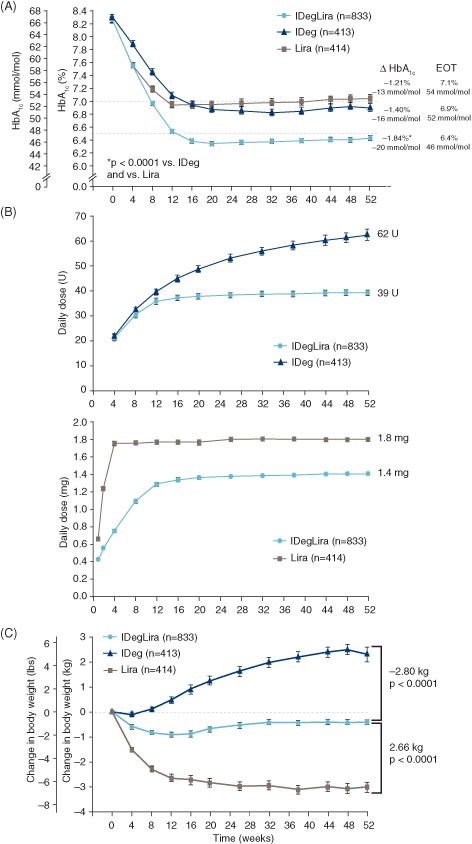
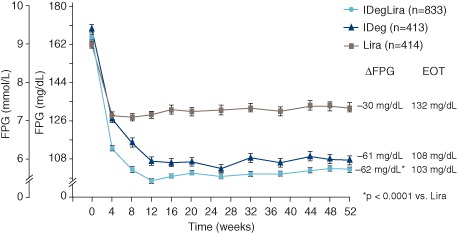
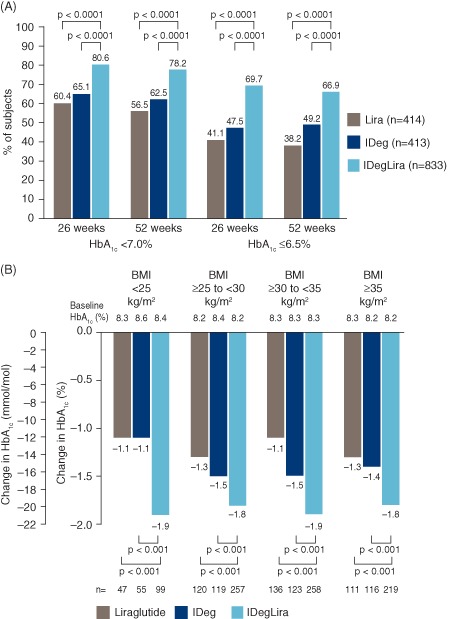
A total of 78.8% of patients (1311/1663) continued into the extension phase. The mean glycated haemoglobin (HbA1c) concentration at 52 weeks was reduced from baseline by 1.84% (20.2 mmol/mol) for the IDegLira group, 1.40% (15.3 mmol/mol) for the insulin degludec group and 1.21% (13.2 mmol/mol) for the liraglutide group. Of the patients on IDegLira, 78% achieved an HbA1c of <7% (53 mmol/mol) versus 63% of the patients on insulin degludec and 57% of those on liraglutide. The mean fasting plasma glucose concentration at the end of the trial was similar for IDegLira (5.7 mmol/l) and insulin degludec (6.0 mmol/l), but higher for liraglutide (7.3 mmol/l). At 52 weeks, the daily insulin dose was 37% lower with IDegLira (39 units) than with insulin degludec (62 units). IDegLira was associated with a significantly greater decrease in body weight (estimated treatment difference, -2.80 kg, p < 0.0001) and a 37% lower rate of hypoglycaemia compared with insulin degludec. Overall, all treatments were well tolerated and no new adverse events or tolerability issues were observed for IDegLira.
These 12-month data, derived from a 26-week extension of the DUAL I trial, confirm the initial 26-week main phase results and the sustainability of the benefits of IDegLira compared with its components in glycaemic efficacy, safety and tolerability.
在一项为期26周的延长期研究中,证实与甘精胰岛素或利拉鲁肽单药治疗相比,甘精胰岛素与利拉鲁肽固定复方制剂(IDegLira)在2型糖尿病患者中的持续疗效和安全性。
在双盲I试验的这项预先计划的26周延长期研究中,将初治的2型糖尿病成年患者随机分配至每日一次的IDegLira、甘精胰岛素或利拉鲁肽治疗组,这些患者除接受二甲双胍±吡格列酮治疗外,继续接受所分配的治疗。
共有78.8%的患者(1311/1663)进入延长期。IDegLira组在52周时糖化血红蛋白(HbA1c)平均浓度较基线降低了1.84%(20.2 mmol/mol),甘精胰岛素组降低了1.40%(15.3 mmol/mol),利拉鲁肽组降低了1.21%(13.2 mmol/mol)。接受IDegLira治疗的患者中,78%的患者HbA1c<7%(53 mmol/mol),而接受甘精胰岛素治疗的患者这一比例为63%,接受利拉鲁肽治疗的患者为57%。试验结束时,IDegLira组(5.7 mmol/l)和甘精胰岛素组(6.0 mmol/l)的空腹血糖平均浓度相似,但利拉鲁肽组(7.3 mmol/l)更高。在52周时,IDegLira组的每日胰岛素剂量(39单位)比甘精胰岛素组(62单位)低37%。与甘精胰岛素相比,IDegLira与体重显著更大幅度的降低(估计治疗差异为-2.80 kg,p<0.0001)以及低血糖发生率降低37%相关。总体而言,所有治疗的耐受性均良好,未观察到IDegLira有新的不良事件或耐受性问题。
这些来自双盲I试验26周延长期的12个月数据,证实了最初26周主要阶段的结果以及与单药成分相比,IDegLira在血糖疗效、安全性和耐受性方面益处的可持续性。