Shah Najeeb, Abdalla Mohammed Altigani, Deshmukh Harshal, Sathyapalan Thozhukat
Hull University Teaching Hospitals NHS Trust, Hull, UK.
Department of Academic Diabetes, Endocrinology & Metabolism, Hull York Medical School, University of Hull, Hull, UK.
Ther Adv Endocrinol Metab. 2021 Sep 23;12:20420188211042145. doi: 10.1177/20420188211042145. eCollection 2021.
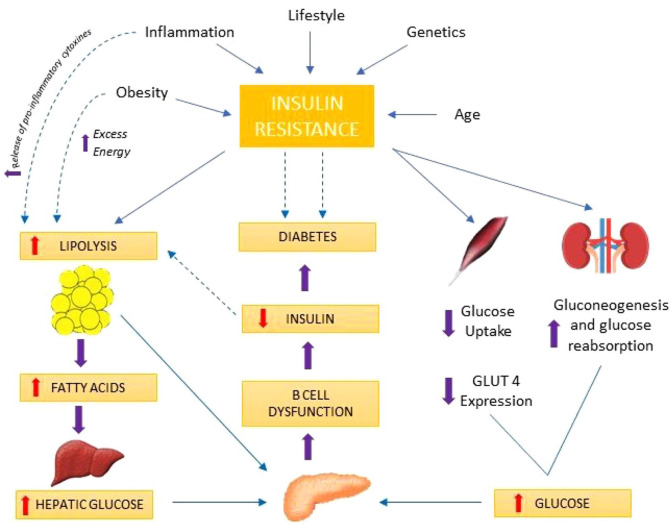
Diabetes mellitus (DM) is a chronic, progressive, and multifaceted illness resulting in significant physical and psychological detriment to patients. As of 2019, 463 million people are estimated to be living with DM worldwide, out of which 90% have type-2 diabetes mellitus (T2DM). Over the years, significant progress has been made in identifying the risk factors for developing T2DM, understanding its pathophysiology and uncovering various metabolic pathways implicated in the disease process. This has culminated in the implementation of robust prevention programmes and the development of effective pharmacological agents, which have had a favourable impact on the management of T2DM in recent times. Despite these advances, the incidence and prevalence of T2DM continue to rise. Continuing research in improving efficacy, potency, delivery and reducing the adverse effect profile of currently available formulations is required to keep pace with this growing health challenge. Moreover, new metabolic pathways need to be targeted to produce novel pharmacotherapy to restore glucose homeostasis and address metabolic sequelae in patients with T2DM. We searched PubMed, MEDLINE, and Google Scholar databases for recently included agents and novel medication under development for treatment of T2DM. We discuss the pathophysiology of T2DM and review how the emerging anti-diabetic agents target the metabolic pathways involved. We also look at some of the limiting factors to developing new medication and the introduction of unique methods, including facilitating drug delivery to bypass some of these obstacles. However, despite the advances in the therapeutic options for the treatment of T2DM in recent years, the industry still lacks a curative agent.
糖尿病(DM)是一种慢性、进行性且多方面的疾病,会给患者带来严重的身体和心理损害。截至2019年,估计全球有4.63亿人患有糖尿病,其中90%为2型糖尿病(T2DM)。多年来,在确定T2DM的危险因素、了解其病理生理学以及揭示疾病过程中涉及的各种代谢途径方面取得了重大进展。这最终促成了强有力的预防计划的实施和有效药物的开发,这些在近年来对T2DM的管理产生了有利影响。尽管取得了这些进展,但T2DM的发病率和患病率仍在上升。需要持续开展研究以提高现有制剂的疗效、效力、给药方式并降低其不良反应,从而跟上这一日益严峻的健康挑战。此外,需要针对新的代谢途径开发新型药物疗法,以恢复T2DM患者的葡萄糖稳态并解决代谢后遗症。我们在PubMed、MEDLINE和谷歌学术数据库中搜索了最近纳入的用于治疗T2DM的药物和正在研发的新型药物。我们讨论了T2DM的病理生理学,并回顾了新兴抗糖尿病药物如何针对相关代谢途径发挥作用。我们还探讨了开发新药物的一些限制因素以及引入独特方法的情况,包括促进药物递送以绕过其中一些障碍。然而,尽管近年来T2DM治疗的治疗选择取得了进展,但该行业仍然缺乏一种治愈性药物。