Woodhouse Emily, Mills Martin A, McGowan Philip J K, Milner-Gulland E J
Imperial College London, London, UK ; University College London, London, UK.
University of Aberdeen, Aberdeen, UK.
Hum Ecol Interdiscip J. 2015;43(2):295-307. doi: 10.1007/s10745-015-9742-4.
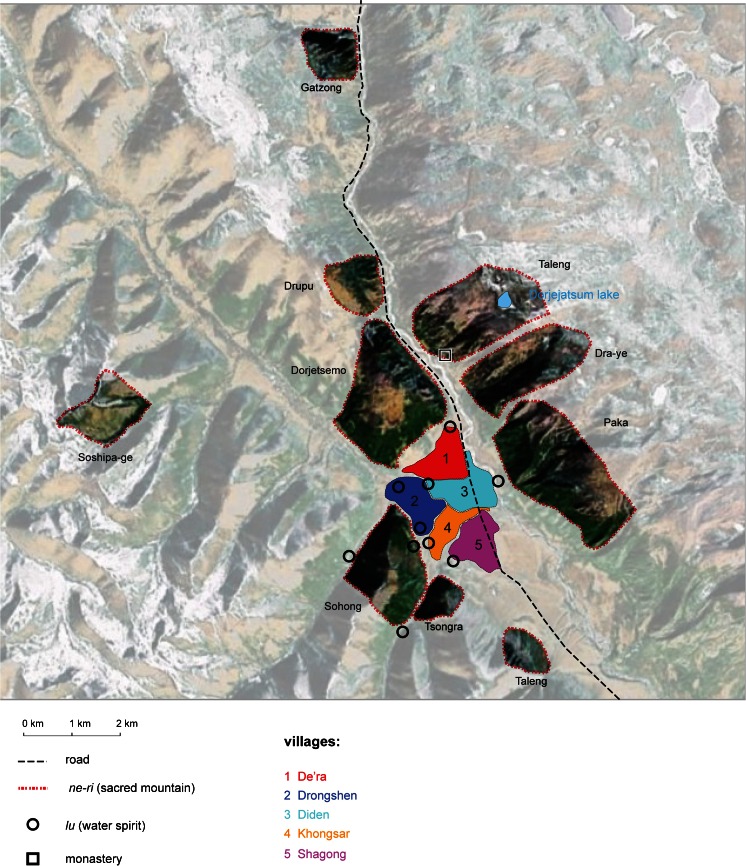
Representations of Green Tibetans connected to Buddhism and indigenous wisdom have been deployed by a variety of actors and persist in popular consciousness. Through interviews, participatory mapping and observation, we explored how these ideas relate to people's notions about the natural environment in a rural community on the Eastern Tibetan plateau, in Sichuan Province, China. We found people to be orienting themselves towards the environment by means of three interlinked religious notions: (1) local gods and spirits in the landscape, which have become the focus of conservation efforts in the form of 'sacred natural sites;' (2) sin and karma related to killing animals and plants; (3) Buddhist moral precepts especially non-violence. We highlight the gaps between externally generated representations and local understandings, but also the dynamic, contested and plural nature of local relationships with the environment, which have been influenced and reshaped by capitalist development and commodification of natural resources, state environmental policies, and Buddhist modernist ideas.
与佛教和本土智慧相关的“绿色藏民”形象已被各种行为者所利用,并持续存在于大众意识中。通过访谈、参与式绘图和观察,我们探究了这些观念如何与中国四川省青藏高原东部一个农村社区的人们对自然环境的看法相关联。我们发现,人们通过三个相互关联的宗教观念来定位自己与环境的关系:(1)当地景观中的神灵,它们以“神圣自然场所”的形式成为保护工作的重点;(2)与杀害动植物相关的罪孽和业力;(3)佛教道德戒律,尤其是非暴力。我们强调了外部产生的形象与当地理解之间的差距,同时也强调了当地与环境关系的动态、有争议和多元性质,这种关系受到资本主义发展、自然资源商品化、国家环境政策和佛教现代主义思想的影响和重塑。