
具有大幅减少磷光发射体用量的高效稳定有机发光二极管。
Highly efficient and stable organic light-emitting diodes with a greatly reduced amount of phosphorescent emitter.
作者信息
Fukagawa Hirohiko, Shimizu Takahisa, Kamada Taisuke, Yui Shota, Hasegawa Munehiro, Morii Katsuyuki, Yamamoto Toshihiro
机构信息
Japan Broadcasting Corporation (NHK), Science &Technology Research Laboratories, 1-10-11 Kinuta, Setagaya-ku, Tokyo 157-8510, Japan.
Tokyo University of Science, 1-3 Kagurazaka, Tokyo 162-8610, Japan.
出版信息
Sci Rep. 2015 May 18;5:9855. doi: 10.1038/srep09855.
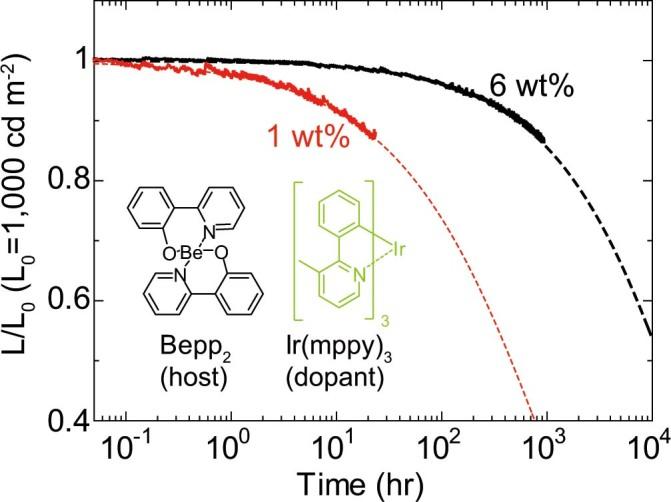
Organic light-emitting diodes (OLEDs) have been intensively studied as a key technology for next-generation displays and lighting. The efficiency of OLEDs has improved markedly in the last 15 years by employing phosphorescent emitters. However, there are two main issues in the practical application of phosphorescent OLEDs (PHOLEDs): the relatively short operational lifetime and the relatively high cost owing to the costly emitter with a concentration of about 10% in the emitting layer. Here, we report on our success in resolving these issues by the utilization of thermally activated delayed fluorescent materials, which have been developed in the past few years, as the host material for the phosphorescent emitter. Our newly developed PHOLED employing only 1 wt% phosphorescent emitter exhibits an external quantum efficiency of over 20% and a long operational lifetime of about 20 times that of an OLED consisting of a conventional host material and 1 wt% phosphorescent emitter.
有机发光二极管(OLED)作为下一代显示器和照明的关键技术,已得到广泛研究。在过去15年中,通过采用磷光发射体,OLED的效率有了显著提高。然而,磷光OLED(PHOLED)在实际应用中存在两个主要问题:工作寿命相对较短,以及由于发光层中浓度约为10%的昂贵发射体导致成本相对较高。在此,我们报告了通过利用过去几年开发的热激活延迟荧光材料作为磷光发射体的主体材料来解决这些问题所取得的成功。我们新开发的仅采用1 wt%磷光发射体的PHOLED,其外量子效率超过20%,工作寿命约为采用传统主体材料和1 wt%磷光发射体的OLED的20倍。


 Zotero 插件