Mitra Abhisek, Mishra Lopa, Li Shulin
Department of Pediatrics, The University of Texas MD Anderson Cancer Center, Houston, TX, USA.
Department of Gastroenterology, Hepatology and Nutrition, The University of Texas MD Anderson Cancer Center, Houston, TX, USA.
Oncotarget. 2015 May 10;6(13):10697-711. doi: 10.18632/oncotarget.4037.
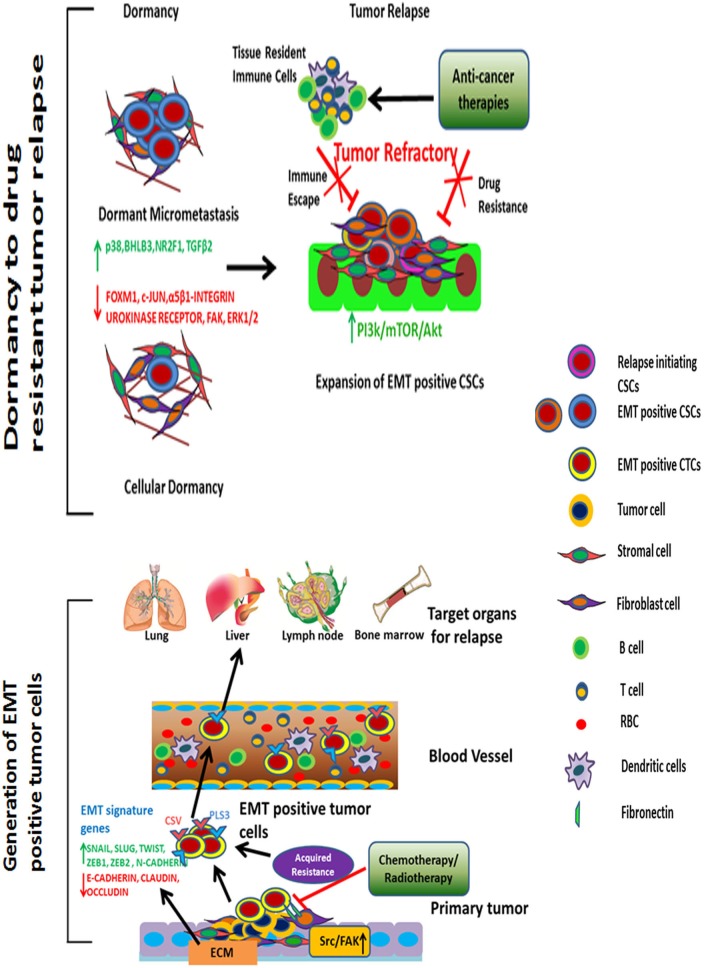
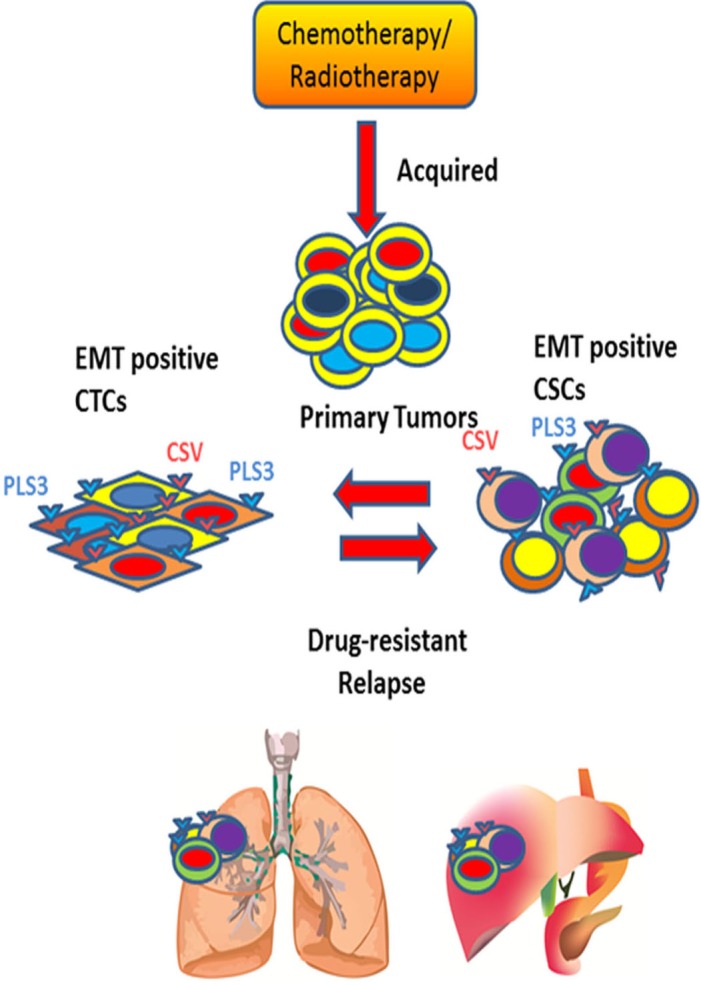
Tumor relapse and metastasis are the primary causes of poor survival rates in patients with advanced cancer despite successful resection or chemotherapeutic treatment. A primary cause of relapse and metastasis is the persistence of cancer stem cells (CSCs), which are highly resistant to chemotherapy. Although highly efficacious drugs suppressing several subpopulations of CSCs in various tissue-specific cancers are available, recurrence is still common in patients. To find more suitable therapy for relapse, the mechanisms underlying metastasis and drug-resistance associated with relapse-initiating CSCs need to be identified. Recent studies in circulating tumor cells (CTCs) of some cancer patients manifest phenotypes of both CSCs and epithelial-mesenchymal transition (EMT). These patients are unresponsive to standard chemotherapies and have low progression free survival, suggesting that EMT-positive CTCs are related to co-occur with or transform into relapse-initiating CSCs. Furthermore, EMT programming in cancer cells enables in the remodeling of extracellular matrix to break the dormancy of relapse-initiating CSCs. In this review, we extensively discuss the association of the EMT program with CTCs and CSCs to characterize a subpopulation of patients prone to relapses. Identifying the mechanisms by which EMT-transformed CTCs and CSCs initiate relapse could facilitate the development of new or enhanced personalized therapeutic regimens.
肿瘤复发和转移是晚期癌症患者生存率低的主要原因,尽管进行了成功的切除或化疗。复发和转移的一个主要原因是癌症干细胞(CSCs)的持续存在,它们对化疗具有高度抗性。虽然有高效药物可抑制各种组织特异性癌症中CSCs的几个亚群,但患者复发仍然很常见。为了找到更适合复发的治疗方法,需要确定与复发起始CSCs相关的转移和耐药的潜在机制。最近对一些癌症患者循环肿瘤细胞(CTCs)的研究显示了CSCs和上皮-间质转化(EMT)的表型。这些患者对标准化疗无反应,无进展生存期短,这表明EMT阳性CTCs与复发起始CSCs同时出现或转化为复发起始CSCs有关。此外,癌细胞中的EMT编程能够重塑细胞外基质,打破复发起始CSCs的休眠。在这篇综述中,我们广泛讨论了EMT程序与CTCs和CSCs的关联,以表征易复发患者的一个亚群。确定EMT转化的CTCs和CSCs引发复发的机制有助于开发新的或增强的个性化治疗方案。