Pereira Elisa Barreto, Collevatti Rosane Garcia, Kokubum Marcelo Nogueira de Carvalho, Miranda Núbia Esther de Oliveira, Maciel Natan Medeiros
Laboratório de Genética & Biodiversidade, Instituto de Ciências Biológicas, Universidade Federal de Goiás (UFG), Campus Samambaia, 74001-970, Goiânia, Goiás, Brazil.
Laboratório de Herpetologia e Comportamento Animal Departamento de Ecologia, Instituto de Ciências Biológicas, Universidade Federal de Goiás, Campus Samambaia, 74001-970, Goiânia, Goiás, Brazil.
BMC Evol Biol. 2015 May 20;15:91. doi: 10.1186/s12862-015-0365-6.
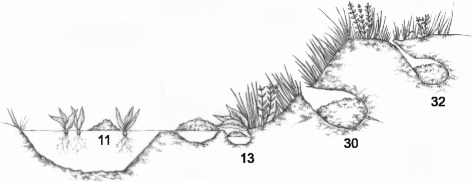
Traditionally, the evolution of terrestrial reproduction in anurans from ancestors that bred in water has been accepted in the literature. Still, the existence of intermediate stages of water dependency, such as species that lay eggs close to water (e.g., in burrows) instead of in bodies of water, supports the hypothesis of an ordered and gradual evolution in the direction of a more terrestrial form of reproduction. However, this conventional view has recently been challenged for some anurans groups. Leptodactylinae frogs are a remarkable example of anurans with an outstanding diversity in terms of reproductive features, with distinct water dependency among lineages. Here, we tested the hypothesis of a gradual and ordered tendency towards terrestriality in Leptodactylinae, including the existence of obligatory intermediate stages, such as semi-terrestrial reproductive strategies. We also addressed the association between reproductive modes and the morphological and ecological features.
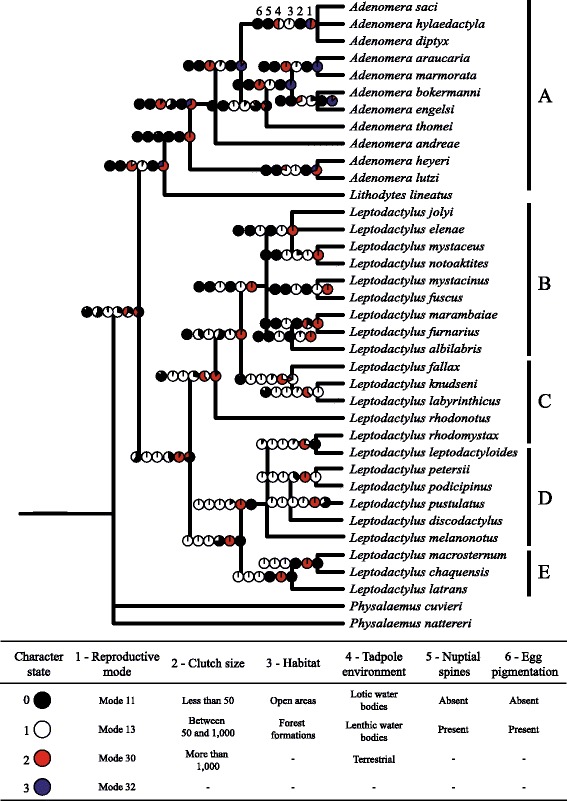
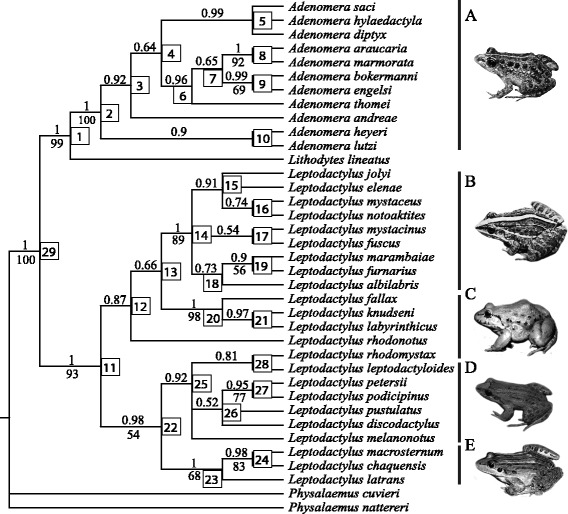
An ancestral reconstruction analysis indicated that even though shifts from aquatic to terrestrial breeding occurred throughout the history of Leptodactylus and Adenomera, shifts from terrestrial to aquatic reproduction happened at almost the same frequency. Our results also demonstrated that reproductive modes for semi-terrestrial tadpoles were not necessarily an intermediate form between aquatic and terrestrial breeds. Correlations among reproductive modes and other life-history traits suggested that tadpole environment, clutch size, nuptial spines, and egg pigmentation were co-evolving and driven by water dependency.
Our results found no evidence of evolutionary tendencies toward terrestriality in Leptodactylinae. We found reversals from terrestrial to aquatic tadpole development and no evidence of obligatory intermediate stages, such as semi-terrestrial reproductive strategies. We also found correlations between reproductive modes and other life-history traits driven by water dependence. Aquatic reproductive modes are associated with higher clutch sizes, lentic waters, and the presence of nuptial spines and egg pigmentation.
传统上,文献中已认可无尾目动物从在水中繁殖的祖先向陆地繁殖的演化。然而,存在水依赖的中间阶段,例如在靠近水的地方(如洞穴中)产卵而非在水体中产卵的物种,这支持了朝着更陆地化繁殖形式有序且逐步演化的假说。然而,最近这种传统观点受到了一些无尾目动物类群的挑战。细趾蟾科蛙类是无尾目动物的一个显著例子,其繁殖特征具有显著的多样性,不同谱系之间对水的依赖程度各异。在此,我们检验了细趾蟾科朝着陆地化逐渐且有序发展的假说,包括是否存在诸如半陆地繁殖策略等 obligatory 中间阶段。我们还探讨了繁殖模式与形态和生态特征之间的关联。
祖先重建分析表明,尽管在细趾蟾属和腺蟾属的整个历史中都发生了从水生繁殖到陆地繁殖的转变,但从陆地繁殖到水生繁殖的转变频率几乎相同。我们的结果还表明,半陆地蝌蚪的繁殖模式不一定是水生和陆地繁殖之间的中间形式。繁殖模式与其他生活史特征之间的相关性表明,蝌蚪环境、窝卵数、婚刺和卵色素沉着是共同演化的,并且受水依赖的驱动。
我们的结果未发现细趾蟾科朝着陆地化演化趋势的证据。我们发现了从陆地蝌蚪发育到水生蝌蚪发育的逆转,且没有证据表明存在诸如半陆地繁殖策略等 obligatory 中间阶段。我们还发现了由水依赖驱动的繁殖模式与其他生活史特征之间的相关性。水生繁殖模式与更高的窝卵数、静水水体以及婚刺和卵色素沉着的存在相关。