Batini Chiara, Hallast Pille, Zadik Daniel, Delser Pierpaolo Maisano, Benazzo Andrea, Ghirotto Silvia, Arroyo-Pardo Eduardo, Cavalleri Gianpiero L, de Knijff Peter, Dupuy Berit Myhre, Eriksen Heidi A, King Turi E, de Munain Adolfo López, López-Parra Ana M, Loutradis Aphrodite, Milasin Jelena, Novelletto Andrea, Pamjav Horolma, Sajantila Antti, Tolun Aslıhan, Winney Bruce, Jobling Mark A
Department of Genetics, University of Leicester, University Road, Leicester LE1 7RH, UK.
Department of Life Sciences and Biotechnology, University of Ferrara, Via Borsari 46, 44121 Ferrara, Italy.
Nat Commun. 2015 May 19;6:7152. doi: 10.1038/ncomms8152.
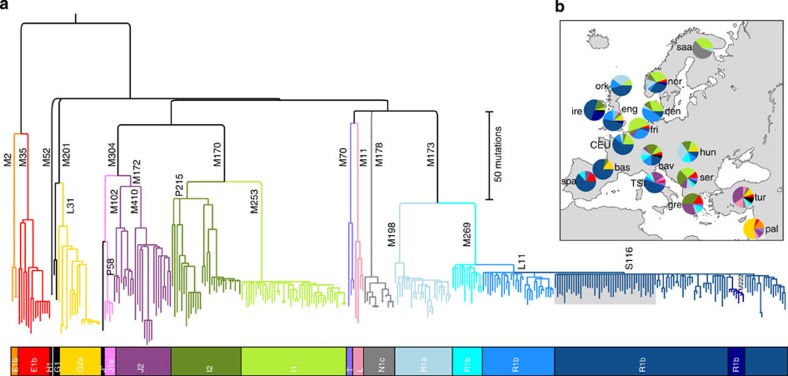
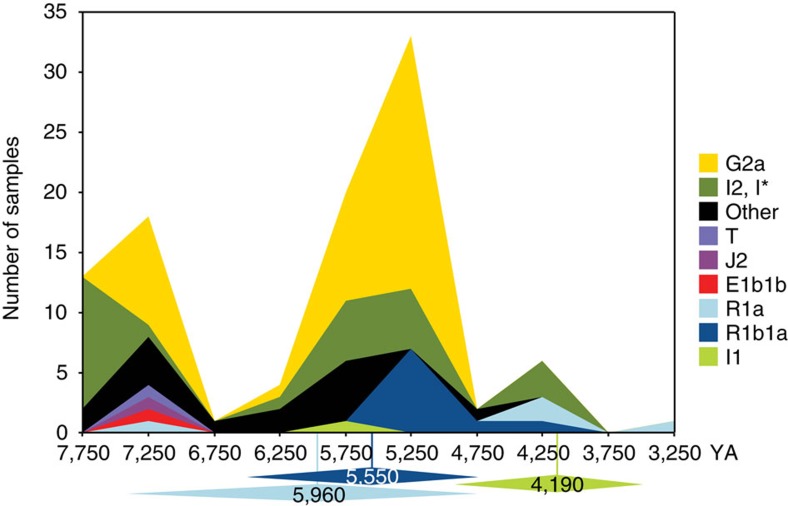
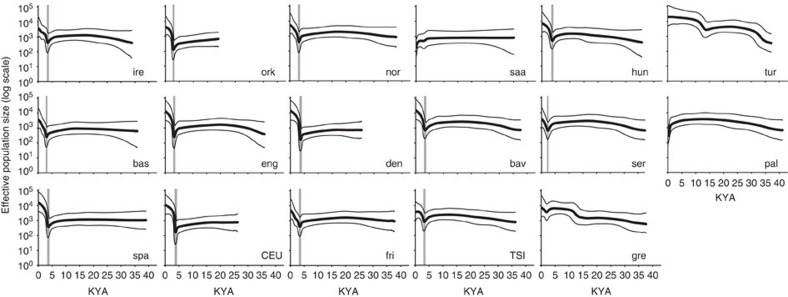
The proportion of Europeans descending from Neolithic farmers ∼ 10 thousand years ago (KYA) or Palaeolithic hunter-gatherers has been much debated. The male-specific region of the Y chromosome (MSY) has been widely applied to this question, but unbiased estimates of diversity and time depth have been lacking. Here we show that European patrilineages underwent a recent continent-wide expansion. Resequencing of 3.7 Mb of MSY DNA in 334 males, comprising 17 European and Middle Eastern populations, defines a phylogeny containing 5,996 single-nucleotide polymorphisms. Dating indicates that three major lineages (I1, R1a and R1b), accounting for 64% of our sample, have very recent coalescent times, ranging between 3.5 and 7.3 KYA. A continuous swathe of 13/17 populations share similar histories featuring a demographic expansion starting ∼ 2.1-4.2 KYA. Our results are compatible with ancient MSY DNA data, and contrast with data on mitochondrial DNA, indicating a widespread male-specific phenomenon that focuses interest on the social structure of Bronze Age Europe.
一万年前(KYA)新石器时代农民或旧石器时代狩猎采集者的欧洲后裔比例一直备受争议。Y染色体的男性特异性区域(MSY)已被广泛应用于这个问题,但一直缺乏对多样性和时间深度的无偏估计。在这里,我们表明欧洲父系谱系在近期经历了全大陆范围的扩张。对来自17个欧洲和中东人群的334名男性的370万个碱基对的MSY DNA进行重测序,确定了一个包含5996个单核苷酸多态性的系统发育树。年代测定表明,占我们样本64%的三个主要谱系(I1、R1a和R1b)的最近共同祖先时间非常近,在3.5至7.3 KYA之间。17个群体中的13个群体连续一片,有着相似的历史,其特征是在约2.1 - 4.2 KYA开始的人口扩张。我们的结果与古代MSY DNA数据相符,并且与线粒体DNA数据形成对比,表明这是一种广泛存在的男性特异性现象,这使得人们对青铜时代欧洲的社会结构产生了兴趣。