Rouse Melvin L, Stevenson Tyler J, Fortune Eric S, Ball Gregory F
Department of Psychological and Brain Sciences, Johns Hopkins University, Baltimore, MD, USA.
Department of Psychological and Brain Sciences, Johns Hopkins University, Baltimore, MD, USA.
Horm Behav. 2015 Jun;72:78-87. doi: 10.1016/j.yhbeh.2015.04.022. Epub 2015 May 16.
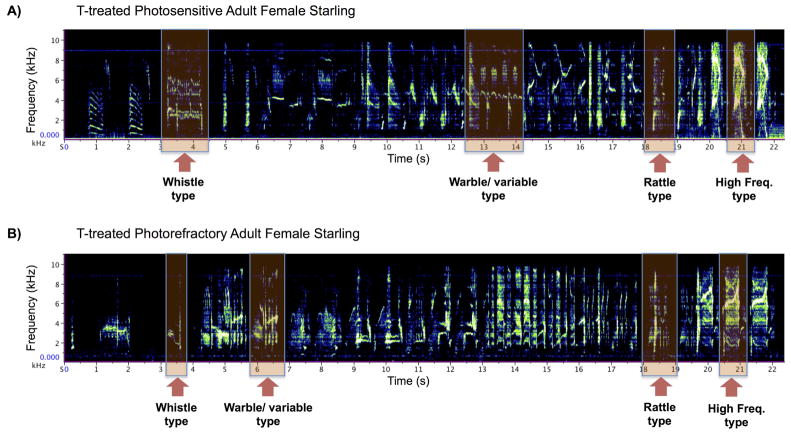
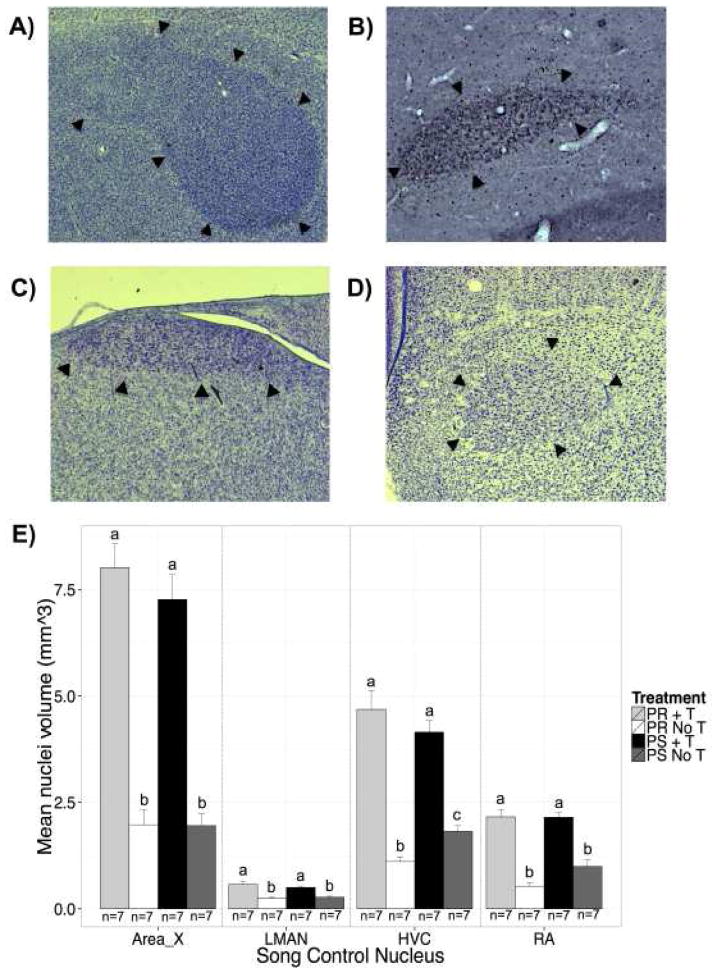
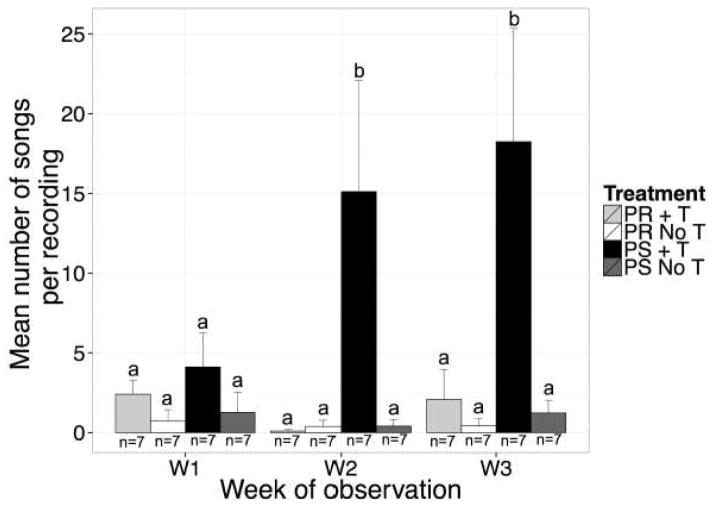
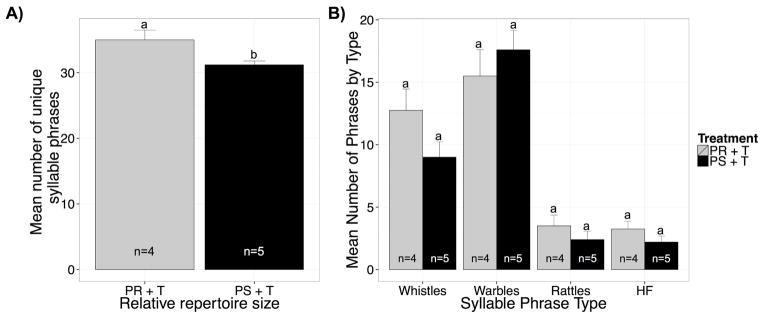
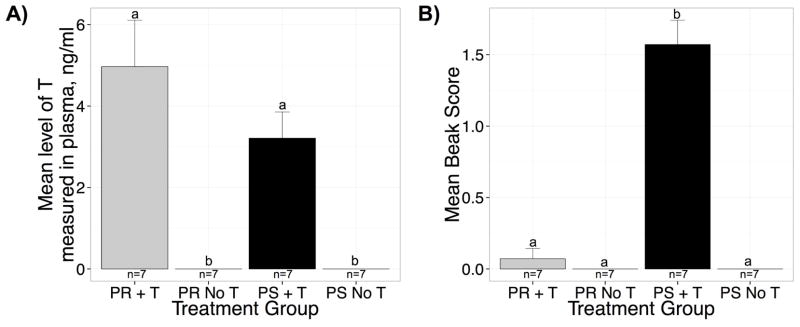
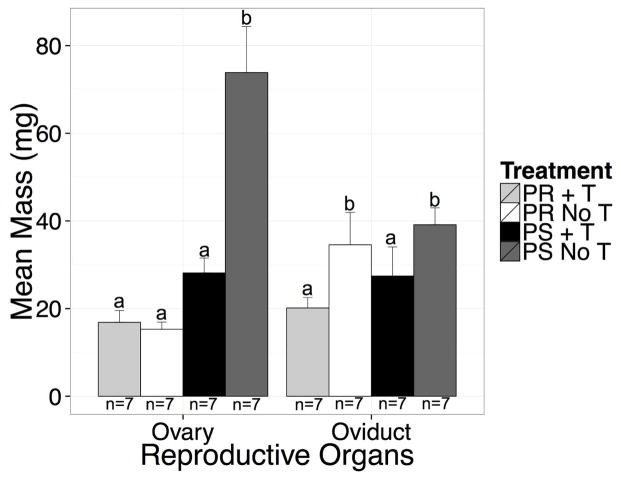
European starlings (Sturnus vulgaris) exhibit seasonal changes in singing and in the volumes of the neural substrate. Increases in song nuclei volume are mediated at least in part by increases in day length, which is also associated with increases in plasma testosterone (T), reproductive activity, and singing behavior in males. The correlations between photoperiod (i.e. daylength), T, reproductive state and singing hamper our ability to disentangle causal relationships. We investigated how photoperiodic-induced variation in reproductive state modulates the effects of T on singing behavior and song nuclei volumes in adult female starlings. Female starlings do not naturally produce measureable levels of circulating T but nevertheless respond to exogenous T, which induces male-like singing. We manipulated photoperiod by placing birds in a photosensitive or photorefractory state and then treated them with T-filled or empty silastic implants. We recorded morning singing behavior for 3 weeks, after which we assessed reproductive condition and measured song nuclei volumes. We found that T-treated photosensitive birds sang significantly more than all other groups including T-treated photorefractory birds. All T-treated birds had larger song nuclei volumes than with blank-treated birds (despite photorefractory T-treated birds not increasing song-rate). There was no effect of photoperiod on the song nuclei volumes of T-treated birds. These data show that the behavioral effects of exogenous T can be modulated by reproductive state in adult female songbirds. Furthermore, these data are consistent with other observations that increases in singing rate in response to T are not necessarily due to the direct effects of T on song nuclei volume.
欧洲椋鸟(Sturnus vulgaris)在鸣叫以及神经基质体积方面呈现出季节性变化。鸣叫核体积的增加至少部分是由日照时长的增加介导的,日照时长的增加还与雄性血浆睾酮(T)水平的升高、生殖活动以及鸣叫行为有关。光周期(即日照时长)、T、生殖状态和鸣叫之间的相关性妨碍了我们理清因果关系的能力。我们研究了成年雌性椋鸟中光周期诱导的生殖状态变化如何调节T对鸣叫行为和鸣叫核体积的影响。雌性椋鸟自然情况下不会产生可测量水平的循环T,但对外源性T仍有反应,外源性T会诱导出类似雄性的鸣叫。我们通过将鸟类置于光敏或光不应状态来操纵光周期,然后用填充T或空的硅橡胶植入物对它们进行处理。我们记录了3周的早晨鸣叫行为,之后评估生殖状况并测量鸣叫核体积。我们发现,接受T处理的光敏鸟类比所有其他组(包括接受T处理的光不应鸟类)鸣叫得明显更多。所有接受T处理的鸟类的鸣叫核体积都比接受空白处理的鸟类大(尽管接受T处理的光不应鸟类鸣叫频率没有增加)。光周期对接受T处理的鸟类的鸣叫核体积没有影响。这些数据表明,外源性T的行为效应可由成年雌性鸣禽的生殖状态调节。此外,这些数据与其他观察结果一致,即对T反应而导致的鸣叫频率增加不一定是由于T对鸣叫核体积的直接影响。