Li Xiuli, Gu Fang, Niu Chenguang, Wang Yuanfen, Liu Zhongyu, Li Na, Pan Bing, He Dan, Kong Jian, Zhang Shaobo, Wang Xu, Yao Yuanqing, Zheng Lemin
Department of Obstetrics and Gynecology, Chinese PLA General Hospital, Beijing, China.
Department of Obstetrics and Gynecology, Beijing Chaoyang Hospital, Beijing, China.
J Transl Med. 2015 May 20;13:164. doi: 10.1186/s12967-015-0522-0.
Alternative splicing of VEGF-A gives rise to two families - the pro-angiogenic VEGFxxx family and the anti-angiogenic VEGFxxxb family that differ by only six amino acids at their C-terminal end. The first verified and widely reported VEGFxxxb family member is VEGF165b, and here VEGF165b is a positive control.
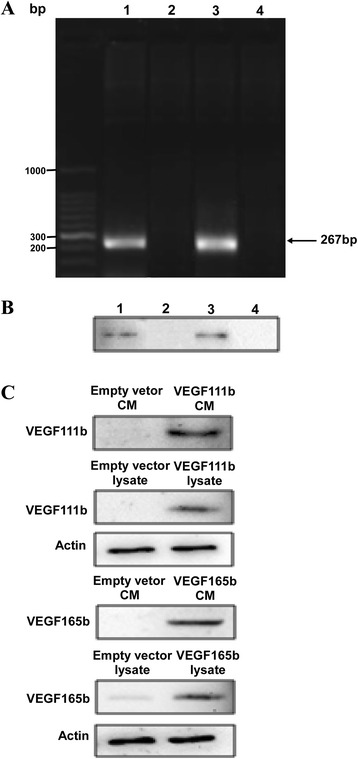
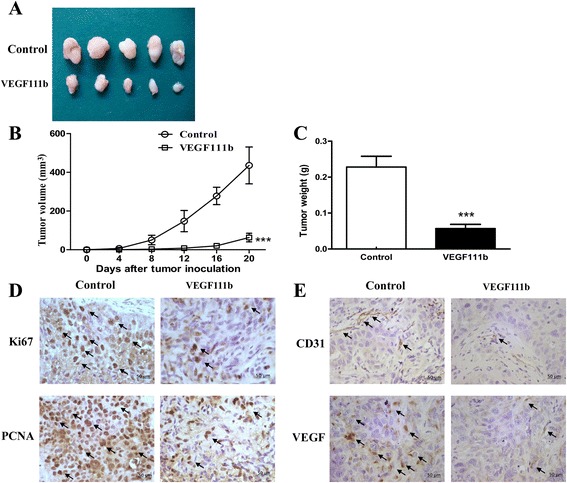
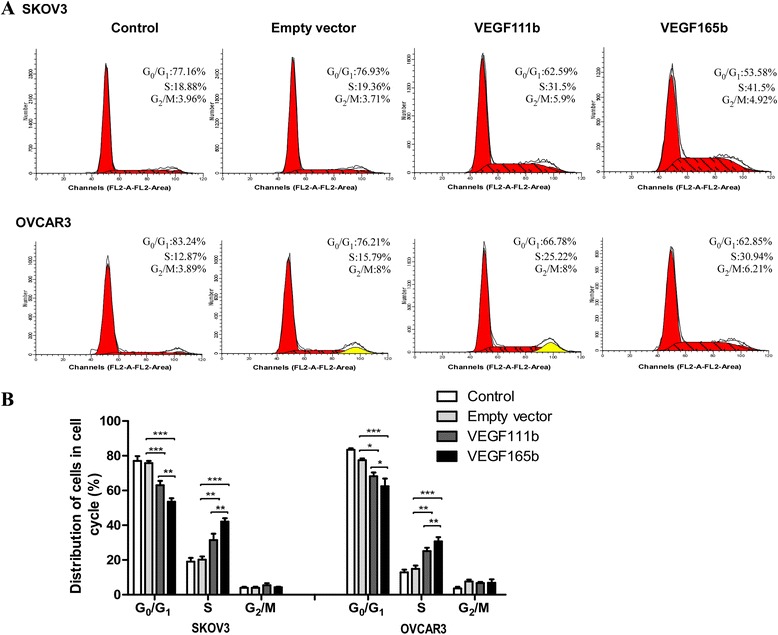
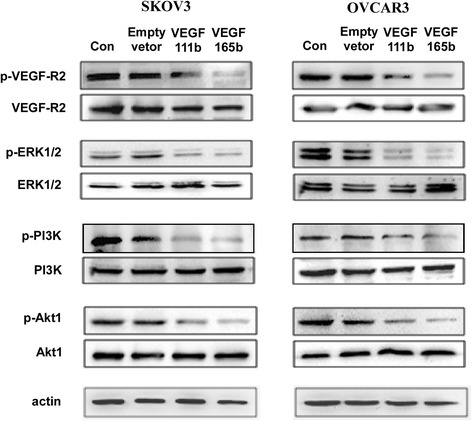
VEGF111b mRNA was detected in ovarian cancer cell lines SKOV3 and OVCAR3 by RT-PCR. Western blot was used to detect VEGF111b and VEGF165b protein in the CMs and lysates of OVCAR3 cells. MTT and colony formation assay were used to detect the short-term and long-term proliferation inhibition ability of ovarian cancer cells with VEGF111b overexpression. Cell-cycle analysis was performed to further characterize VEGF111b inhibition effects. VEGF111b signaling on ovarian cancer cells were determined by western blot. The expression levels of Ki67, PCNA, CD31 and VEGF in VEGF111b overexpression xenograft model were detected by immunohistochemistry.
Under the effect of mitomycin C, we identify a new member of VEGFxxxb family-VEGF111b in ovarian cancer cell lines. SKOV3 and OVCAR cells were transfected with empty lentivirus, VEGF111b or VEGF165b lentivirus. VEGF111b and VEGF165b overexpression inhibits proliferation of the ovarian cancer cells, but inhibition effect of VEGF111b is slightly less efficient than VEGF165b. Cell cycle analysis was further used to elucidate the mechanism involved in the inhibition effect. Further, we detected the expression of VEGF-R2 in SKOV3 and OVCAR3 cells, and shown that VEGF111b might bind to conventional VEGF-R2 with the results of reducing VEGF-R2 tyrosine phosphorylation and downstream signaling to have anti-tumor effects. In vivo VEGF111b overexpression inhibits ovarian cancer growth in xenograft mice.
Our results show that VEGF111b, as a new member of VEGFxxxb family, with similar properties to VEGF165b, plays potent anti-tumor effect in vitro and in vivo that can target the VEGF-R2 and its signaling pathway to inhibit ovarian tumor growth. This also opens a new avenue for treating ovarian cancer.
血管内皮生长因子A(VEGF-A)的可变剪接产生了两个家族——促血管生成的VEGFxxx家族和抗血管生成的VEGFxxxb家族,它们在C末端仅相差六个氨基酸。第一个得到验证且被广泛报道的VEGFxxxb家族成员是VEGF165b,在此VEGF165b作为阳性对照。
采用逆转录聚合酶链反应(RT-PCR)检测卵巢癌细胞系SKOV3和OVCAR3中VEGF111b mRNA的表达。采用蛋白质免疫印迹法检测OVCAR3细胞的条件培养基(CMs)和裂解物中VEGF111b和VEGF165b蛋白的表达。采用MTT法和集落形成试验检测过表达VEGF111b对卵巢癌细胞的短期和长期增殖抑制能力。进行细胞周期分析以进一步明确VEGF111b的抑制作用机制。通过蛋白质免疫印迹法确定VEGF111b对卵巢癌细胞的信号传导作用。采用免疫组织化学法检测VEGF111b过表达异种移植模型中Ki67、增殖细胞核抗原(PCNA)、CD31和VEGF的表达水平。
在丝裂霉素C的作用下,我们在卵巢癌细胞系中鉴定出VEGFxxxb家族的一个新成员——VEGF111b。将空载体慢病毒、VEGF111b或VEGF165b慢病毒转染SKOV3和OVCAR细胞。VEGF111b和VEGF165b过表达均抑制卵巢癌细胞的增殖,但VEGF111b的抑制作用略弱于VEGF165b。进一步通过细胞周期分析阐明其抑制作用的机制。此外,我们检测了SKOV3和OVCAR3细胞中VEGF受体2(VEGF-R2)的表达,结果显示VEGF111b可能与传统的VEGF-R2结合,从而降低VEGF-R2的酪氨酸磷酸化及其下游信号传导,发挥抗肿瘤作用。在体内,VEGF111b过表达抑制异种移植小鼠卵巢癌的生长。
我们的结果表明,VEGF111b作为VEGFxxxb家族的新成员,与VEGF165b具有相似的特性,在体外和体内均发挥强大的抗肿瘤作用,可靶向VEGF-R2及其信号通路抑制卵巢肿瘤生长。这也为卵巢癌的治疗开辟了一条新途径。