• 文献检索
  • 文档翻译
  • 深度研究
  • 学术资讯
  • Suppr Zotero 插件Zotero 插件
  • 邀请有礼
  • 套餐&价格
  • 历史记录
应用&插件
Suppr Zotero 插件Zotero 插件浏览器插件Mac 客户端Windows 客户端微信小程序
定价
高级版会员购买积分包购买API积分包
服务
文献检索文档翻译深度研究API 文档MCP 服务
关于我们
关于 Suppr公司介绍联系我们用户协议隐私条款
关注我们

Suppr 超能文献

核心技术专利:CN118964589B侵权必究
粤ICP备2023148730 号-1Suppr @ 2026

文献检索

告别复杂PubMed语法,用中文像聊天一样搜索,搜遍4000万医学文献。AI智能推荐,让科研检索更轻松。

立即免费搜索

文件翻译

保留排版,准确专业,支持PDF/Word/PPT等文件格式,支持 12+语言互译。

免费翻译文档

深度研究

AI帮你快速写综述,25分钟生成高质量综述,智能提取关键信息,辅助科研写作。

立即免费体验

超重女性对减肥应用的期望:一项针对阿拉伯女性的定性研究。

What overweight women want from a weight loss app: a qualitative study on arabic women.

机构信息

King Saud University, Food Science and Nutrition, Riyadh, Saudi Arabia.

出版信息

JMIR Mhealth Uhealth. 2015 May 20;3(2):e41. doi: 10.2196/mhealth.4409.

DOI:10.2196/mhealth.4409
PMID:25993907
原文链接:https://pmc.ncbi.nlm.nih.gov/articles/PMC4454823/
Abstract

BACKGROUND

Overweight and obesity are international public health issues. With mobile and app use growing globally, the development of weight loss apps are increasing along with evidence that interventions using technology have been effective in the treatment of obesity. Although studies have been conducted regarding what content health professionals would recommend within weight loss apps, there are limited studies that explore users' viewpoints. There is specifically a paucity of research that takes the cultural background of the user into consideration, especially in Middle Eastern countries where the lives and weight loss intervention needs of women not only vary vastly from the West, but the obesity rate is also increasing exponentially.

OBJECTIVE

The current study sought to explore the proposed features of an Arabic weight loss app by seeking the experiences and opinions of overweight and obese Saudi Arabian users in order to design a mobile phone app to fit their needs.

METHODS

Focus group discussions were conducted with a purposive sample of volunteer overweight and obese Saudi women (BMI ≥ 25) who were older than 18 years and who owned a mobile phone. The most common Arabic and English weight loss mobile apps were downloaded to initiate dialogue about app usage and to get their opinions on what an ideal weight loss app would look like and the features it would include. All transcribed, translated discussions were thematically analyzed, categorized for each of the main topics of the discussion, and specific quotations were identified.

RESULTS

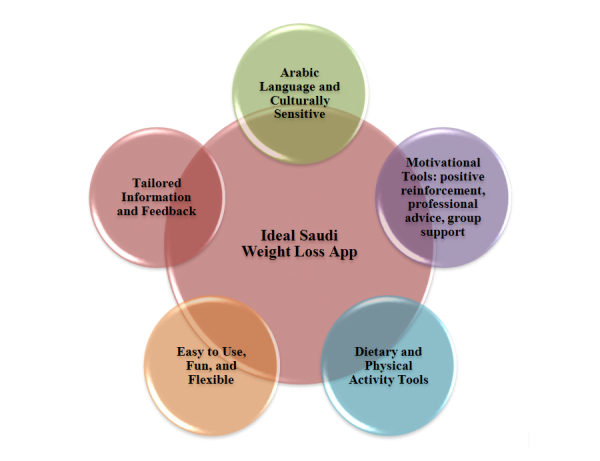
Four focus groups were conducted with a total of 39 participants. Most participants owned an Android mobile phone and only a few participants were aware of the availability of health-related apps. Barriers to weight loss were identified including: motivation, support (social and professional), boring diets, customs, and lifestyle. Diverse themes emerged as suggestions for an ideal weight loss app including: Arabic language and culturally sensitive; motivational support and social networking; dietary and physical activity tools; and a tailorable, user-friendly interface.

CONCLUSIONS

This study identifies weight loss app features from the users' perspective, which should be considered in the development of a weight loss app for this population.

摘要

背景

超重和肥胖是国际公共卫生问题。随着移动设备和应用程序在全球范围内的普及,减肥应用程序的开发也在增加,同时有证据表明,使用技术的干预措施在肥胖治疗方面是有效的。尽管已经有研究探讨了健康专业人士在减肥应用程序中推荐哪些内容,但很少有研究探讨用户的观点。特别是在中东国家,由于女性的生活和减肥干预需求不仅与西方大不相同,而且肥胖率也在呈指数级增长,因此,考虑到用户的文化背景,相关研究还很少。

目的

本研究旨在通过超重和肥胖的沙特阿拉伯用户的经验和意见,探讨阿拉伯语减肥应用程序的建议功能,以便设计一款适合他们需求的手机应用程序。

方法

采用目的抽样法,对 39 名年龄在 18 岁以上、拥有手机的超重和肥胖沙特女性志愿者进行了焦点小组讨论。下载了最常见的阿拉伯语和英语减肥移动应用程序,以启动关于应用程序使用的对话,并获取他们对理想减肥应用程序的看法以及它应包含的功能的意见。对所有转录和翻译的讨论进行了主题分析,按照讨论的每个主题进行分类,并确定了具体的引语。

结果

共进行了 4 次焦点小组讨论,共有 39 名参与者。大多数参与者拥有一部安卓手机,只有少数参与者知道有健康相关的应用程序。减肥的障碍包括:动力、支持(社会和专业)、无聊的饮食、习俗和生活方式。为理想的减肥应用程序提出了不同的主题,包括:阿拉伯语和文化敏感;动机支持和社交网络;饮食和体育活动工具;以及可定制的、用户友好的界面。

结论

本研究从用户的角度确定了减肥应用程序的功能,这在为该人群开发减肥应用程序时应予以考虑。
https://cdn.ncbi.nlm.nih.gov/pmc/blobs/57cd/4454823/1fb0a12c1970/mhealth_v3i2e41_fig1.jpg

相似文献

1
What overweight women want from a weight loss app: a qualitative study on arabic women.超重女性对减肥应用的期望:一项针对阿拉伯女性的定性研究。
JMIR Mhealth Uhealth. 2015 May 20;3(2):e41. doi: 10.2196/mhealth.4409.
2
The Development of an Arabic Weight-Loss App Akser Waznk: Qualitative Results.一款阿拉伯语减肥应用程序Akser Waznk的开发:定性结果
JMIR Form Res. 2019 Mar 14;3(1):e11785. doi: 10.2196/11785.
3
Development of 'Twazon': An Arabic App for Weight Loss.“Twazon”的开发:一款用于减肥的阿拉伯语应用程序。
JMIR Res Protoc. 2016 May 16;5(2):e76. doi: 10.2196/resprot.5497.
4
Use of Weight-Management Mobile Phone Apps in Saudi Arabia: A Web-Based Survey.沙特阿拉伯的体重管理手机应用程序使用情况:一项基于网络的调查。
JMIR Mhealth Uhealth. 2019 Feb 22;7(2):e12692. doi: 10.2196/12692.
5
Relationship Between Evidence Requirements, User Expectations, and Actual Experiences: Usability Evaluation of the Twazon Arabic Weight Loss App.证据要求、用户期望与实际体验之间的关系:Twazon阿拉伯语减肥应用程序的可用性评估
JMIR Hum Factors. 2018 Apr 17;5(2):e16. doi: 10.2196/humanfactors.9765.
6
A Mobile Social Networking App for Weight Management and Physical Activity Promotion: Results From an Experimental Mixed Methods Study.移动社交网络应用于体重管理和身体活动促进:一项实验性混合方法研究的结果。
J Med Internet Res. 2020 Dec 8;22(12):e19991. doi: 10.2196/19991.
7
Popular Mobile Phone Apps for Diet and Weight Loss: A Content Analysis.热门手机应用程序在节食和减肥中的应用:内容分析。
JMIR Mhealth Uhealth. 2016 Jul 11;4(3):e80. doi: 10.2196/mhealth.5406.
8
The Twazon Arabic Weight Loss App: App-Based Intervention for Saudi Women With Obesity.特瓦宗阿拉伯文减肥应用:针对沙特肥胖女性的基于应用程序的干预措施。
JMIR Mhealth Uhealth. 2019 May 28;7(5):e10923. doi: 10.2196/10923.
9
Opportunities and challenges for smartphone applications in supporting health behavior change: qualitative study.智能手机应用在支持健康行为改变方面的机遇与挑战:定性研究
J Med Internet Res. 2013 Apr 18;15(4):e86. doi: 10.2196/jmir.2583.
10
Targeting Parents for Childhood Weight Management: Development of a Theory-Driven and User-Centered Healthy Eating App.针对父母的儿童体重管理:一个基于理论和用户为中心的健康饮食应用程序的开发。
JMIR Mhealth Uhealth. 2015 Jun 18;3(2):e69. doi: 10.2196/mhealth.3857.

引用本文的文献

1
Exploring Desired Features of Mobile Health Apps for Patients With Diabetes to Enhance Engagement and Self-Management: Qualitative Study.探索糖尿病患者移动健康应用程序的理想功能以提高参与度和自我管理能力:定性研究。
JMIR Diabetes. 2025 Aug 14;10:e69176. doi: 10.2196/69176.
2
Mining User Reviews From Hypertension Management Mobile Health Apps to Explore Factors Influencing User Satisfaction and Their Asymmetry: Comparative Study.从高血压管理移动健康应用中挖掘用户评论,探索影响用户满意度的因素及其非对称性:比较研究。
JMIR Mhealth Uhealth. 2024 Mar 28;12:e55199. doi: 10.2196/55199.
3
Barriers and Motivators to Weight Loss in People With Obesity.

本文引用的文献

1
How can weight-loss app designers' best engage and support users? A qualitative investigation.减肥应用程序设计师如何才能最好地吸引和支持用户?一项定性研究。
Br J Health Psychol. 2015 Feb;20(1):151-71. doi: 10.1111/bjhp.12114. Epub 2014 Aug 14.
2
Adapting a database of text messages to a mobile-based weight loss program: the case of the middle East.将短信数据库应用于基于移动设备的减肥计划:中东地区的案例
Int J Telemed Appl. 2014;2014:658149. doi: 10.1155/2014/658149. Epub 2014 Jan 6.
3
Evidence-based strategies in weight-loss mobile apps.
肥胖人群体重减轻的障碍与动力
Cureus. 2023 Nov 19;15(11):e49040. doi: 10.7759/cureus.49040. eCollection 2023 Nov.
4
Perceptions of self-monitoring dietary intake according to a plate-based approach: A qualitative study.基于餐盘法的自我监测饮食摄入感知:一项定性研究。
PLoS One. 2023 Nov 28;18(11):e0294652. doi: 10.1371/journal.pone.0294652. eCollection 2023.
5
Assessing the Views and Needs of People at High Risk of Gestational Diabetes Mellitus for the Development of Mobile Health Apps: Descriptive Qualitative Study.评估妊娠期糖尿病高危人群对移动健康应用程序开发的看法和需求:描述性定性研究
JMIR Form Res. 2022 Jul 8;6(7):e36392. doi: 10.2196/36392.
6
Qualitative research in the Arabic language. When should translations to English occur? A literature review.阿拉伯语的定性研究。何时应翻译成英文?文献综述。
Explor Res Clin Soc Pharm. 2022 Jun 24;6:100153. doi: 10.1016/j.rcsop.2022.100153. eCollection 2022 Jun.
7
The Quality of Indian Obesity-Related mHealth Apps: PRECEDE-PROCEED Model-Based Content Analysis.印度肥胖相关移动健康应用的质量:基于 PRECEDE-PROCEED 模型的内容分析。
JMIR Mhealth Uhealth. 2022 May 11;10(5):e15719. doi: 10.2196/15719.
8
Considering intermittent fasting among Saudis: insights into practices.考虑在沙特人中实行间歇性禁食:实践中的见解。
BMC Public Health. 2022 Mar 26;22(1):592. doi: 10.1186/s12889-022-12908-4.
9
Protocol for a qualitative study exploring the perception of need, importance and acceptability of a digital diabetes prevention intervention for women with gestational diabetes mellitus during and after pregnancy in Malaysia (Explore-MYGODDESS).马来西亚探索妊娠期糖尿病女性对孕期和产后数字糖尿病预防干预措施的感知、需求、重要性和可接受性的定性研究方案(探索-MYGODDESS)。
BMJ Open. 2021 Aug 26;11(8):e044878. doi: 10.1136/bmjopen-2020-044878.
10
Feasibility Study of a Newly Developed Technology-Mediated Lifestyle Intervention for Overweight and Obese Young Adults.一项新开发的技术介导的生活方式干预超重和肥胖青年的可行性研究。
Nutrients. 2021 Jul 26;13(8):2547. doi: 10.3390/nu13082547.
基于证据的减肥移动应用策略。
Am J Prev Med. 2013 Nov;45(5):576-82. doi: 10.1016/j.amepre.2013.04.025.
4
Weight loss social support in 140 characters or less: use of an online social network in a remotely delivered weight loss intervention.用 140 个字符或更少的文字描述减肥社会支持:在线社交网络在远程减肥干预中的应用。
Transl Behav Med. 2013 Sep;3(3):287-94. doi: 10.1007/s13142-012-0183-y.
5
Weight loss-there is an app for that! But does it adhere to evidence-informed practices?减肥——有一款应用程序可以做到!但它是否遵循基于证据的实践呢?
Transl Behav Med. 2011 Dec;1(4):523-9. doi: 10.1007/s13142-011-0076-5.
6
Opportunities and challenges for smartphone applications in supporting health behavior change: qualitative study.智能手机应用在支持健康行为改变方面的机遇与挑战:定性研究
J Med Internet Res. 2013 Apr 18;15(4):e86. doi: 10.2196/jmir.2583.
7
Experiences of obesity among Saudi Arabian women contemplating bariatric surgery: an interpretative phenomenological analysis.考虑接受减肥手术的沙特阿拉伯女性的肥胖经历:一项诠释现象学分析。
J Health Psychol. 2014 May;19(5):664-77. doi: 10.1177/1359105313476977. Epub 2013 Mar 11.
8
Technology Interventions to Curb Obesity: A Systematic Review of the Current Literature.遏制肥胖的技术干预措施:当前文献的系统综述
Curr Cardiovasc Risk Rep. 2012 Apr;6(2):120-134. doi: 10.1007/s12170-012-0222-8.
9
Barriers and facilitators of weight management: perspectives of Arab women at risk for type 2 diabetes.体重管理的障碍和促进因素:患 2 型糖尿病风险的阿拉伯妇女的观点。
Health Soc Care Community. 2010 Mar;18(2):219-28. doi: 10.1111/j.1365-2524.2009.00896.x. Epub 2010 Jan 4.