Porciuncula Franchino S, Rao Ashwini K, McIsaac Tara L
Department of Biobehavioral Sciences, Teachers College Columbia University, Movement Sciences, Box 199, 525 West 120th St., New York, NY, 10027, USA.
Department of Rehabilitation and Regenerative Medicine (Physical Therapy) and G.H. Sergievsky Center, College of Physicians and Surgeons, Columbia University, 710 West 168th St., 8th Floor, New York, NY, 10032, USA.
Aging Clin Exp Res. 2016 Feb;28(1):121-30. doi: 10.1007/s40520-015-0372-x. Epub 2015 May 21.
It is unclear how young and older adults modulate dual-task mobility under changing postural challenges.
To examine age-related changes in dual-task processing during specific phases of dual-task Timed Up-and-Go (TUGdual-task).
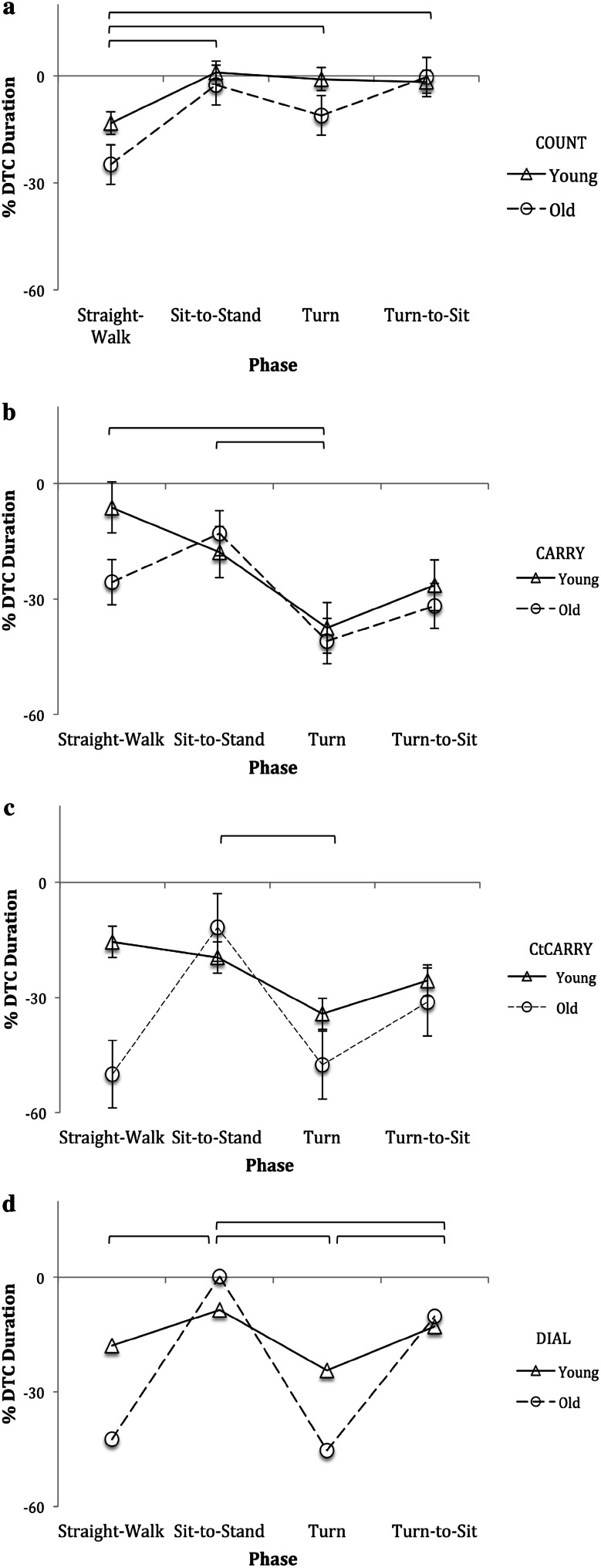
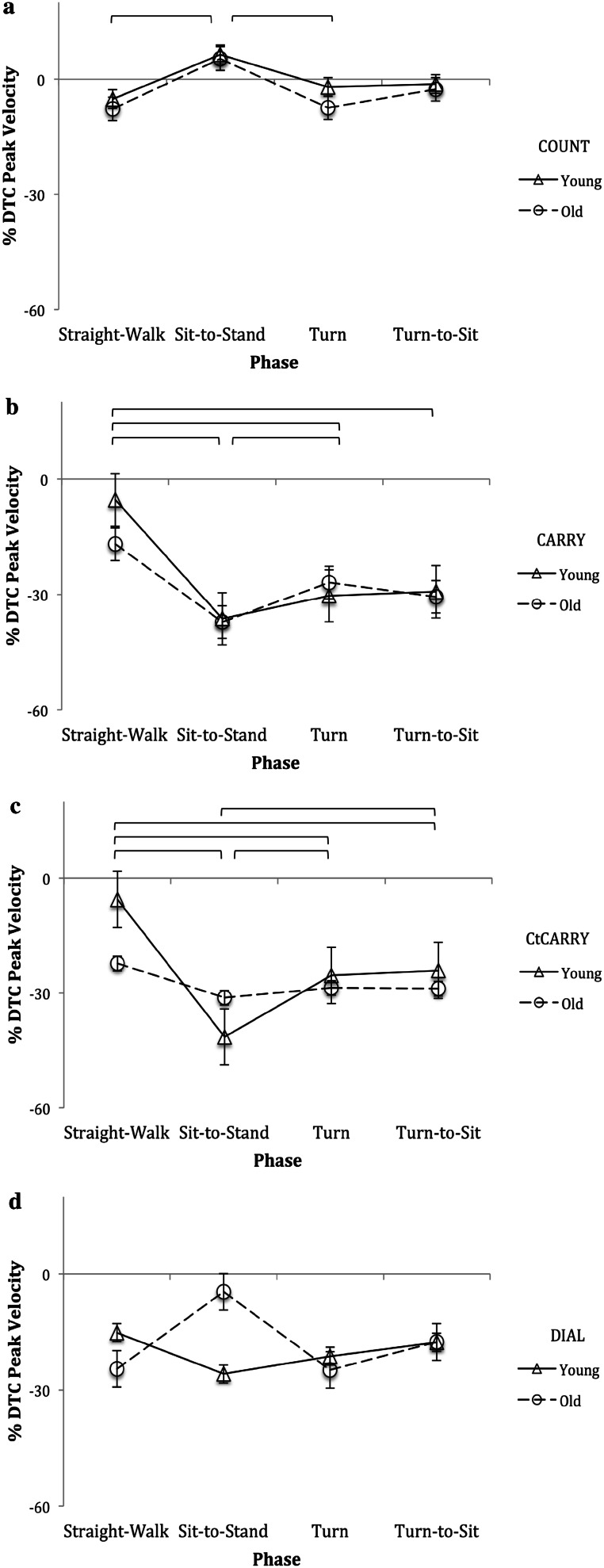
Healthy young and older adults performed the Timed Up-and-Go (TUG) with the following dual-task conditions: (1) serial-three subtractions, (2) carrying cup of water, (3) combined subtraction and carrying water, and (4) dialing cell phone. The primary outcome was the dual-task cost on performance of TUG (percent change from single- to dual-task) based on duration and peak trunk velocity of each phase: (a) straight-walk, (b) sit-to-stand, (c) turn, (d) turn-to-sit. Mixed-design univariate analysis of variance was performed for each type of task.
Older adults had more pronounced mobility decrements than young adults during straight-ahead walking and turns when the secondary task engaged both cognitive and manual modalities. Simple cognitive or manual tasks during TUGdual-task did not differentiate young from older participants. Subtraction performance during simple and complex cognitive conditions differed by phase of the TUG. Manual task performance of carrying water did not vary by phase or age.
Our findings suggest that dual-task processing is dynamic across phases of TUGdual-task. Aging-related dual-task decrements are demonstrated during straight-ahead walking and turning, particularly when the secondary task is more complex.
Older adults are susceptible to reduced dual-task mobility during straight-ahead walking and turning particularly when attentional loading was increased.
目前尚不清楚年轻人和老年人在姿势挑战不断变化的情况下如何调节双任务移动能力。
研究在双任务定时起立行走(TUG双任务)的特定阶段中与年龄相关的双任务处理变化。
健康的年轻人和老年人在以下双任务条件下进行定时起立行走(TUG):(1)连续减3,(2)端一杯水,(3)减法和端水相结合,以及(4)拨打手机。主要结果是基于每个阶段(a)直行、(b)从坐到站、(c)转身、(d)从转到坐的持续时间和躯干峰值速度,TUG表现的双任务成本(从单任务到双任务的百分比变化)。对每种类型的任务进行混合设计单变量方差分析。
当次要任务涉及认知和手动模式时,老年人在直行和转身过程中的移动能力下降比年轻人更明显。TUG双任务期间的简单认知或手动任务并没有区分年轻和老年参与者。简单和复杂认知条件下的减法表现因TUG阶段而异。端水的手动任务表现不随阶段或年龄而变化。
我们的研究结果表明,双任务处理在TUG双任务的各个阶段是动态的。在直行和转弯过程中表现出与年龄相关的双任务能力下降,特别是当次要任务更复杂时。
老年人在直行和转弯过程中容易出现双任务移动能力下降,特别是当注意力负荷增加时。