Rotteau Leahora, Webster Fiona, Salkeld Erin, Hellings Chelsea, Guttmann Astrid, Vermeulen Marian J, Bell Robert S, Zwarenstein Merrick, Rowe Brian H, Nigam Amit, Schull Michael J
The Centre for Quality Improvement and Patient Safety, University of Toronto, Toronto, Ontario, Canada.
The Department of Family and Community Medicine, University of Toronto, Toronto, Ontario, Canada.
Acad Emerg Med. 2015 Jun;22(6):720-9. doi: 10.1111/acem.12688. Epub 2015 May 20.
In recent years, Lean manufacturing principles have been applied to health care quality improvement efforts to improve wait times. In Ontario, an emergency department (ED) process improvement program based on Lean principles was introduced by the Ministry of Health and Long-Term Care as part of a strategy to reduce ED length of stay (LOS) and to improve patient flow. This article aims to describe the hospital-based teams' experiences during the ED process improvement program implementation and the teams' perceptions of the key factors that influenced the program's success or failure.
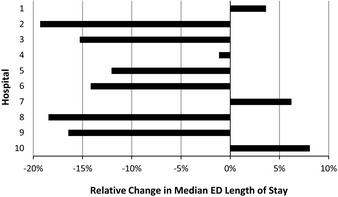
A qualitative evaluation was conducted based on semistructured interviews with hospital implementation team members, such as team leads, medical leads, and executive sponsors, at 10 purposively selected hospitals in Ontario, Canada. Sites were selected based, in part, on their changes in median ED LOS following the implementation period. A thematic framework approach as used for interviews, and a standard thematic coding framework was developed.
Twenty-four interviews were coded and analyzed. The results are organized according to participants' experience and are grouped into four themes that were identified as significantly affecting the implementation experience: local contextual factors, relationship between improvement team and support players, staff engagement, and success and sustainability. The results demonstrate the importance of the context of implementation, establishing strong relationships and communication strategies, and preparing for implementation and sustainability prior to the start of the project.
Several key factors were identified as important to the success of the program, such as preparing for implementation, ensuring strong executive support, creation of implementation teams based on the tasks and outcomes of the initiative, and using multiple communication strategies throughout the implementation process. Explicit incorporation of these factors into the development and implementation of future similar interventions in health care settings could be useful.
近年来,精益制造原则已应用于医疗保健质量改进工作,以缩短等待时间。在安大略省,卫生和长期护理部引入了一项基于精益原则的急诊科(ED)流程改进计划,作为减少急诊科住院时间(LOS)和改善患者流程战略的一部分。本文旨在描述医院团队在急诊科流程改进计划实施过程中的经验,以及团队对影响该计划成败的关键因素的看法。
基于对加拿大安大略省10家有目的地选择的医院的医院实施团队成员(如团队负责人、医疗负责人和执行发起人)的半结构化访谈,进行了定性评估。部分站点是根据实施期后急诊科中位住院时间的变化来选择的。采用主题框架方法进行访谈,并制定了标准的主题编码框架。
对24次访谈进行了编码和分析。结果根据参与者的经验进行组织,并分为四个主题,这些主题被确定为对实施经验有重大影响:当地背景因素、改进团队与支持人员之间的关系、员工参与度以及成功与可持续性。结果表明了实施背景、建立牢固关系和沟通策略以及在项目开始前为实施和可持续性做好准备的重要性。
确定了几个对该计划成功至关重要的关键因素,如为实施做准备、确保强有力的行政支持、根据倡议的任务和成果创建实施团队,以及在整个实施过程中使用多种沟通策略。将这些因素明确纳入未来医疗保健环境中类似干预措施的开发和实施中可能会有所帮助。