University College Dublin Centre for Interdisciplinary Research, Education and Innovation in Health Systems (UCD IRIS), Belfield, Dublin 4, Ireland.
University College Dublin School of Nursing, Midwifery and Health Systems, Belfield, Dublin 4, Ireland.
BMC Health Serv Res. 2020 Jun 29;20(1):591. doi: 10.1186/s12913-020-05212-7.
The implementation of evidence-based healthcare interventions is challenging, with a 17-year gap identified between the generation of evidence and its implementation in routine practice. Although contextual factors such as culture and leadership are strong influences for successful implementation, context remains poorly understood, with a lack of consensus regarding how it should be defined and captured within research. This study addresses this issue by providing insight into how context is defined and assessed within healthcare implementation science literature and develops a definition to enable effective measurement of context.
Medline, PsychInfo, CINAHL and EMBASE were searched. Articles were included if studies were empirical and evaluated context during the implementation of a healthcare initiative. These English language articles were published in the previous 10 years and included a definition and assessment of context. Results were synthesised using a narrative approach.
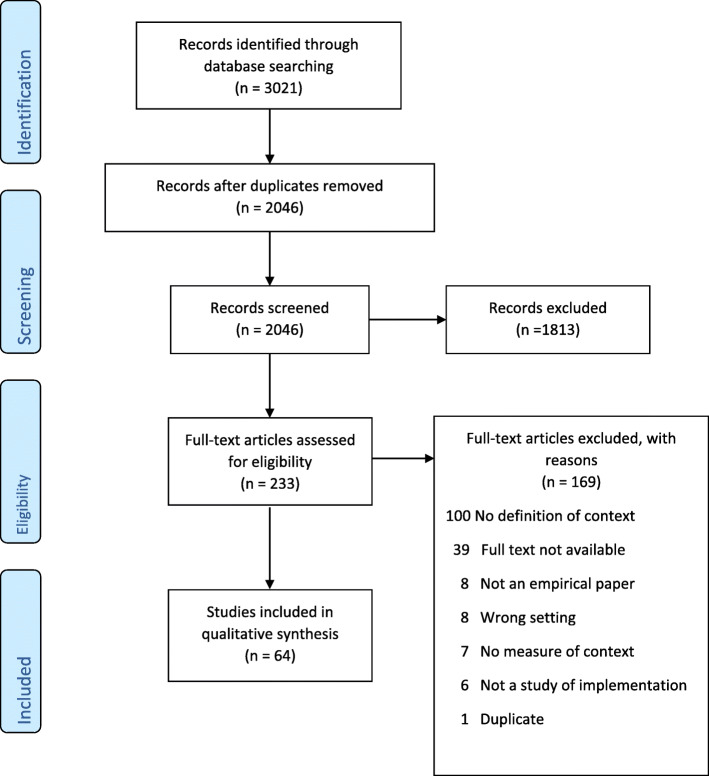
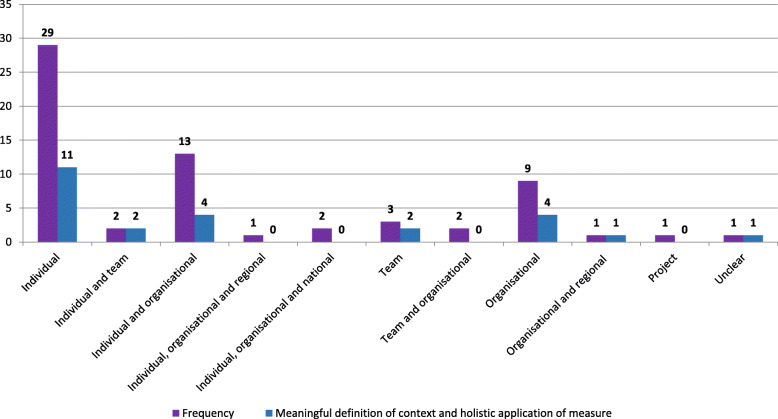
Three thousand and twenty-one search records were obtained of which 64 met the eligibility criteria and were included in the review. Studies used a variety of definitions in terms of the level of detail and explanation provided. Some listed contextual factors (n = 19) while others documented sub-elements of a framework that included context (n = 19). The remaining studies provide a rich definition of general context (n = 11) or aspects of context (n = 15). The Alberta Context Tool was the most frequently used quantitative measure (n = 4), while qualitative papers used a range of frameworks to evaluate context. Mixed methods studies used diverse approaches; some used frameworks to inform the methods chosen while others used quantitative measures to inform qualitative data collection. Most studies (n = 50) applied the chosen measure to all aspects of study design with a majority analysing context at an individual level (n = 29).
This review highlighted inconsistencies in defining and measuring context which emphasised the need to develop an operational definition. By providing this consensus, improvements in implementation processes may result, as a common understanding will help researchers to appropriately account for context in research.
实施循证医疗干预措施具有挑战性,在证据产生和在常规实践中实施之间存在 17 年的差距。尽管文化和领导力等背景因素对成功实施有很强的影响,但背景因素仍未得到充分理解,对于如何在研究中定义和捕捉背景因素,尚未达成共识。本研究通过深入了解医疗实施科学文献中背景的定义和评估方式,解决了这一问题,并提出了一个定义,以实现对背景的有效测量。
对 Medline、PsychInfo、CINAHL 和 EMBASE 进行了检索。如果研究是实证性的,并在医疗保健举措实施过程中评估了背景,则将其纳入研究。这些英文文章在过去 10 年内发表,并对背景进行了定义和评估。使用叙述性方法对结果进行了综合。
共获得 3021 条检索记录,其中 64 条符合入选标准并纳入综述。研究在定义背景的详细程度和解释方面使用了各种定义。一些研究列出了背景因素(n=19),而另一些研究则记录了包括背景的框架的子元素(n=19)。其余研究则提供了对一般背景(n=11)或背景方面(n=15)的丰富定义。阿尔伯塔省背景工具是使用最频繁的定量测量方法(n=4),而定性论文则使用了一系列框架来评估背景。混合方法研究采用了不同的方法;有些研究使用框架来指导选择的方法,而另一些研究则使用定量测量来指导定性数据收集。大多数研究(n=50)将所选测量方法应用于研究设计的所有方面,其中大多数研究(n=29)在个体层面上分析背景。
本综述强调了定义和测量背景的不一致性,这突出了开发操作性定义的必要性。通过达成共识,可以改进实施过程,因为共同的理解将有助于研究人员在研究中适当地考虑背景因素。