Shen Xinying, Li Yong, Zhang Yanfang, Kong Jian, Li Yanhao
Department of Interventional Radiology, Nanfang Hospital, Southern Medical University, Guangzhou, People's Republic of China ; Department of Interventional Radiology, Shenzhen People's Hospital, The Second Clinical Medical College of Jinan University, Shenzhen, People's Republic of China.
Department of Interventional Radiology, Shenzhen People's Hospital, The Second Clinical Medical College of Jinan University, Shenzhen, People's Republic of China.
Onco Targets Ther. 2015 May 2;8:991-7. doi: 10.2147/OTT.S83140. eCollection 2015.
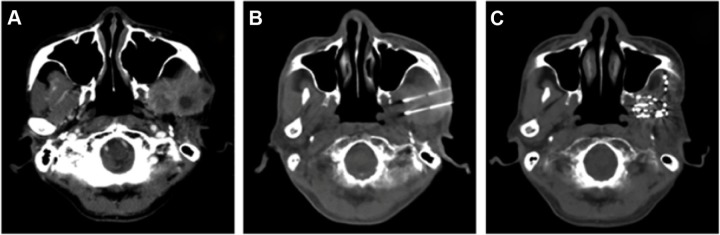
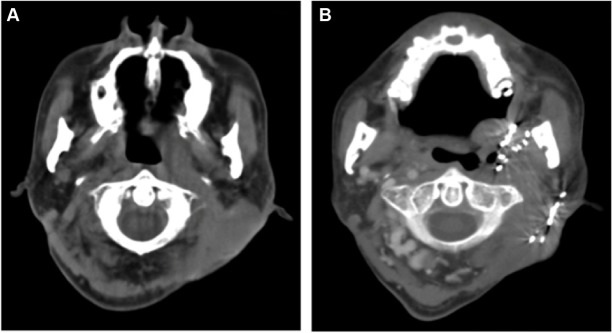
(125)I seed implantation is a new method in treatment of nasopharyngeal carcinoma (NPC), and it is worthwhile to evaluate its feasibility. In this study, we performed brachytherapy with computed tomography (CT)-guided permanent implantation of (125)I seeds in the treatment of patients with the recurrence of NPC.
A total 30 patients (20 male and ten female) at the median age of 55 (range 25-80) years were diagnosed with recurrent nonkeratin NPC, with a total 38 lesions and a short disease-free interval (mediañ11 months) after primary radiotherapy alone or combined with chemotherapy. Patients received CT scan, starting from 2 months after the treatment. Follow-up was conducted for ~2-38 months to observe the local control rate and overall survival rate. We also analyzed the possible correlation between survival periods and the status of recurrent tumors.
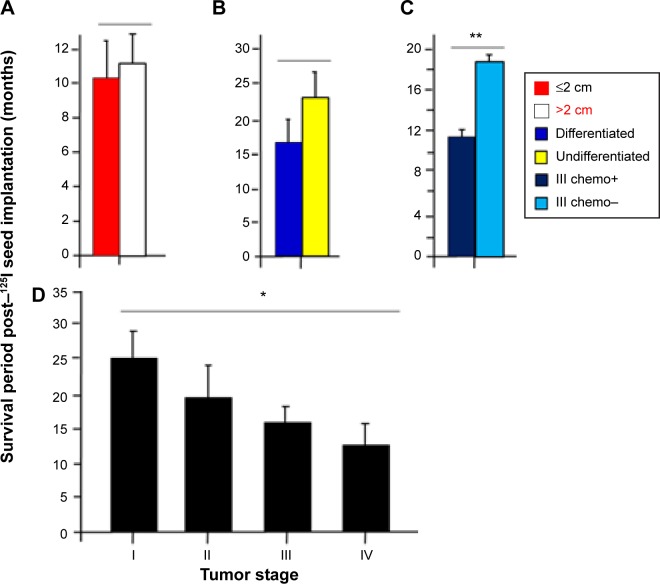
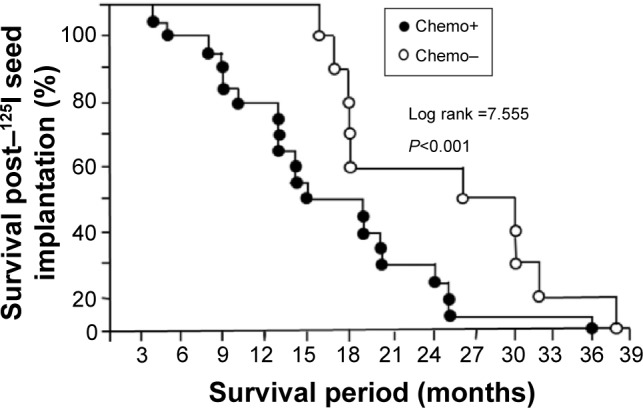
The local control rates at 6, 12, 24, 30, and 36 months after the procedure of (125)I seed implantation were 86.8%, 73.7%, 26.3%, 15.8%, and 5.3%, respectively. The overall 1-, 2-, and 3-year survival rates were 80.0% (24/30), 30.0% (9/30), and 6.7% (2/30), respectively, with a median survival period of 18 months (17.6±8.6 months). Interestingly, the survival periods of the patients who had primary radiotherapy with or without chemotherapy were 15.8±7.9 and 24.3±7.9 months, respectively. Kaplan-Meier survival analysis demonstrated that χ (2) (log rank) was 7.555, with very significant difference (P<0.01). The survival periods of patients in tumor stages I, II, III, and IV were 25.4±8.7, 19.8±9.4, 16.1±4.5, and 12.8±7.8 months, respectively, with significant differences (P<0.05).
Our data suggest that the survival period of recurrent NPC patients after (125)I seed implantation is inversely related to the tumor stages of the recurrence but not to chemotherapy after the primary radiotherapy. Therefore, CT-guided (125)I seed implantation can be set for treatment of recurrent NPC, for better survival rate with minimal damage.
碘-125粒子植入是鼻咽癌治疗的一种新方法,评估其可行性很有必要。本研究中,我们对鼻咽癌复发患者进行了计算机断层扫描(CT)引导下碘-125粒子永久植入近距离放射治疗。
共30例患者(男20例,女10例),中位年龄55岁(范围25 - 80岁),诊断为复发性非角化型鼻咽癌,共有38个病灶,在单纯原发放疗或联合化疗后无病间期短(中位11个月)。患者在治疗后2个月开始接受CT扫描。随访约2 - 38个月,观察局部控制率和总生存率。我们还分析了生存期与复发肿瘤状态之间可能的相关性。
碘-125粒子植入术后6、12、24、30和36个月的局部控制率分别为86.8%、73.7%、26.3%、15.8%和5.3%。1年、2年和3年总生存率分别为80.0%(24/30)、30.0%(9/30)和6.7%(2/30),中位生存期为18个月(17.6±8.6个月)。有趣的是,接受过或未接受过化疗的原发放疗患者的生存期分别为15.8±7.9个月和24.3±7.9个月。Kaplan-Meier生存分析显示,χ(2)(对数秩)为7.555,差异非常显著(P<0.01)。肿瘤分期为I、II、III和IV期的患者生存期分别为25.4±8.7、19.8±9.4、16.1±4.5和12.8±7.8个月,差异有统计学意义(P<0.05)。
我们的数据表明,碘-125粒子植入后复发性鼻咽癌患者的生存期与复发肿瘤分期呈负相关,而与原发放疗后的化疗无关。因此,CT引导下碘-125粒子植入可用于复发性鼻咽癌的治疗,以获得更好的生存率且损伤最小。