Keidser Gitte, Best Virginia, Freeston Katrina, Boyce Alexandra
National Acoustic Laboratories Sydney, NSW, Australia.
Department of Speech, Language, and Hearing Sciences, Boston University Boston, MA, USA.
Front Psychol. 2015 May 6;6:597. doi: 10.3389/fpsyg.2015.00597. eCollection 2015.
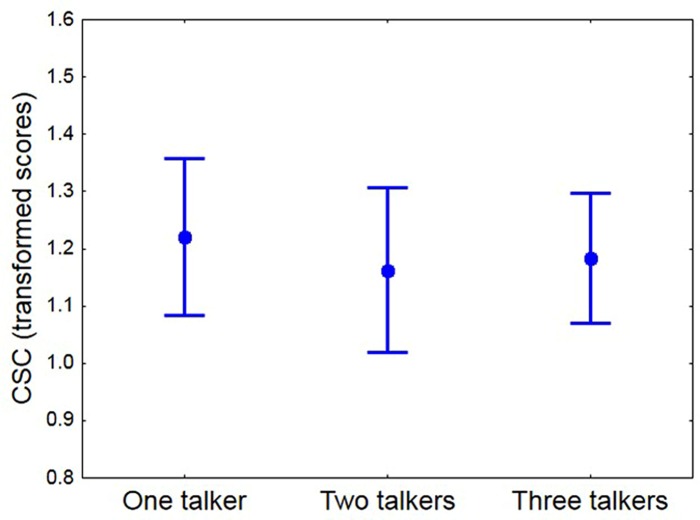
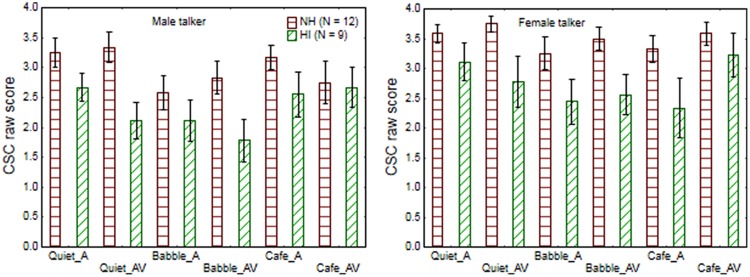
It is well-established that communication involves the working memory system, which becomes increasingly engaged in understanding speech as the input signal degrades. The more resources allocated to recovering a degraded input signal, the fewer resources, referred to as cognitive spare capacity (CSC), remain for higher-level processing of speech. Using simulated natural listening environments, the aims of this paper were to (1) evaluate an English version of a recently introduced auditory test to measure CSC that targets the updating process of the executive function, (2) investigate if the test predicts speech comprehension better than the reading span test (RST) commonly used to measure working memory capacity, and (3) determine if the test is sensitive to increasing the number of attended locations during listening. In Experiment I, the CSC test was presented using a male and a female talker, in quiet and in spatially separated babble- and cafeteria-noises, in an audio-only and in an audio-visual mode. Data collected on 21 listeners with normal and impaired hearing confirmed that the English version of the CSC test is sensitive to population group, noise condition, and clarity of speech, but not presentation modality. In Experiment II, performance by 27 normal-hearing listeners on a novel speech comprehension test presented in noise was significantly associated with working memory capacity, but not with CSC. Moreover, this group showed no significant difference in CSC as the number of talker locations in the test increased. There was no consistent association between the CSC test and the RST. It is recommended that future studies investigate the psychometric properties of the CSC test, and examine its sensitivity to the complexity of the listening environment in participants with both normal and impaired hearing.
众所周知,交流涉及工作记忆系统,随着输入信号质量下降,该系统在理解言语时的参与度会越来越高。分配用于恢复退化输入信号的资源越多,用于言语高级处理的资源(即认知备用容量,CSC)就越少。本文利用模拟自然聆听环境,旨在:(1)评估一种最近推出的旨在测量针对执行功能更新过程的CSC的听觉测试的英文版本;(2)研究该测试在预测言语理解方面是否比常用于测量工作记忆容量的阅读广度测试(RST)表现更好;(3)确定该测试对聆听过程中增加被关注声源位置数量是否敏感。在实验一中,CSC测试通过男性和女性说话者呈现,分别处于安静环境以及空间分离的嘈杂声(类似嘈杂餐厅声)环境中,以纯音频和视听两种模式进行。收集的21名听力正常和听力受损听众的数据证实,CSC测试的英文版本对人群组、噪声条件和言语清晰度敏感,但对呈现方式不敏感。在实验二中,27名听力正常的听众在噪声环境下进行的一项新颖言语理解测试中的表现与工作记忆容量显著相关,但与CSC无关。此外,随着测试中说话者位置数量的增加,该组听众的CSC没有显著差异。CSC测试与RST之间没有一致的关联。建议未来的研究调查CSC测试的心理测量特性,并检验其对听力正常和听力受损参与者聆听环境复杂性的敏感性。