Zhu Timothy C, Liang Xing, Sandell Julia, Finlay Jarod C, Dimofte Andreea, Rodriguez Carmen, Cengel Keith, Friedberg Joseph, Hahn Stephen M, Glatstein Eli
Department of Radiation Oncology, University of Pennsylvania, 3400 Civic Center Boulevard, Philadelphia, PA, USA 19104.
Proc SPIE Int Soc Opt Eng. 2012 Feb 13;8210. doi: 10.1117/12.908032.
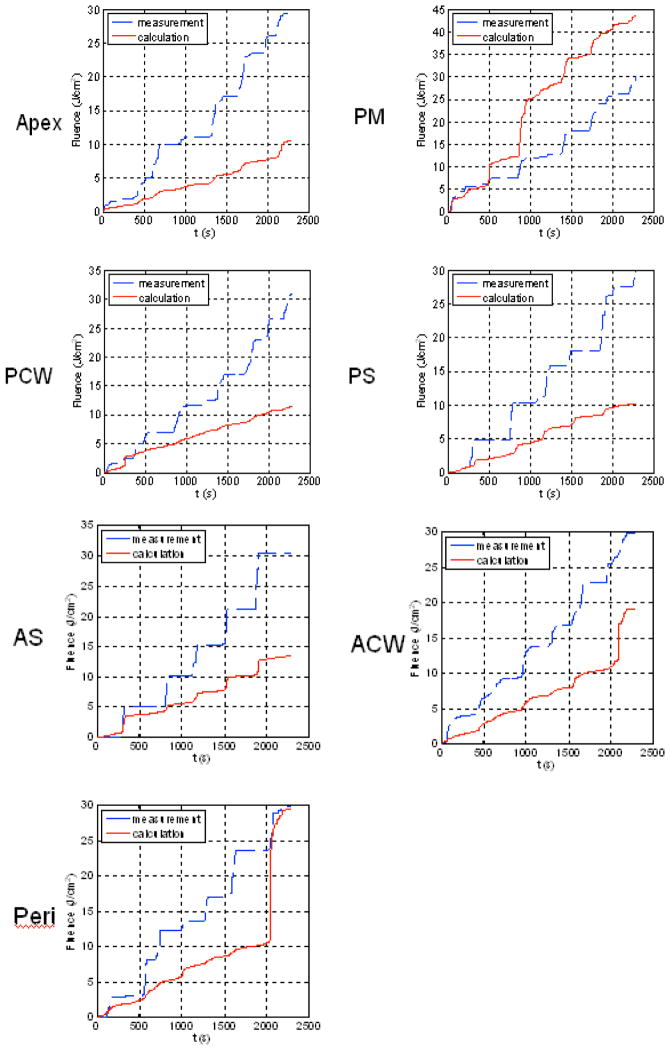
Intrapleural photodynamic therapy (PDT) has been used as an adjuvant treatment with lung-sparing surgical treatment for mesothelioma. In the current intrapleural PDT protocol, a moving fiber-based point source is used to deliver the light and the light dose are monitored by 7 detectors placed in the pleural cavity. To improve the delivery of light dose uniformity, an infrared (IR) camera system is used to track the motion of the light sources. A treatment planning system uses feedback from the detectors as well as the IR camera to update light fluence distribution in real-time, which is used to guide the light source motion for uniform light dose distribution. We have reported previously the success of using IR camera to passively monitor the light fluence rate distribution. In this study, the real-time feedback has been implemented in the current system prototype, by transferring data from the IR camera to a computer at a rate of 20 Hz, and by calculation/displaying using Matlab. A dual-correction method is used in the feedback system, so that fluence calculation can match detector readings. Preliminary data from a phantom showed superior light uniformity using this method. Light fluence uniformity from patient treatments is also shown using the correction method dose model.
胸膜内光动力疗法(PDT)已被用作间皮瘤保肺手术治疗的辅助治疗方法。在当前的胸膜内PDT方案中,基于移动光纤的点光源用于传输光线,光线剂量由放置在胸腔内的7个探测器监测。为了提高光剂量分布的均匀性,使用红外(IR)摄像系统来跟踪光源的运动。治疗计划系统利用探测器以及红外摄像机的反馈实时更新光通量分布,这用于指导光源运动以实现均匀的光剂量分布。我们之前报道了使用红外摄像机被动监测光通量率分布的成功案例。在本研究中,通过以20 Hz的速率将红外摄像机的数据传输到计算机,并使用Matlab进行计算/显示,在当前系统原型中实现了实时反馈。反馈系统中使用了双校正方法,以便通量计算能够与探测器读数匹配。来自模型的初步数据表明使用该方法具有更好的光均匀性。使用校正方法剂量模型也展示了患者治疗中的光通量均匀性。