Symonowicz Beata, Kieruzel Maria, Szczuka Anna, Korczyńska Julita, Wnuk Andrzej, Mazurkiewicz Paweł Jarosław, Chiliński Michał, Godzińska Ewa Joanna
Department of Neurophysiology Laboratory of Ethology, Nencki Institute of Experimental Biology, Pasteur St 3, 02-093 Warsaw, Poland.
Department of Neurophysiology Laboratory of Ethology, Nencki Institute of Experimental Biology, Pasteur St 3, 02-093 Warsaw, Poland ; College of Inter-Faculty Individual Studies in Mathematics and Natural Sciences, University of Warsaw, Żwirki i Wigury St. 93, 02-089 Warsaw, Poland.
J Insect Behav. 2015;28(3):245-256. doi: 10.1007/s10905-015-9496-2. Epub 2015 Apr 2.
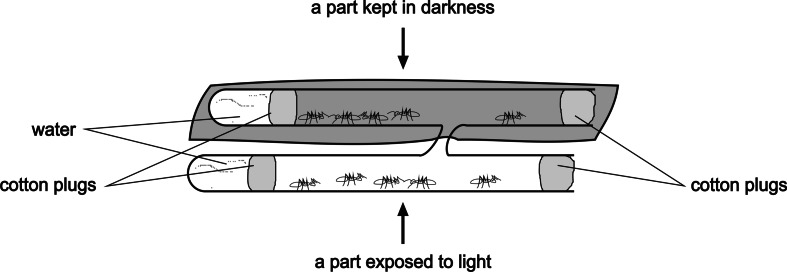
Social insect workers usually start adult life from intranidal tasks and then switch to extranidal activities, but this process may be reversed: foragers may switch again to intranidal brood care. The transition forager - reverted nurse is known as the behavioral reversion. Ant foragers are known to avoid illuminated zones less strongly than intranidal workers, but illumination responses of reverted nurses were so far never investigated. We compared dark-light choice behavior of three classes of workers of the red wood ant : nurses, foragers and reverted nurses. Sets of ten ants belonging to the same class were tested in "double nests" made of two interconnected test tubes, one kept in darkness and the other exposed to light. The number of ants present in the illuminated zone of each nest (n) was recorded on 10 sample points at 30 min intervals. The values of n were lower in nurses than in foragers and reverted nurses and decreased as a function of time in all three groups. Nurses differed from foragers with respect to the dynamics of dark-light choice behavior, but reverted nurses did not differ in that respect either from nurses, or from foragers. Reverted nurses and foragers did not differ significantly from each other with respect to the overall level of avoidance of illuminated zone, nor with respect to the dynamics of dark-light choice behavior. This implies that behavioral reversion is not accompanied by the return of illumination responses of workers of to the state characteristic for nurses.
群居昆虫的工蚁通常从巢内任务开始成年后的生活,然后转向巢外活动,但这个过程可能会逆转:觅食者可能会再次转向巢内照顾幼虫。觅食者转变为抚育蚁的这种转变被称为行为逆转。已知蚂蚁觅食者比巢内工蚁对光照区域的回避程度要弱,但到目前为止,尚未对转变后的抚育蚁的光照反应进行过研究。我们比较了红木蚁三类工蚁(抚育蚁、觅食者和转变后的抚育蚁)在明暗选择行为上的差异。将每组十只属于同一类别的蚂蚁放在由两个相互连接的试管制成的“双巢”中进行测试,一个试管保持黑暗,另一个暴露在光线下。每隔30分钟在10个采样点记录每个巢的光照区域内的蚂蚁数量(n)。抚育蚁的n值低于觅食者和转变后的抚育蚁,并且在所有三组中n值都随时间下降。抚育蚁在明暗选择行为的动态变化方面与觅食者不同,但转变后的抚育蚁在这方面与抚育蚁或觅食者都没有差异。转变后的抚育蚁和觅食者在对光照区域的总体回避程度上,以及在明暗选择行为的动态变化方面,彼此之间没有显著差异。这意味着行为逆转并没有伴随着工蚁的光照反应恢复到抚育蚁特有的状态。