Bai Yu, Gou Maling, Yi Tao, Yang Li, Liu Lili, Lin Xiaojuan, Su Dan, Wei Yuquan, Zhao Xia
1. Department of Gynecology and Obstetrics, Key Laboratory of Obstetric and Gynecologic and Pediatric Diseases and Birth Defects of Ministry of Education, West China Second Hospital, Sichuan University, Chengdu, Sichuan 610041, P.R. China.
2. State Key Laboratory of Biotherapy and Cancer Center, West China Hospital, Sichuan University, Chengdu, Sichuan 610041, P.R. China.
Int J Med Sci. 2015 May 8;12(5):397-406. doi: 10.7150/ijms.10929. eCollection 2015.
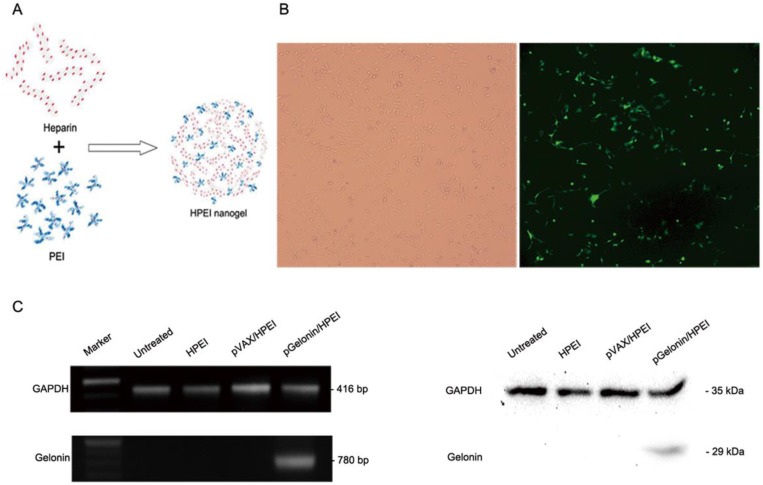
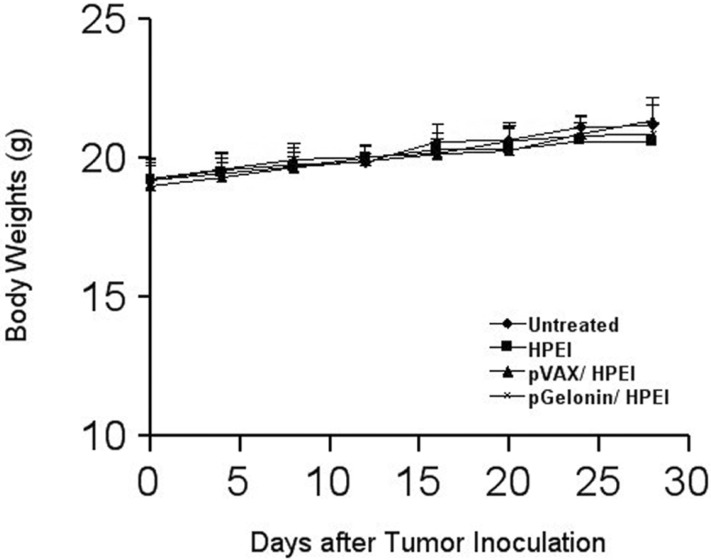
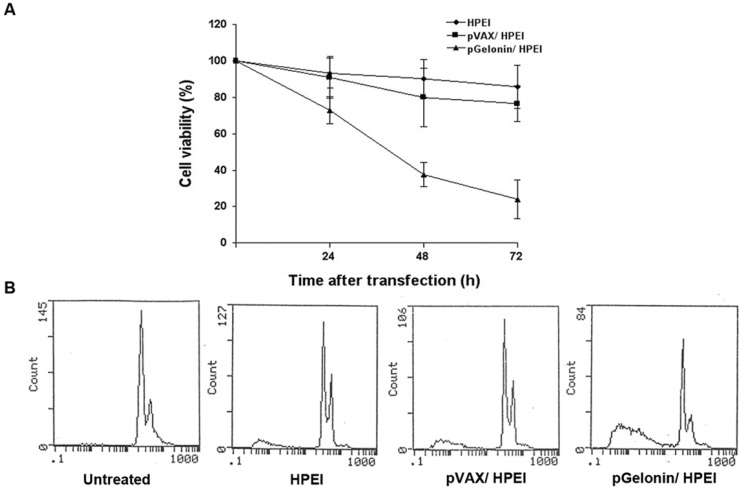
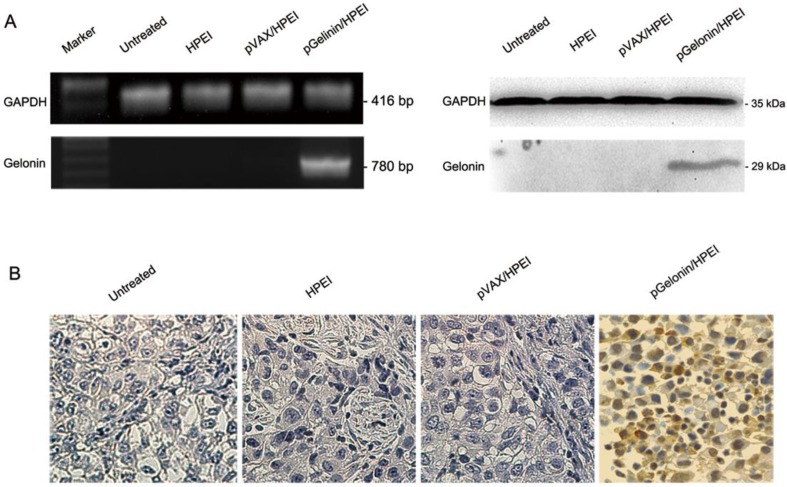
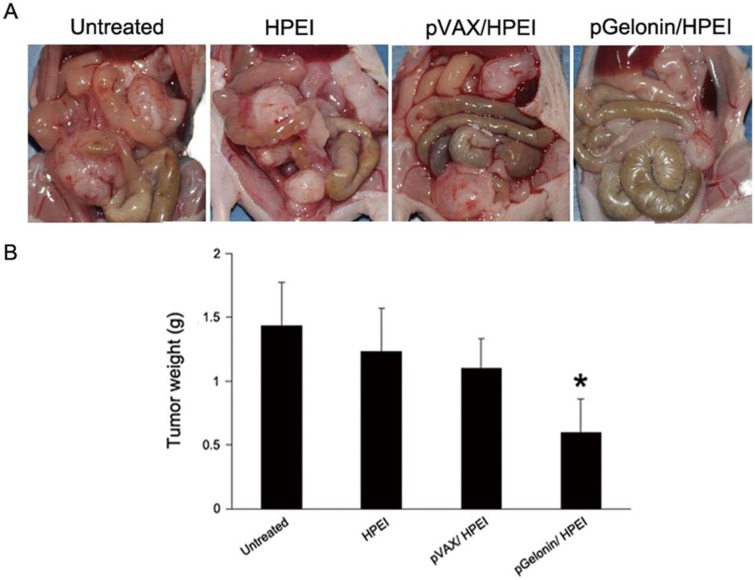
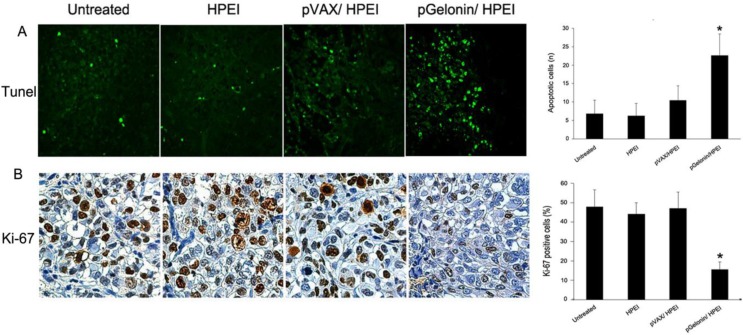
The use of toxins for cancer therapy has great promise. Gelonin, a potent plant toxin, causes cell death by inactivating the 60S ribosomal subunit. Recently, we developed a novel gene delivery system using biodegradable cationic heparin-polyethyleneimine (HPEI) nanogels. In the current study, the antitumor activity of a recombinant plasmid expressing gelonin (pGelonin) on human ovarian cancer was assessed. The application of HPEI nanogels, was also evaluated. Gelonin-cDNA was cloned into the pVAX1 plasmid vector and transfected into SKOV3 human ovarian cancer cells using biodegradable cationic HPEI nanogels. The expression of gelonin in vitro and in vivo was confirmed using RT-PCR and western blot analysis. Cell viability and apoptosis were examined using an MTT assay and flow cytometric analysis. For the in vivo study, an SKOV3 intraperitoneal ovarian carcinomatosis model was established, and nude mice were randomly assigned into four groups receiving i.p. administration of pGelonin/HPEI complexes, pVAX/HPEI complexes, HPEI alone and 5% glucose solution. The tumor weight was monitored, and a TUNEL assay and Ki-67 immunohistochemistry were performed to evaluate apoptosis and cell proliferation in the tumor tissue sections, respectively. Gelonin was efficiently expressed in SKOV3 cancer cells in vitro and in vivo using pGelonin incorporated with HPEI nanogels. The pGelonin/HPEI complexes inhibited cell viability and induced apoptosis in the cell culture. Treatment for intraperitoneal carcinomatosis with pGelonin/HPEI complexes reduced the tumor weight by ~58.55% compared to the control groups (P<0.05). The antitumor effect was accompanied by increased apoptosis and reduced cell proliferation (P<0.05). No significant side effects were observed with i.p. administration of the pGelonin/HPEI complexes. Our data indicate that HPEI nanogel-delivered pGelonin may have promising applications against human ovarian cancer.
使用毒素进行癌症治疗具有巨大潜力。相思豆毒素是一种强效植物毒素,通过使60S核糖体亚基失活导致细胞死亡。最近,我们开发了一种使用可生物降解的阳离子肝素-聚乙烯亚胺(HPEI)纳米凝胶的新型基因递送系统。在本研究中,评估了表达相思豆毒素的重组质粒(pGelonin)对人卵巢癌的抗肿瘤活性。同时也评估了HPEI纳米凝胶的应用。将相思豆毒素-cDNA克隆到pVAX1质粒载体中,并使用可生物降解的阳离子HPEI纳米凝胶转染到SKOV3人卵巢癌细胞中。通过RT-PCR和蛋白质印迹分析确认了相思豆毒素在体外和体内的表达。使用MTT法和流式细胞术分析检测细胞活力和凋亡情况。对于体内研究,建立了SKOV3腹膜内卵巢癌模型,并将裸鼠随机分为四组,分别腹腔注射pGelonin/HPEI复合物、pVAX/HPEI复合物、单独的HPEI和5%葡萄糖溶液。监测肿瘤重量,并分别进行TUNEL检测和Ki-67免疫组织化学分析,以评估肿瘤组织切片中的凋亡和细胞增殖情况。使用与HPEI纳米凝胶结合的pGelonin,相思豆毒素在SKOV3癌细胞中在体外和体内均有效表达。pGelonin/HPEI复合物在细胞培养中抑制细胞活力并诱导凋亡。与对照组相比,用pGelonin/HPEI复合物治疗腹膜内癌可使肿瘤重量减轻约58.55%(P<0.05)。抗肿瘤作用伴随着凋亡增加和细胞增殖减少(P<0.05)。腹腔注射pGelonin/HPEI复合物未观察到明显的副作用。我们的数据表明,HPEI纳米凝胶递送的pGelonin可能在抗人卵巢癌方面具有广阔的应用前景。