Sanada Fumihiro, Taniyama Yoshiaki, Azuma Junya, Yuka Ikeda-Iwabe, Kanbara Yasuhiro, Iwabayashi Masaaki, Rakugi Hiromi, Morishita Ryuichi
Department of Clinical Gene Therapy.
Department of Clinical Gene Therapy ; Department of Geriatric Medicine and Nephrology, Osaka University Graduate School of Medicine, Suita, Osaka 565-0871, Japan.
Immunol Endocr Metab Agents Med Chem. 2014 Apr;14(1):32-39. doi: 10.2174/1871522213999131231105139.
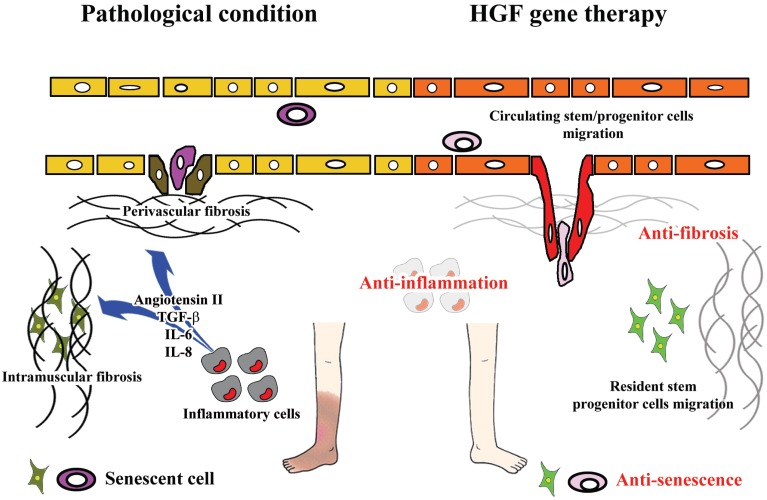
Peripheral artery disease (PAD) is caused by atherosclerosis, hardening and narrowing arteries over time due to buildup of fatty deposit in vascular bed called plaque. Severe blockage of an artery of the lower extremity markedly reduce blood flow, resulting in critical limb ischemia (CLI) manifested by a variety of clinical syndromes including rest pain in the feet or toes, ulcer and gangrene with infection. Despite significant advances in clinical care and interventions for revascularization, patients with CLI remain at high risk for amputation and cardiovascular death. To overcome this unmet need, therapeutic angiogenesis using angiogenic growth factors has evolved in an attempt to increase blood flow in ischemic limb. Initial animal studies and phase I clinical trials with vascular endothelial growth factor (VEGF) or fibroblast growth factor (FGF) demonstrated promising results, inspiring scientists to progress forward. However, more rigorous phase II and III clinical trials have failed to demonstrate beneficial effects of these angiogenic growth factors to date. Recently, two multicenter, double-blind, placebo-controlled clinical trials in Japan (phase III) and US (phase II) demonstrated that hepatocyte growth factor (HGF) gene therapy for CLI significant improved primary end points and tissue oxygenation up to two years in comparison to placebo. These clinical results implicate a distinct action of HGF on cellular processes involved in vascular remodeling under pathological condition. This review presents data from phase I-III clinical trials of therapeutic angiogenesis by gene therapy in patients with PAD. Further, we discuss the potential explanation for the success or failure of clinical trials in the context of the biological mechanisms underlying angiogenesis and vascular remodeling, including cellular senescence, inflammation, and tissue fibrosis.
外周动脉疾病(PAD)是由动脉粥样硬化引起的,随着时间的推移,由于血管床中脂肪沉积物(称为斑块)的积累,动脉会变硬并变窄。下肢动脉的严重堵塞会显著减少血流量,导致严重肢体缺血(CLI),表现为多种临床综合征,包括足部或脚趾静息痛、溃疡和伴有感染的坏疽。尽管在临床护理和血管重建干预方面取得了重大进展,但CLI患者截肢和心血管死亡的风险仍然很高。为了满足这一未被满足的需求,使用血管生成生长因子的治疗性血管生成应运而生,旨在增加缺血肢体的血流量。最初的动物研究以及血管内皮生长因子(VEGF)或成纤维细胞生长因子(FGF)的I期临床试验显示出了有前景的结果,激励科学家们继续前进。然而,迄今为止,更严格的II期和III期临床试验未能证明这些血管生成生长因子的有益效果。最近,日本的两项多中心、双盲、安慰剂对照的III期临床试验和美国的一项II期临床试验表明,与安慰剂相比,肝细胞生长因子(HGF)基因疗法治疗CLI在长达两年的时间里显著改善了主要终点和组织氧合。这些临床结果暗示了HGF在病理条件下对参与血管重塑的细胞过程具有独特作用。本综述展示了PAD患者基因治疗性血管生成的I - III期临床试验数据。此外,我们在血管生成和血管重塑的生物学机制背景下,包括细胞衰老、炎症和组织纤维化,讨论了临床试验成功或失败的潜在原因。