McDonough Caitrin W, McClure Leslie A, Mitchell Braxton D, Gong Yan, Horenstein Richard B, Lewis Joshua P, Field Thalia S, Talbert Robert L, Benavente Oscar R, Johnson Julie A, Shuldiner Alan R
Department of Pharmacotherapy and Translational Research and Center for Pharmacogenomics, College of Pharmacy, University of Florida, Gainesville, FL (C.W.M.D., Y.G., J.A.J.).
Department of Biostatistics, School of Public Health, University of Alabama at Birmingham, AL (L.A.M.C.).
J Am Heart Assoc. 2015 May 27;4(6):e001652. doi: 10.1161/JAHA.114.001652.
The role of the CYP2C19 genotype on clopidogrel efficacy has been studied widely, with data suggesting reduced clopidogrel efficacy in loss-of-function variant carriers taking clopidogrel after percutaneous coronary intervention; however, data are limited regarding the association between CYP2C19 genetic variants and outcomes in stroke patients. We investigated whether CYP2C19 metabolizer status affects the risk of recurrent stroke or major bleeding in subcortical stroke patients taking dual antiplatelet therapy with aspirin and clopidogrel.
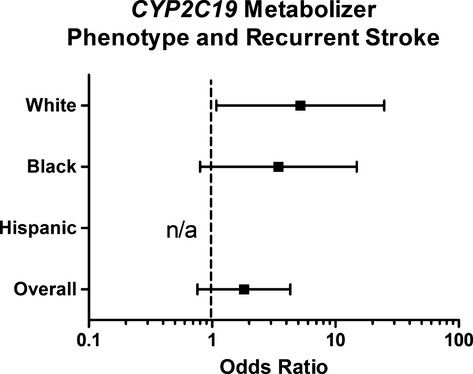
CYP2C192 and CYP2C1917 were genotyped in 522 patients treated with dual antiplatelet therapy from the Secondary Prevention of Small Subcortical Strokes (SPS3) study. CYP2C19 metabolizer status was inferred from genotype, and associations with the risk of recurrent stroke and major bleeding were assessed in the overall cohort and by race/ethnic group with logistic regression modeling. In the overall cohort, there were no differences in outcomes by CYP2C19 metabolizer status (recurrent stroke, odds ratio 1.81 [95% CI 0.76 to 4.30]; major bleeding, odds ratio 0.67 [95% CI 0.22 to 2.03]). In white participants, those with CYP2C19 intermediate or poor metabolizer status had higher odds of recurrent stroke (odds ratio 5.19 [95% CI 1.08 to 24.90]) than those with extensive or ultrarapid metabolizer status, but there was no evidence of difference in major bleeding.
There were significant differences in recurrent stroke by CYP2C19 genotype-inferred metabolizer status in white subcortical stroke patients receiving dual antiplatelet therapy with aspirin and clopidogrel, consistent with cardiovascular studies on CYP2C19 and clopidogrel; however, the bleeding risk that led to early termination of the antiplatelet arm of the SPS3 trial does not appear to be explained by CYP2C19 genotype. This study was relatively underpowered; therefore, these findings should be interpreted with caution and warrant replication.
URL: www.clinicaltrials.gov. Unique identifier: NCT00059306.
CYP2C19基因型对氯吡格雷疗效的影响已得到广泛研究,数据表明,经皮冠状动脉介入治疗后服用氯吡格雷的功能缺失变异携带者中,氯吡格雷疗效降低;然而,关于CYP2C19基因变异与卒中患者预后之间的关联,数据有限。我们调查了CYP2C19代谢状态是否会影响接受阿司匹林和氯吡格雷双重抗血小板治疗的皮质下卒中患者复发性卒中或大出血的风险。
在小规模皮质下卒中二级预防(SPS3)研究中,对522例接受双重抗血小板治疗的患者进行CYP2C192和CYP2C1917基因分型。根据基因型推断CYP2C19代谢状态,并通过逻辑回归模型在整个队列以及按种族/族裔分组中评估其与复发性卒中和大出血风险的关联。在整个队列中,CYP2C19代谢状态与预后无差异(复发性卒中,比值比1.81[95%CI0.76至4.30];大出血,比值比0.67[95%CI0.22至2.03])。在白人参与者中,CYP2C19中间或慢代谢状态者复发性卒中的几率(比值比5.19[95%CI1.08至24.90])高于快或超快代谢状态者,但大出血方面无差异证据。
在接受阿司匹林和氯吡格雷双重抗血小板治疗的白人皮质下卒中患者中,根据CYP2C19基因型推断的代谢状态在复发性卒中方面存在显著差异,这与关于CYP2C19和氯吡格雷的心血管研究一致;然而,导致SPS3试验抗血小板治疗组提前终止的出血风险似乎无法用CYP2C19基因型来解释。本研究的效能相对不足;因此,这些发现应谨慎解读并需要重复验证。