Asgharikhatooni Azam, Bani Soheila, Hasanpoor Shirin, Mohammad Alizade Sakineh, Javadzadeh Yousef
Department of Midwifery, School of Nursing and Midwifery, Aras international branch, Tabriz University of Medical Sciences, Tabriz, IR Iran.
Neuroscience Research Center, Department of Midwifery, School of Nursing and Midwifery, Tabriz University of Medical Sciences, Tabriz, IR Iran.
Iran Red Crescent Med J. 2015 Mar 31;17(3):e25637. doi: 10.5812/ircmj.25637. eCollection 2015 Mar.
Episiotomy, a common surgical practice in midwifery, is accompanied with high levels of pain and discomfort for mothers. The importance of medicinal herbs and traditional medicine in wound healing cannot be neglected.
Considering the positive effects and easy accessibility of Equisetum arvense, this study examined the effectiveness of topical application of Equisetum arvense ointment in wound healing, reduction of inflammation and pain relief after episiotomy in nulliparous mothers.
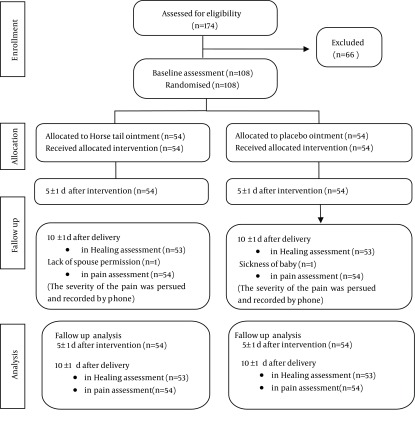
This double-blind clinical trial was performed on 108 postpartum nulliparous mothers (54 women in horsetail group and 54 women in placebo group) in Alzahra Educational-Medical Center (Tabriz, Iran). About 5 ± 1 and 10 ± 1 days after the childbirth, the primary outcomes of episiotomy, i.e. wound healing and pain intensity, were assessed based on redness, edema, ecchymosis, discharge and approximation of the edges (REEDA) scale and a visual analogue scale (VAS), respectively. The secondary outcomes evaluated in the current research were the number of used painkillers and the adverse events during the 10-day period of the study. Data was analyzed using independent t and Mann-Whitney U tests.
The case and control groups had no significant differences in for the mean wound healing score (5.0 ± 1.6 vs. 4.1 ± 1.6) and mean pain intensity (5.7 ± 2.4 vs. 5.3 ± 2.2) at baseline. During both follow-up sessions (5 ± 1 and 10 ± 1days after delivery), the mean scores were significantly lower in the case group than the control group. The adjusted pain score difference (MD) after 5 ± 1 and 10 ± 1 days was -2.3 (95% CI: -3.2 to -1.3) and 3.8 (95% CI: -4.7 to -3.0), respectively. The mean numbers of acetaminophen pills used in the control and case groups during the 10-day period of the study were 6.8 ± 4.4 and 11.6 ± 7.1, respectively (P < 0.001).
According to our findings, 3% Equisetum arvense ointment promoted wound healing and relieved pain during the 10-day period after episiotomy. Since this study was the first to assess the effects of Equisetum arvense ointment on wound healing and pain intensity following episiotomy in humans, further research is warranted to fully clarify the beneficial effects of prepared ointment.
会阴切开术是助产术中一种常见的外科手术,会给产妇带来高度的疼痛和不适。草药和传统医学在伤口愈合中的重要性不可忽视。
鉴于问荆的积极作用和易于获取,本研究探讨了外用问荆软膏对初产妇会阴切开术后伤口愈合、减轻炎症和缓解疼痛的有效性。
本双盲临床试验在阿尔扎赫拉教育医疗中心(伊朗大不里士)对108名产后初产妇进行(马尾草组54名妇女,安慰剂组54名妇女)。分娩后约5±1天和10±1天,分别根据发红、水肿、瘀斑、分泌物和边缘接近程度(REEDA)量表及视觉模拟量表(VAS)评估会阴切开术的主要结局,即伤口愈合和疼痛强度。本研究评估的次要结局是研究10天期间使用止痛药的数量和不良事件。数据采用独立t检验和曼-惠特尼U检验进行分析。
病例组和对照组在基线时的平均伤口愈合评分(5.0±1.6对4.1±1.6)和平均疼痛强度(5.7±2.4对5.3±2.2)无显著差异。在两次随访期间(分娩后5±1天和10±1天),病例组的平均评分均显著低于对照组。5±1天和10±1天后调整后的疼痛评分差异(MD)分别为-2.3(95%CI:-3.2至-1.3)和-3.8(95%CI:-4.7至-3.0)。在研究的10天期间对照组和病例组使用对乙酰氨基酚片的平均数量分别为6.8±4.4和11.6±7.1(P<0.001)。
根据我们的研究结果,3%问荆软膏在会阴切开术后10天内促进了伤口愈合并减轻了疼痛强度。由于本研究是首次评估问荆软膏对人类会阴切开术后伤口愈合和疼痛强度的影响,因此有必要进行进一步研究以充分阐明制备软膏的有益效果。