Zheng Yi-Zi, Wang Lei, Hu Xin, Shao Zhi-Ming
Department of Breast Surgery, Key Laboratory of Breast Cancer in Shanghai, Fudan University Shanghai Cancer Center, Fudan University, Shanghai, China.
Department of Oncology, Shanghai Medical College, Fudan University, Shanghai, China.
Oncotarget. 2015 Sep 8;6(26):22985-95. doi: 10.18632/oncotarget.3945.
BACKGROUND & AIMS: The prognostic value of tumor size is variable. We aimed to characterize the interaction between tumor size and hormone receptor (HoR) status to determine breast cancer-specific mortality (BCSM).
We used the Surveillance, Epidemiology and End Results (SEER) registry to identify 328, 870 female patients diagnosed with invasive breast cancer from 1990 through 2010. Primary study variables included tumor size, joint HoR status and their corresponding relationship. Kaplan-Meier and adjusted Cox proportional hazards models with interaction terms were utilized.
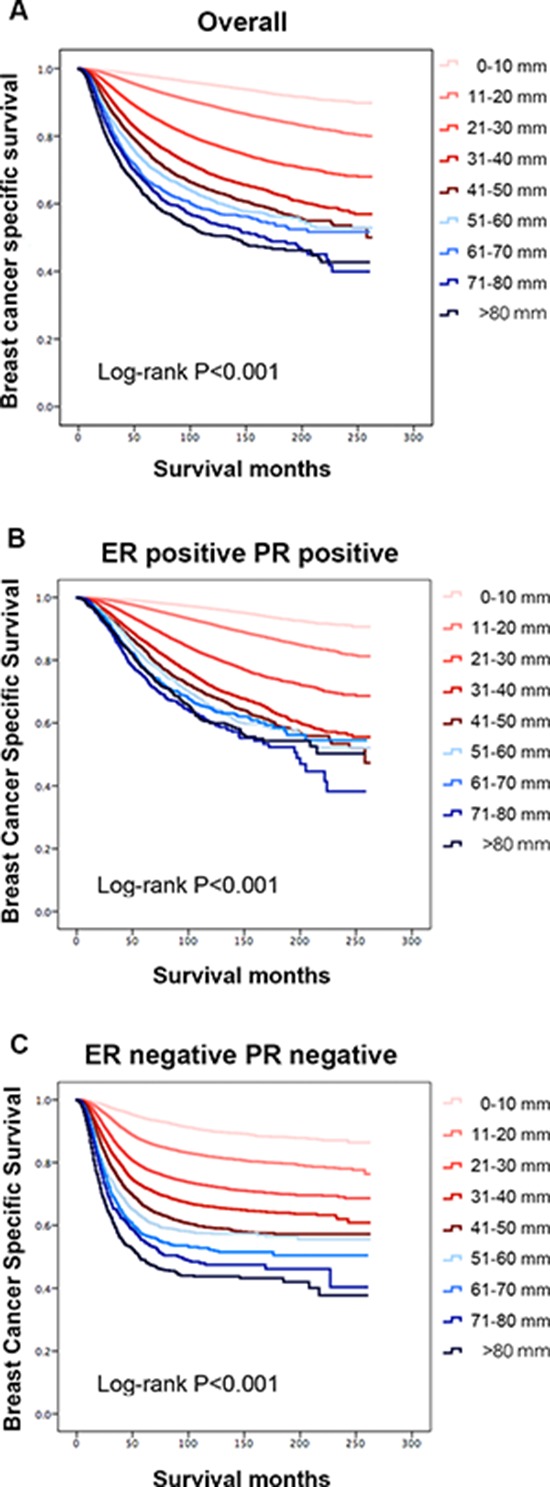
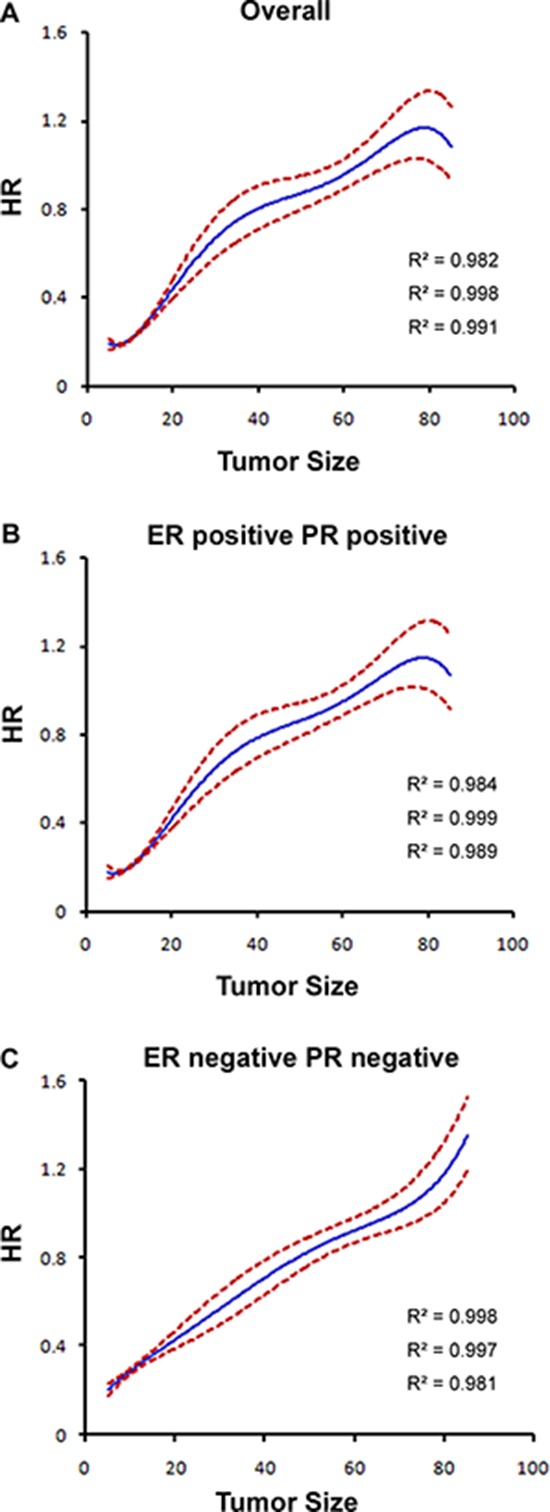
The multivariable analysis revealed a significant interaction between tumor size and HoR status (P < 0.001). Using tumors 61-70 mm in size as the reference for estrogen receptor-negative (ER-) and progesterone receptor-negative (PR-) disease, the hazard ratio (HR) for BCSM increased with increasing tumor size across nearly all categories. In the ER-positive (ER+) and PR-positive (PR+) group, however, patients with tumors > 50 mm had nearly identical BCSM rates (P = 0.127, P = 0.099 and P = 0.370 for 51-60 mm, 71-80 mm and > 80 mm tumors, respectively), whereas BCSM was positively correlated with tumors < 51 mm.
The observation of identical HRs for BCSM among patients with ER+ and PR+ tumors >50 mm underscores the importance of individualized treatment. Our findings may contribute to a better understanding of breast cancer biology.
肿瘤大小的预后价值存在差异。我们旨在描述肿瘤大小与激素受体(HoR)状态之间的相互作用,以确定乳腺癌特异性死亡率(BCSM)。
我们使用监测、流行病学和最终结果(SEER)登记处的数据,识别出1990年至2010年间被诊断为浸润性乳腺癌的328870名女性患者。主要研究变量包括肿瘤大小、联合HoR状态及其相应关系。采用Kaplan-Meier法和带有交互项的校正Cox比例风险模型。
多变量分析显示肿瘤大小与HoR状态之间存在显著交互作用(P < 0.001)。以61 - 70mm大小的肿瘤作为雌激素受体阴性(ER-)和孕激素受体阴性(PR-)疾病的参考,几乎所有类别中,BCSM的风险比(HR)均随肿瘤大小增加而升高。然而,在雌激素受体阳性(ER+)和孕激素受体阳性(PR+)组中,肿瘤>50mm的患者BCSM率几乎相同(51 - 60mm、71 - 80mm和>80mm肿瘤的P值分别为0.127、0.099和0.370),而BCSM与<51mm的肿瘤呈正相关。
ER+和PR+且肿瘤>50mm的患者中BCSM的HR相同,这一观察结果强调了个体化治疗的重要性。我们的发现可能有助于更好地理解乳腺癌生物学。