
血浆蛋白质组学特征作为急性冠状动脉综合征早期诊断的战略工具。
The plasma proteomic signature as a strategic tool for early diagnosis of acute coronary syndrome.
作者信息
Laborde Carlos M, Alonso-Orgaz Sergio, Mourino-Alvarez Laura, Moreu José, Vivanco Fernando, Padial Luis R, Barderas María G
机构信息
Laboratory of Vascular Physiopathology, Hospital Nacional de Parapléjicos, SESCAM, Toledo, Spain.
Department of Hemodynamic, Hospital Virgen de la Salud, SESCAM, Toledo, Spain.
出版信息
Proteome Sci. 2014 Oct 10;12:43. doi: 10.1186/1477-5956-12-43. eCollection 2014.
BACKGROUND
Acute coronary syndrome is the major cause of death in developed countries. Despite its high prevalence, there is still a strong need for new biomarkers which permit faster and more accurate diagnostics and new therapeutic drugs. The basis for this challenge lay in improving our understanding of the whole atherosclerotic process from atherogenesis to atherothrombosis. In this study, we conducted two different proteomic analyses of peripheral blood plasma from non-ST elevation acute coronary syndrome and ST elevation acute coronary syndrome patients vs healthy controls.
RESULTS
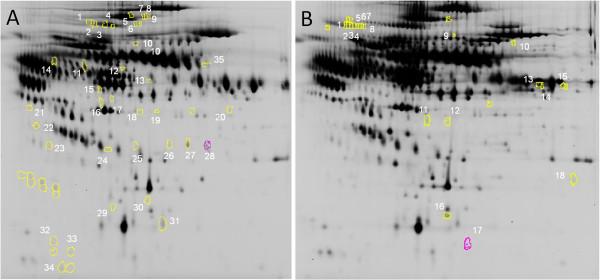
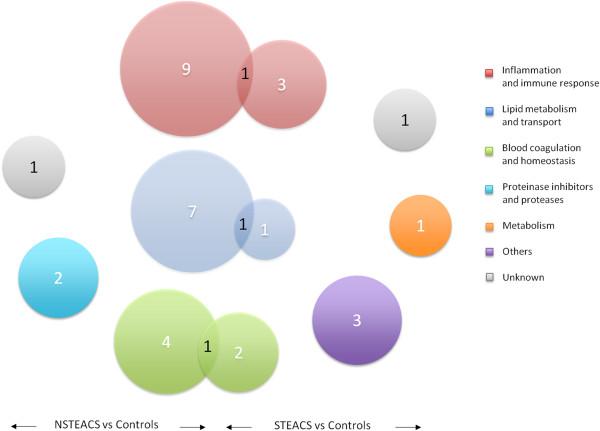
Two-dimensional Fluorescence Difference in Gel Electrophoresis and mass spectrometry permitted the identification of 31 proteins with statistical differences (p < 0.05) between experimental groups. Additionally, validation by Western blot and Selected Reaction Monitoring permitted us to confirm the identification of a different and characteristic plasma proteomic signature for NSTEACS and STEACS patients.
CONCLUSIONS
We purpose the severity of hypoxia as the cornerstone for explaining the differences observed between both groups.
背景
急性冠状动脉综合征是发达国家主要的死亡原因。尽管其发病率很高,但仍然迫切需要能够实现更快、更准确诊断的新型生物标志物以及新型治疗药物。这一挑战的基础在于加深我们对从动脉粥样硬化形成到动脉粥样硬化血栓形成的整个动脉粥样硬化过程的理解。在本研究中,我们对非ST段抬高型急性冠状动脉综合征和ST段抬高型急性冠状动脉综合征患者与健康对照者的外周血血浆进行了两种不同的蛋白质组学分析。
结果
二维荧光差异凝胶电泳和质谱分析能够鉴定出实验组之间具有统计学差异(p < 0.05)的31种蛋白质。此外,通过蛋白质印迹法和选择反应监测进行的验证使我们能够确认非ST段抬高型急性冠状动脉综合征和ST段抬高型急性冠状动脉综合征患者不同的特征性血浆蛋白质组学特征。
结论
我们认为缺氧的严重程度是解释两组之间观察到的差异的基石。




 Zotero 插件