Walenkamp Monique M J, de Muinck Keizer Robert-Jan, Goslings J Carel, Vos Lara M, Rosenwasser Melvin P, Schep Niels W L
Academic Medical Centre, University of Amsterdam, Meibergdreef 9, 1105 AZ, Amsterdam, The Netherlands,
Clin Orthop Relat Res. 2015 Oct;473(10):3235-41. doi: 10.1007/s11999-015-4376-9. Epub 2015 Jun 4.
The Patient-rated Wrist Evaluation (PRWE) is a commonly used instrument in upper extremity surgery and in research. However, to recognize a treatment effect expressed as a change in PRWE, it is important to be aware of the minimum clinically important difference (MCID) and the minimum detectable change (MDC). The MCID of an outcome tool like the PRWE is defined as the smallest change in a score that is likely to be appreciated by a patient as an important change, while the MDC is defined as the smallest amount of change that can be detected by an outcome measure. A numerical change in score that is less than the MCID, even when statistically significant, does not represent a true clinically relevant change. To our knowledge, the MCID and MDC of the PRWE have not been determined in patients with distal radius fractures.
QUESTIONS/PURPOSES: We asked: (1) What is the MCID of the PRWE score for patients with distal radius fractures? (2) What is the MDC of the PRWE?
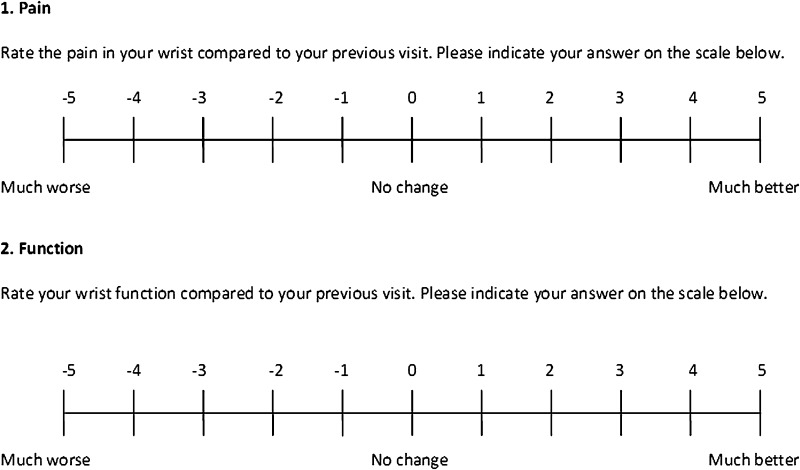
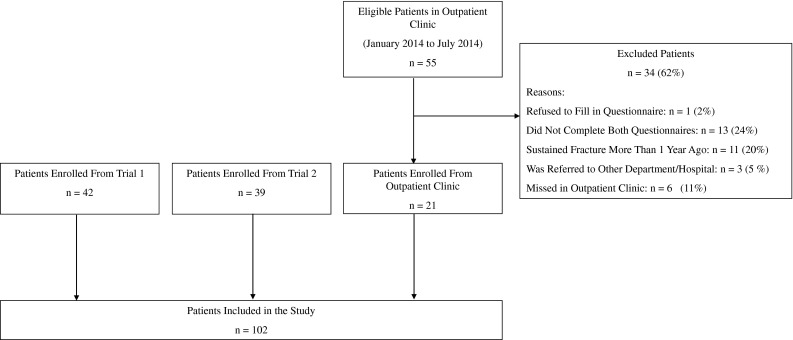
Our prospective cohort study included 102 patients with a distal radius fracture and a median age of 59 years (interquartile range [IQR], 48-66 years). All patients completed the PRWE questionnaire during each of two separate visits. At the second visit, patients were asked to indicate the degree of clinical change they appreciated since the previous visit. Accordingly, patients were categorized in two groups: (1) minimally improved or (2) no change. The groups were used to anchor the changes observed in the PRWE score to patients' perspectives of what was clinically important. We determined the MCID using an anchor-based receiver operator characteristic method. In this context, the change in the PRWE score was considered a diagnostic test, and the anchor (minimally improved or no change as noted by the patients from visit to visit) was the gold standard. The optimal receiver operator characteristic cutoff point calculated with the Youden index reflected the value of the MCID.
In our study, the MCID of the PRWE was 11.5 points. The area under the curve was 0.54 (95% CI, 0.37-0.70) for the pain subscale and 0.71 (95% CI, 0.57-0.85) for the function subscale. We determined the MDC to be 11.0 points.
We determined the MCID of the PRWE score for patients with distal radius fractures using the anchor-based approach and verified that the MDC of the PRWE was sufficiently small to detect our MCID.
We recommend using an improvement on the PRWE of more than 11.5 points as the smallest clinically relevant difference when evaluating the effects of treatments and when performing sample-size calculations on studies of distal radius fractures.
患者自评腕关节评估(PRWE)是上肢外科手术及研究中常用的工具。然而,要识别以PRWE变化表示的治疗效果,了解最小临床重要差异(MCID)和最小可检测变化(MDC)很重要。像PRWE这样的结局工具的MCID被定义为分数上的最小变化,这种变化很可能被患者视为重要变化,而MDC被定义为结局测量能够检测到的最小变化量。分数上小于MCID的数值变化,即使具有统计学意义,也不代表真正的临床相关变化。据我们所知,PRWE在桡骨远端骨折患者中的MCID和MDC尚未确定。
问题/目的:我们提出以下问题:(1)桡骨远端骨折患者PRWE评分的MCID是多少?(2)PRWE的MDC是多少?
我们的前瞻性队列研究纳入了102例桡骨远端骨折患者,中位年龄59岁(四分位间距[IQR],48 - 66岁)。所有患者在两次单独就诊时均完成了PRWE问卷。在第二次就诊时,要求患者指出自上次就诊以来他们所感受到的临床变化程度。据此,患者被分为两组:(1)改善轻微或(2)无变化。这些组用于将PRWE评分中观察到的变化与患者对临床重要性的看法联系起来。我们使用基于锚定的受试者工作特征方法确定MCID。在此背景下,PRWE评分的变化被视为一项诊断测试,而锚定(患者每次就诊时指出的改善轻微或无变化)为金标准。用约登指数计算的最佳受试者工作特征截断点反映了MCID的值。
在我们的研究中,PRWE的MCID为11.5分。疼痛子量表的曲线下面积为0.54(95%CI,0.37 - 0.70),功能子量表的曲线下面积为0.71(95%CI,0.57 - 0.85)。我们确定MDC为11.0分。
我们使用基于锚定的方法确定了桡骨远端骨折患者PRWE评分的MCID,并验证了PRWE的MDC足够小以检测我们确定的MCID。
我们建议在评估治疗效果以及对桡骨远端骨折研究进行样本量计算时,将PRWE改善超过11.5分作为最小的临床相关差异。