Glykos Vasileios, Whittington Miles A, LeBeau Fiona E N
Institute of Neuroscience, Newcastle University, Medical School, Framlington Place, Newcastle-upon-Tyne, NE2 4HH, UK.
York-Hull Medical School, F1- Department of Biology, York University, Heslington, YO10 5DD, UK.
J Physiol. 2015 Aug 15;593(16):3597-615. doi: 10.1113/JP270811. Epub 2015 Jun 30.
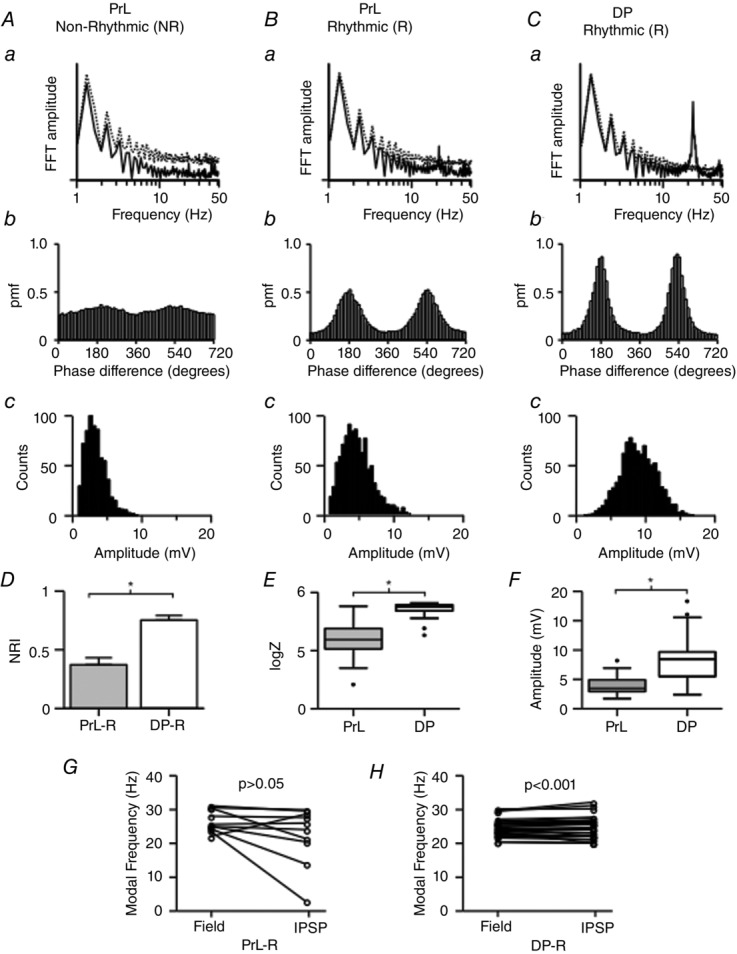
Fast network oscillations in the beta (20-30 Hz) frequency range can be evoked with combined activation of muscarinic and kainate receptors in different subregions of the medial prefrontal cortex (mPFC). Subregional differences were observed as the oscillations in the dorsal prelimbic cortex (PrL) were smaller in magnitude than those in the ventral dorsopeduncular (DP) region, and these differences persisted in trimmed slices containing only PrL and DP regions. Oscillations in both regions were dependent upon GABAA and AMPA receptor activation but NMDA receptor blockade decreased oscillations only in the DP region. Subregional differences in neuronal properties of the presumed pyramidal cells were found between PrL and DP, with many more cells in DP firing rhythmically compared to the PrL region. Presumed inhibitory synaptic potentials (IPSPs) recorded from principal cells were more rhythmic and coherent, and significantly larger in amplitude, in the DP region; the data suggest that variation in the patterns of activity between subregions may reflect distinct functional roles.
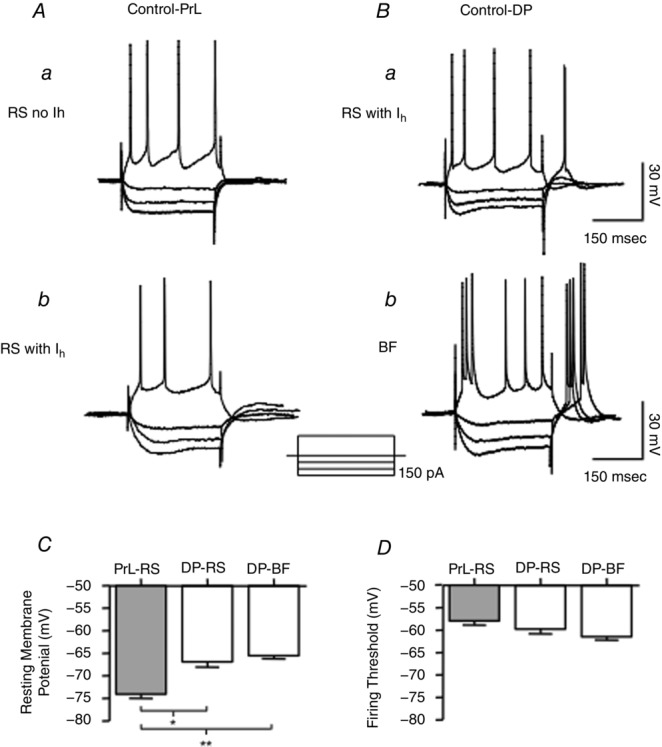
Fast network oscillations in the beta (20-30 Hz) and low gamma (30-80 Hz) range underlie higher cognitive functions associated with the medial prefrontal cortex (mPFC) including attention and working memory. Using a combination of kainate (KA, 200 nm) and the cholinergic agonist carbachol (Cb, 10 μm) fast network oscillations, in the beta frequency range, were evoked in the rat mPFC in vitro. Oscillations were elicited in the prelimbic (PrL), infralimbic (IL) and the dorsopeduncular (DP) cortex, with the largest oscillations observed in DP cortex. Oscillations in both the PrL and DP were dependent, with slightly different sensitivities, on γ-aminobutyric acid (GABA)A , α-amino-3-hydroxy-5-methyl-4-isoxazolepropionic acid (AMPA) and kainate receptors, but only oscillations in the DP were significantly reduced by N-methyl-d-aspartate (NMDA) receptor blockade. Intracellular recordings showed that 9/20 regular spiking (RS) cells in the PrL exhibited a notable cAMP-dependent hyperpolarisation activated current (Ih ) in contrast to 16/17 in the DP cortex. Extracellular single unit recordings showed that the majority of cells in the PrL, and DP regions had interspike firing frequencies (IFFs) at beta (20-30 Hz) frequencies and fired at the peak negativity of the field oscillation. Recordings in DP revealed presumed inhibitory postsynaptic potentials (IPSPs) that were larger in amplitude and more rhythmic than those in the PrL region. Our data suggest that each PFC subregion may be capable of generating distinct patterns of network activity with different cell types involved. Variation in the properties of oscillations evoked in the PrL and DP probably reflects the distinct functional roles of these different PFC regions.

在内侧前额叶皮质(mPFC)的不同亚区域,毒蕈碱受体和红藻氨酸受体联合激活可诱发β(20 - 30Hz)频率范围内的快速网络振荡。观察到亚区域差异,即背侧前边缘皮质(PrL)中的振荡幅度小于腹侧背脚核(DP)区域中的振荡幅度,并且这些差异在仅包含PrL和DP区域的修剪切片中仍然存在。两个区域的振荡均依赖于GABAA和AMPA受体激活,但NMDA受体阻断仅使DP区域的振荡减少。在PrL和DP之间发现了假定锥体细胞的神经元特性存在亚区域差异,与PrL区域相比,DP中有更多细胞有节律地放电。从主要细胞记录的假定抑制性突触后电位(IPSPs)在DP区域更有节律且连贯,并且幅度明显更大;数据表明亚区域之间活动模式的变化可能反映了不同的功能作用。
β(20 - 30Hz)和低γ(30 - 80Hz)范围内的快速网络振荡是与内侧前额叶皮质(mPFC)相关的高级认知功能(包括注意力和工作记忆)的基础。使用红藻氨酸(KA,200nm)和胆碱能激动剂卡巴胆碱(Cb,10μm)的组合,在体外大鼠mPFC中诱发了β频率范围内的快速网络振荡。在前边缘(PrL)、下边缘(IL)和背脚核(DP)皮质中诱发了振荡,在DP皮质中观察到的振荡最大。PrL和DP中的振荡均依赖于γ-氨基丁酸(GABA)A、α-氨基-3-羟基-5-甲基-4-异恶唑丙酸(AMPA)和红藻氨酸受体,敏感性略有不同,但只有DP中的振荡被N-甲基-D-天冬氨酸(NMDA)受体阻断显著降低。细胞内记录显示,PrL中的20个规则放电(RS)细胞中有9个表现出明显的环磷酸腺苷(cAMP)依赖性超极化激活电流(Ih),而DP皮质中的17个细胞中有16个表现出该电流。细胞外单单位记录显示,PrL和DP区域中的大多数细胞在β(20 - 30Hz)频率下有峰间放电频率(IFFs),并在场振荡的负峰值处放电。DP中的记录显示假定的抑制性突触后电位(IPSPs)幅度比PrL区域中的更大且更有节律。我们的数据表明,每个PFC亚区域可能能够产生不同的网络活动模式,涉及不同的细胞类型。PrL和DP中诱发的振荡特性的变化可能反映了这些不同PFC区域的不同功能作用。