Thibaut Jean-Pierre, Witt Arnaud
LEAD-Centre National de la Recherche Scientifique UMR-5022, Université de Bourgogne Dijon, France.
Front Psychol. 2015 May 19;6:643. doi: 10.3389/fpsyg.2015.00643. eCollection 2015.
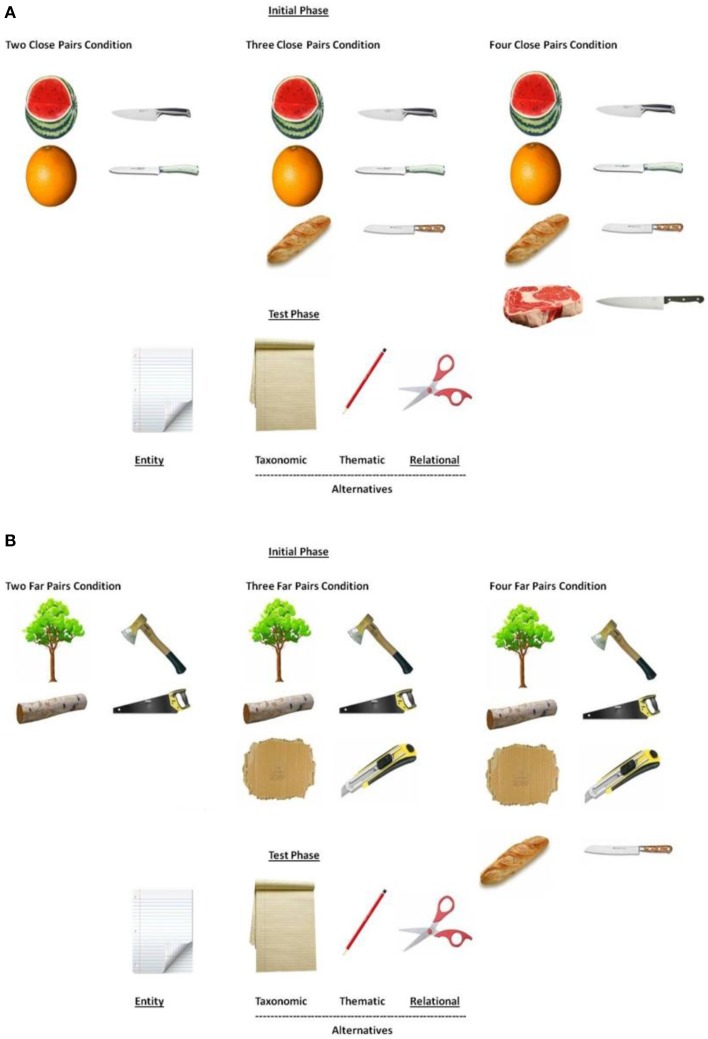
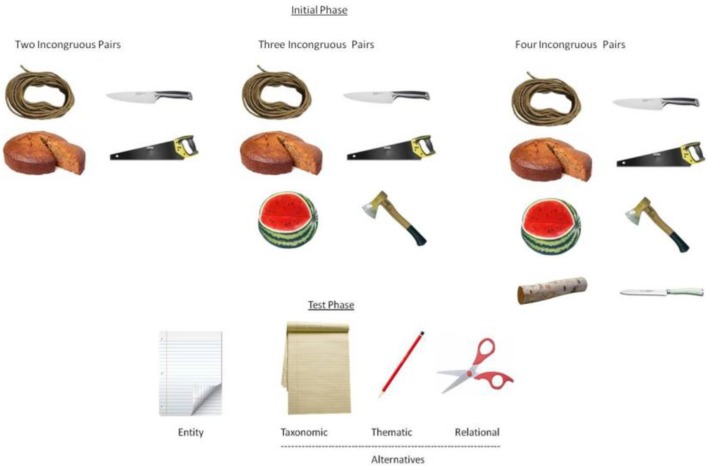
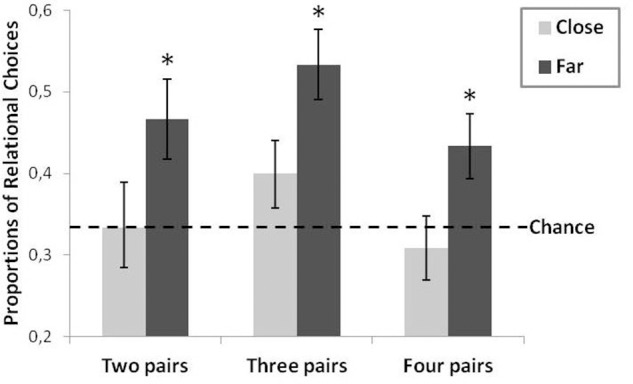
Relational categories are notoriously difficult to learn because they are not defined by intrinsic stable properties. We studied the impact of comparisons on relational concept learning with a novel word learning task in 42-month-old children. Capitalizing on Gentner et al. (2011), two, three or four pairs of stimuli were introduced with a novel relational word. In a given trial, the set of pairs was composed of either close or far pairs (e.g., close pair: knife1-watermelon, knife2-orange, knife3-slice of bread and knife4-meat; far pair: ax-evergreen tree, saw-log, cutter-cardboard, and knife-slice of bread, for the "cutter for" relation). Close pairs (2 vs. 3 vs. 4 pairs) led to random generalizations whereas comparisons with far pairs gave the expected relational generalization. The 3 pair case gave the best results. It is argued that far pairs promote deeper comparisons than close pairs. As shown by a control experiment, this was the case only when far pairs display well known associations.
关系类别 notoriously 难以学习,因为它们不是由内在的稳定属性定义的。我们用一项针对42个月大儿童的新颖单词学习任务研究了比较对关系概念学习的影响。借鉴Gentner等人(2011年)的研究,用一个新颖的关系词引入了两对、三对或四对刺激。在给定的试验中,这组对子由近对子或远对子组成(例如,近对子:刀1 - 西瓜、刀2 - 橙子、刀3 - 面包片和刀4 - 肉;远对子:斧头 - 常青树、锯子 - 原木、切割器 - 硬纸板,以及刀 - 面包片,用于“用于……的切割工具”关系)。近对子(2对与3对与4对)导致随机泛化,而与远对子的比较则产生了预期的关系泛化。3对的情况产生了最佳结果。有人认为,远对子比近对子促进更深入的比较。如一项对照实验所示,只有当远对子显示出众所周知的关联时才是这种情况。