Plant Dominic T, Pariante Carmine M, Sharp Deborah, Pawlby Susan
Dominic T. Plant, PhD, Department of Psychological Medicine, Institute of Psychiatry, Psychology & Neuroscience, King's College London, UK; Carmine M. Pariante, MD, FRCPsych, PhD, Department of Psychological Medicine, Institute of Psychiatry, Psychology & Neuroscience, King's College London, UK; Deborah Sharp, MA, FRCGP, PhD, School of Social and Community Medicine, University of Bristol, UK; Susan Pawlby, MA, PhD, CPsychol, Department of Psychological Medicine, Institute of Psychiatry, Psychology & Neuroscience, King's College London, UK
Dominic T. Plant, PhD, Department of Psychological Medicine, Institute of Psychiatry, Psychology & Neuroscience, King's College London, UK; Carmine M. Pariante, MD, FRCPsych, PhD, Department of Psychological Medicine, Institute of Psychiatry, Psychology & Neuroscience, King's College London, UK; Deborah Sharp, MA, FRCGP, PhD, School of Social and Community Medicine, University of Bristol, UK; Susan Pawlby, MA, PhD, CPsychol, Department of Psychological Medicine, Institute of Psychiatry, Psychology & Neuroscience, King's College London, UK.
Br J Psychiatry. 2015 Sep;207(3):213-20. doi: 10.1192/bjp.bp.114.156620. Epub 2015 Jun 4.
Studies have shown that maternal depression during pregnancy predicts offspring depression in adolescence. Child maltreatment is also a risk factor for depression.
To investigate (a) whether there is an association between offspring exposure to maternal depression in pregnancy and depression in early adulthood, and (b) whether offspring child maltreatment mediates this association.
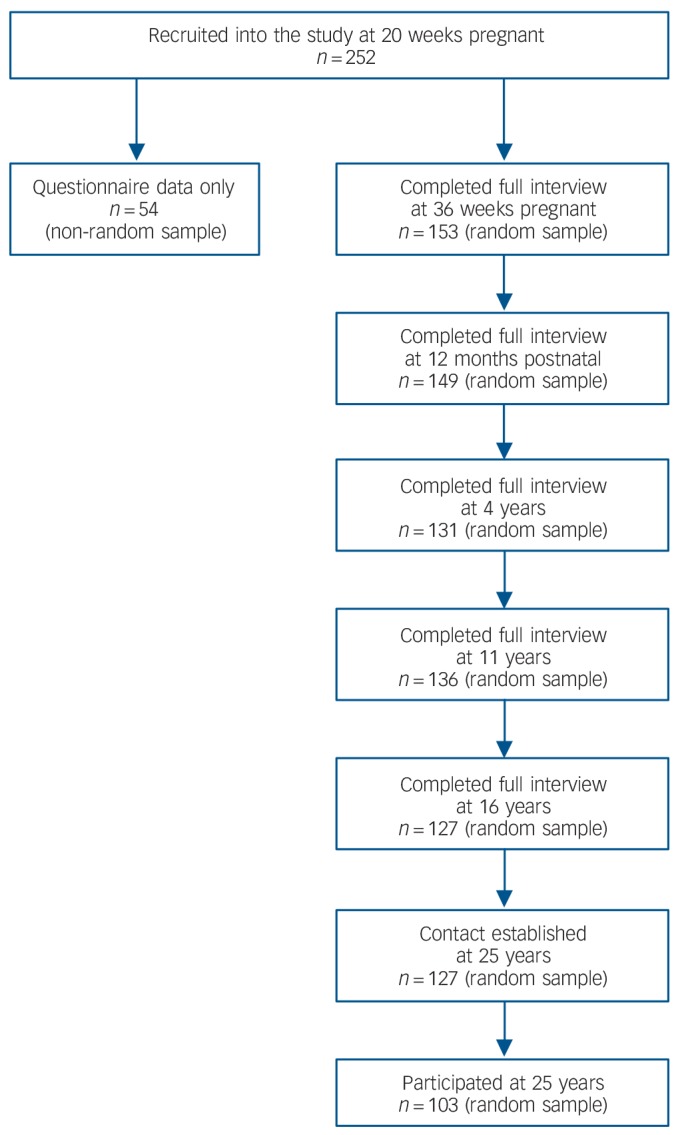
Prospectively collected data on maternal clinical depression in pregnancy, offspring child maltreatment and offspring adulthood (18-25 years) DSM-IV depression were analysed in 103 mother-offspring dyads of the South London Child Development Study.
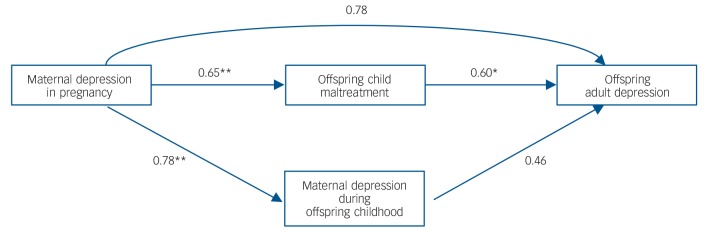
Adult offspring exposed to maternal depression in pregnancy were 3.4 times more likely to have a DSM-IV depressive disorder, and 2.4 times more likely to have experienced child maltreatment, compared with non-exposed offspring. Path analysis revealed that offspring experience of child maltreatment mediated the association between exposure to maternal depression in pregnancy and depression in adulthood.
Maternal depression in pregnancy is a key vulnerability factor for offspring depression in early adulthood.
研究表明,孕期母亲抑郁可预测子代青春期抑郁。儿童期受虐待也是抑郁的一个风险因素。
调查(a)孕期子代暴露于母亲抑郁与成年早期抑郁之间是否存在关联,以及(b)子代受虐待是否介导了这种关联。
对南伦敦儿童发展研究中103对母婴的数据进行前瞻性分析,这些数据包括孕期母亲临床抑郁情况、子代受虐待情况以及子代成年期(18 - 25岁)的DSM - IV抑郁情况。
与未暴露的子代相比,孕期暴露于母亲抑郁的成年子代患DSM - IV抑郁障碍的可能性高3.4倍,经历儿童期受虐待的可能性高2.4倍。路径分析显示,子代受虐待经历介导了孕期暴露于母亲抑郁与成年期抑郁之间的关联。
孕期母亲抑郁是子代成年早期抑郁的一个关键易感性因素。