Singh Ritu, Hassan Md Imtaiyaz, Islam Asimul, Ahmad Faizan
Centre for Interdisciplinary Research in Basic Sciences, Jamia Millia Islamia, New Delhi, India.
PLoS One. 2015 Jun 5;10(6):e0128740. doi: 10.1371/journal.pone.0128740. eCollection 2015.
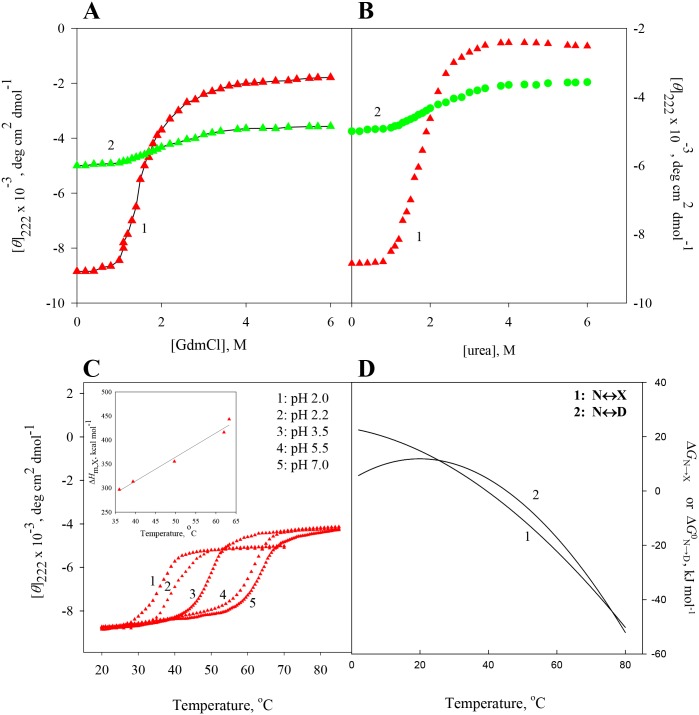
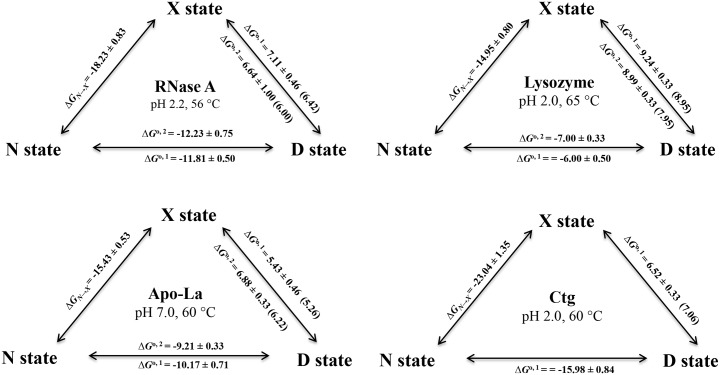
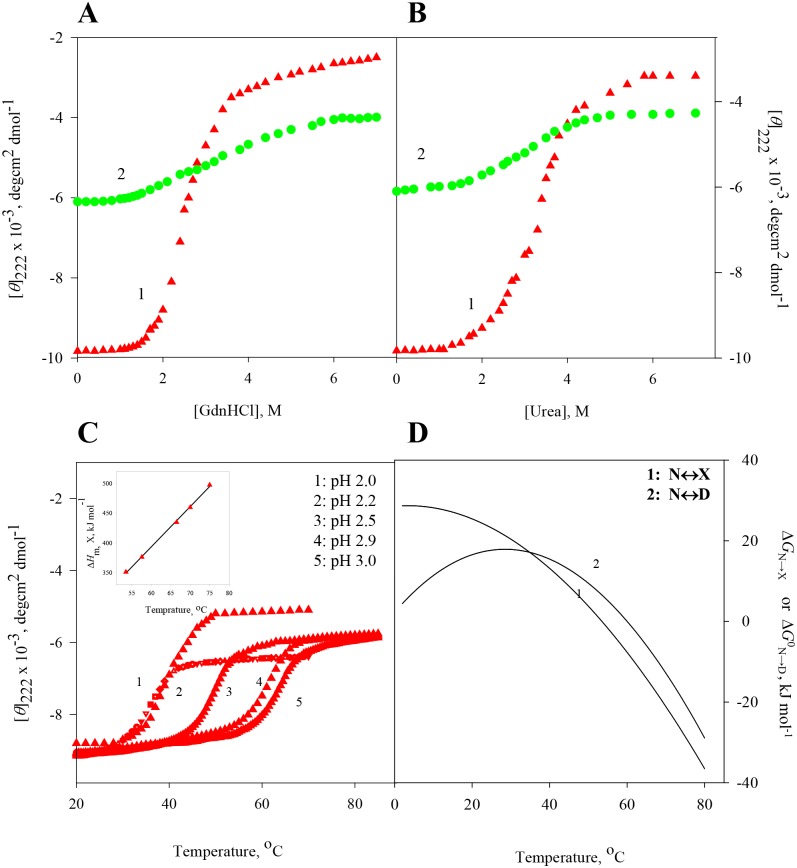
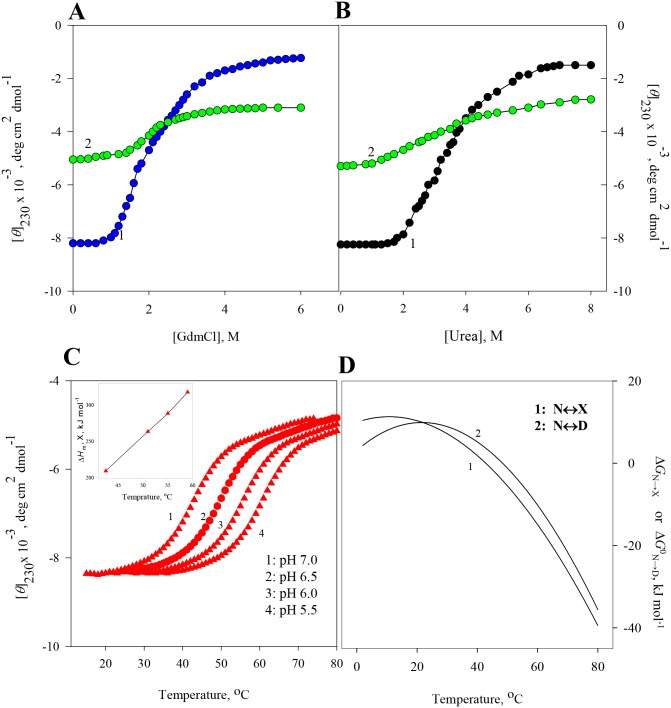
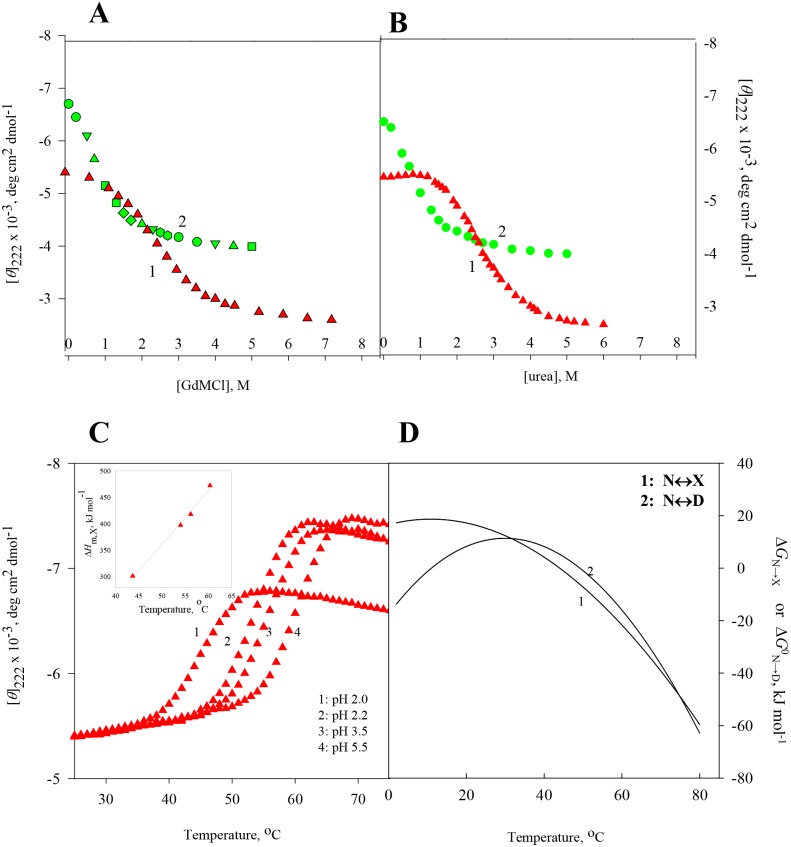
The denatured states of proteins have always attracted our attention due to the fact that the denatured state is the only experimentally achievable state of a protein, which can be taken as initial reference state for considering the in vitro folding and defining the native protein stability. It is known that heat and guanidinium chloride (GdmCl) give structurally different states of RNase-A, lysozyme, α-chymotrypsinogen A and α-lactalbumin. On the contrary, differential scanning calorimetric (DSC) and isothermal titration calorimetric measurements, reported in the literature, led to the conclusion that heat denatured and GdmCl denatured states are thermodynamically and structurally identical. In order to resolve this controversy, we have measured changes in the far-UV CD (circular dichroism) of these heat-denatured proteins on the addition of different concentrations of GdmCl. The observed sigmoidal curve of each protein was analyzed for Gibbs free energy change in the absence of the denaturant (ΔG0X→D) associated with the process heat denatured (X) state ↔ GdmCl denatured (D) state. To confirm that this thermodynamic property represents the property of the protein alone and is not a manifestation of salvation effect, we measured urea-induced denaturation curves of these heat denatured proteins under the same experimental condition in which GdmCl-induced denaturation was carried out. In this paper we report that (a) heat denatured proteins contain secondary structure, and GdmCl (or urea) induces a cooperative transition between X and D states, (b) for each protein at a given pH and temperature, thermodynamic cycle connects quantities, ΔG0N→X (native (N) state ↔ X state), ΔG0X→D and ΔG0N→D (N state ↔ D state), and
蛋白质的变性状态一直吸引着我们的关注,因为变性状态是蛋白质唯一可通过实验实现的状态,它可被视为考虑体外折叠和定义天然蛋白质稳定性的初始参考状态。已知热和氯化胍(GdmCl)会使核糖核酸酶A、溶菌酶、α-胰凝乳蛋白酶原A和α-乳白蛋白呈现结构不同的状态。相反,文献中报道的差示扫描量热法(DSC)和等温滴定量热法测量结果得出结论,热变性状态和GdmCl变性状态在热力学和结构上是相同的。为了解决这一争议,我们测量了在添加不同浓度GdmCl时这些热变性蛋白质的远紫外圆二色性(CD)变化。分析了每种蛋白质观察到的S形曲线,以确定与热变性(X)状态↔GdmCl变性(D)状态过程相关的在无变性剂情况下的吉布斯自由能变化(ΔG0X→D)。为了证实这种热力学性质仅代表蛋白质本身的性质,而非溶剂化效应的体现,我们在与进行GdmCl诱导变性相同的实验条件下测量了这些热变性蛋白质的尿素诱导变性曲线。在本文中我们报道:(a)热变性蛋白质含有二级结构,且GdmCl(或尿素)会诱导X和D状态之间的协同转变;(b)对于每种蛋白质在给定的pH和温度下,热力学循环连接了ΔG0N→X(天然(N)状态↔X状态)、ΔG0X→D和ΔG0N→D(N状态↔D状态)这些量,并且