Abou Elazab Mohamed Fahmy, Horiuchi Hiroyuki, Furusawa Shuichi
Laboratory of Immunobiology, Department of Molecular and Applied Bioscience, Graduate School of Biosphere Science, Hiroshima University, 1-4-4 Kagamiyama, Higashi-Hiroshima, Hiroshima 739-8528, Japan.
J Vet Med Sci. 2015 Nov;77(11):1363-9. doi: 10.1292/jvms.14-0525. Epub 2015 Jun 6.
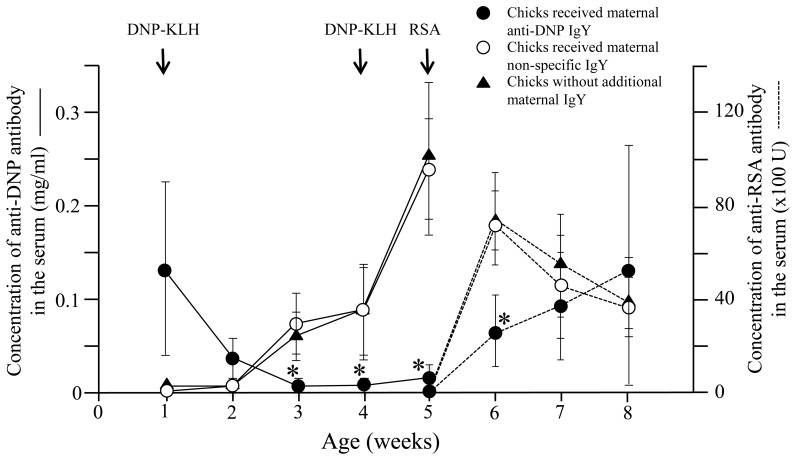
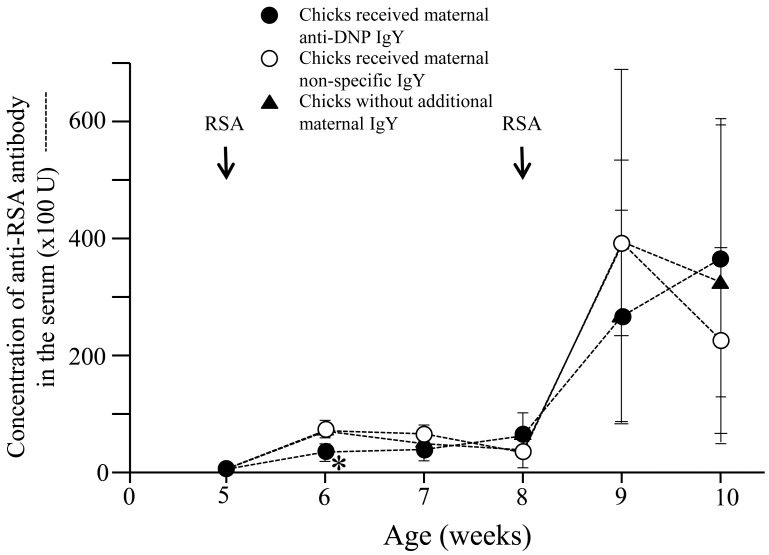
Specific immune suppression in newly hatched chicks induced by specific maternal antibodies has been reported. Laying hens were immunized with dinitrophenyl-keyhole limpet hemocyanin (DNP-KLH). Purified maternal anti-DNP and non-specific immunoglobulin (Ig) Y antibodies were transferred by yolk sac inoculation to newly hatched chicks, and then, they were immunized with an optimum immunogenic dose of DNP-KLH at 1 and 4 weeks of age. Concentrations of anti-DNP antibodies in serum samples of these chicks were measured by using Enzyme-linked immunosorbent assay (ELISA). Proportions of T-cell subsets in peripheral blood of these chicks were also measured by flow cytometric analysis at 5 weeks of age (one week after the second immunization). Suppression of anti-DNP antibody response and down-regulation of CD3(+)CD4(+) cells were observed in the chicks received high dose of maternal anti-DNP antibodies and immunized with DNP-KLH. On the other hand, normal anti-DNP antibody response and normal proportion of CD3(+)CD4(+) cells were observed in the chicks received high dose of non-specific IgY antibodies and immunized with DNP-KLH. Furthermore, when chicks received high dose of maternal anti-DNP antibodies and immunized with DNP-KLH at 1 and 4 weeks of age and then with rabbit serum albumin (RSA) at 5 and 8 weeks of age, their primary anti-RSA response was also significantly suppressed. We indicate here that specific maternal antibodies can affect both B and T cell responses and induce non-specific suppression against different antigens. However, this non-specific suppression does not continue for a long time.
已有报道称,特定的母源抗体可诱导新孵出雏鸡出现特异性免疫抑制。用二硝基苯基-钥孔戚血蓝蛋白(DNP-KLH)对产蛋母鸡进行免疫。通过卵黄囊接种将纯化的母源抗DNP和非特异性免疫球蛋白(Ig)Y抗体转移至新孵出的雏鸡,然后在1周龄和4周龄时用最佳免疫原剂量的DNP-KLH对它们进行免疫。使用酶联免疫吸附测定(ELISA)测量这些雏鸡血清样本中抗DNP抗体的浓度。在5周龄(第二次免疫后1周)时,还通过流式细胞术分析测量这些雏鸡外周血中T细胞亚群的比例。在接受高剂量母源抗DNP抗体并接种DNP-KLH的雏鸡中,观察到抗DNP抗体反应受到抑制以及CD3(+)CD4(+)细胞下调。另一方面,在接受高剂量非特异性IgY抗体并接种DNP-KLH的雏鸡中,观察到正常的抗DNP抗体反应和正常比例的CD3(+)CD4(+)细胞。此外,当雏鸡在1周龄和4周龄时接受高剂量母源抗DNP抗体并接种DNP-KLH,然后在5周龄和8周龄时接种兔血清白蛋白(RSA)时,它们对RSA的初次反应也受到显著抑制。我们在此表明,特定的母源抗体可影响B细胞和T细胞反应,并诱导对不同抗原的非特异性抑制。然而,这种非特异性抑制不会持续很长时间。