Mussai Francis, Egan Sharon, Hunter Stuart, Webber Hannah, Fisher Jonathan, Wheat Rachel, McConville Carmel, Sbirkov Yordan, Wheeler Kate, Bendle Gavin, Petrie Kevin, Anderson John, Chesler Louis, De Santo Carmela
School of Cancer Sciences, University of Birmingham, Birmingham, United Kingdom.
School of Veterinary Medicine and Science, University of Nottingham, Nottingham, Sutton Bonnington, United Kingdom.
Cancer Res. 2015 Aug 1;75(15):3043-53. doi: 10.1158/0008-5472.CAN-14-3443. Epub 2015 Jun 8.
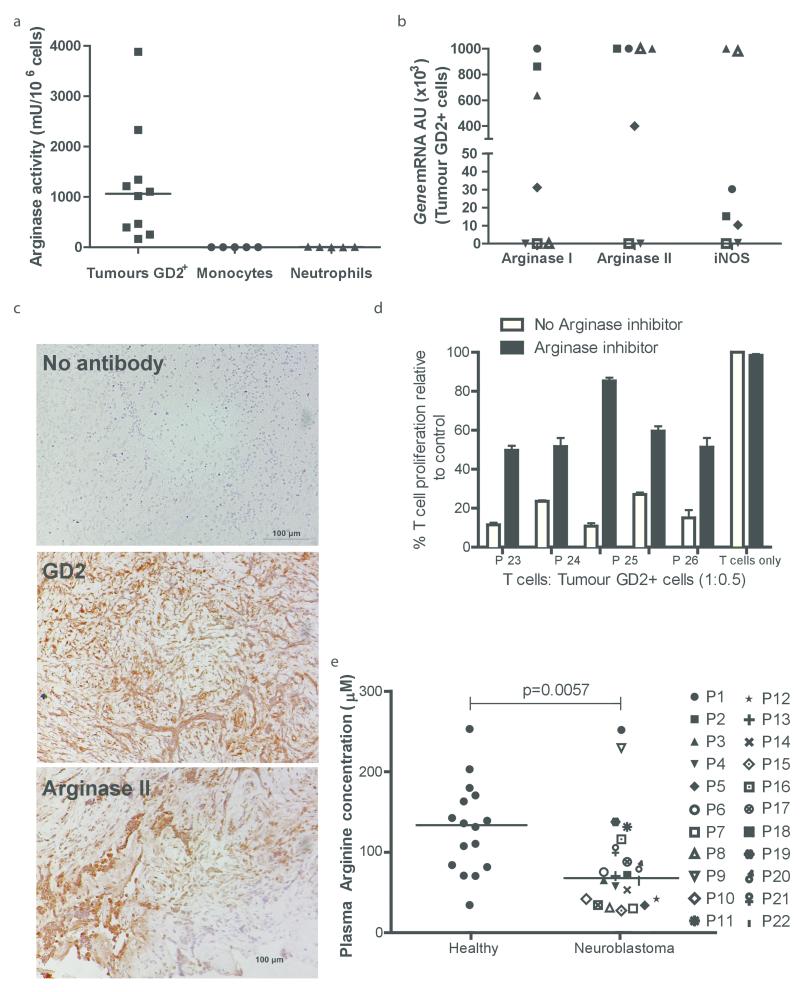
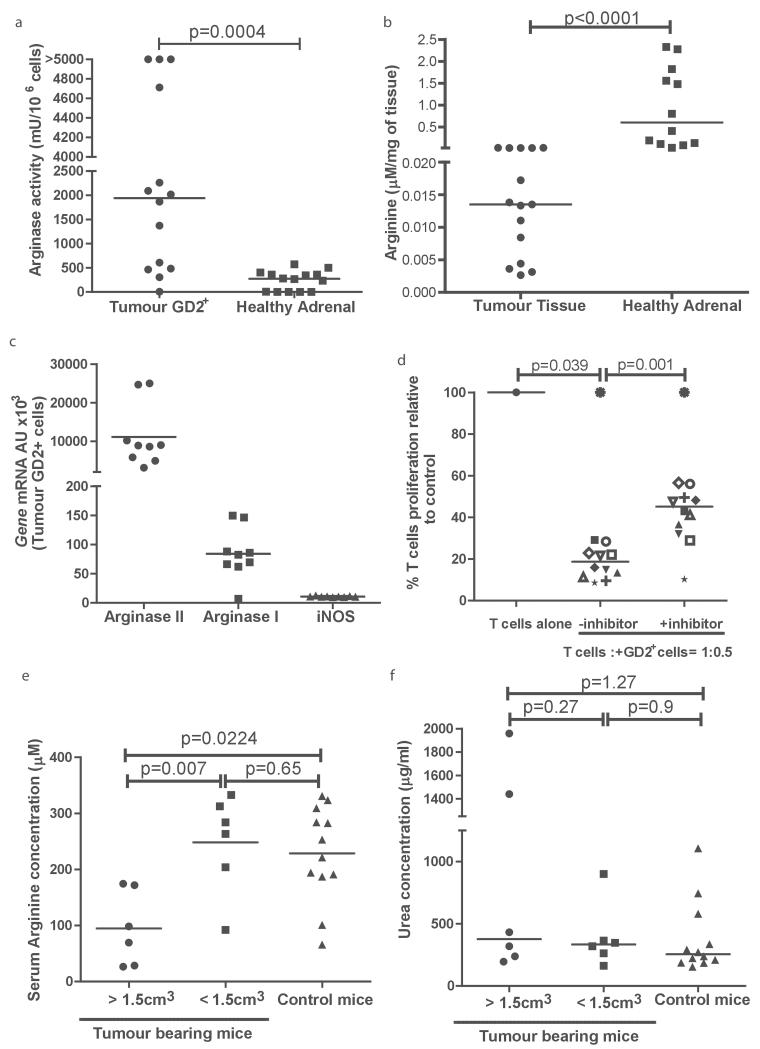
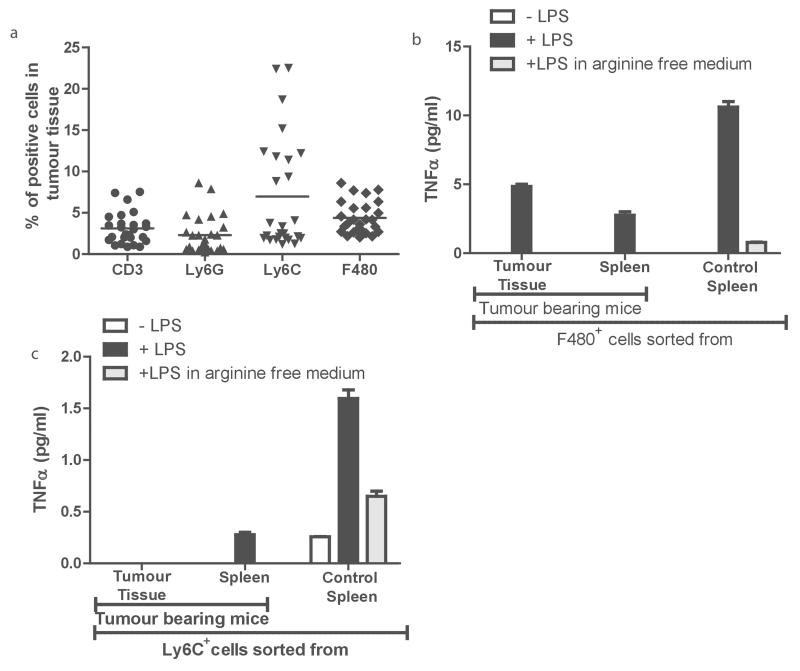
Neuroblastoma is the most common extracranial solid tumor of childhood, and survival remains poor for patients with advanced disease. Novel immune therapies are currently in development, but clinical outcomes have not matched preclinical results. Here, we describe key mechanisms in which neuroblastoma inhibits the immune response. We show that murine and human neuroblastoma tumor cells suppress T-cell proliferation through increased arginase activity. Arginase II is the predominant isoform expressed and creates an arginine-deplete local and systemic microenvironment. Neuroblastoma arginase activity results in inhibition of myeloid cell activation and suppression of bone marrow CD34(+) progenitor proliferation. Finally, we demonstrate that the arginase activity of neuroblastoma impairs NY-ESO-1-specific T-cell receptor and GD2-specific chimeric antigen receptor-engineered T-cell proliferation and cytotoxicity. High arginase II expression correlates with poor survival for patients with neuroblastoma. The results support the hypothesis that neuroblastoma creates an arginase-dependent immunosuppressive microenvironment in both the tumor and blood that leads to impaired immunosurveillance and suboptimal efficacy of immunotherapeutic approaches.
神经母细胞瘤是儿童最常见的颅外实体瘤,晚期疾病患者的生存率仍然很低。新型免疫疗法目前正在研发中,但临床结果尚未达到临床前研究结果。在此,我们描述了神经母细胞瘤抑制免疫反应的关键机制。我们发现,小鼠和人类神经母细胞瘤肿瘤细胞通过增加精氨酸酶活性来抑制T细胞增殖。精氨酸酶II是主要表达的同工型,会造成局部和全身精氨酸耗竭的微环境。神经母细胞瘤的精氨酸酶活性导致髓样细胞活化受到抑制以及骨髓CD34(+)祖细胞增殖受到抑制。最后,我们证明神经母细胞瘤的精氨酸酶活性会损害NY-ESO-1特异性T细胞受体和GD2特异性嵌合抗原受体工程化T细胞的增殖及细胞毒性。精氨酸酶II高表达与神经母细胞瘤患者的不良生存相关。这些结果支持了这样一种假说,即神经母细胞瘤在肿瘤和血液中都会形成一种依赖精氨酸酶的免疫抑制微环境,导致免疫监视受损以及免疫治疗方法的疗效欠佳。