Sørensen Gunnar, Reddy India A, Weikop Pia, Graham Devon L, Stanwood Gregg D, Wortwein Gitta, Galli Aurelio, Fink-Jensen Anders
Laboratory of Neuropsychiatry, Department of Neuroscience and Pharmacology, University of Copenhagen, Denmark; Psychiatric Centre Copenhagen, University of Copenhagen, Denmark.
Neuroscience Graduate Program, Vanderbilt University Medical Center, Nashville, TN, USA; Department of Molecular Physiology and Biophysics, Vanderbilt University Medical Center, Nashville, TN, USA; Neuroscience Program in Substance Abuse, Vanderbilt University Medical Center, Nashville, TN, USA.
Physiol Behav. 2015 Oct 1;149:262-8. doi: 10.1016/j.physbeh.2015.06.013. Epub 2015 Jun 11.
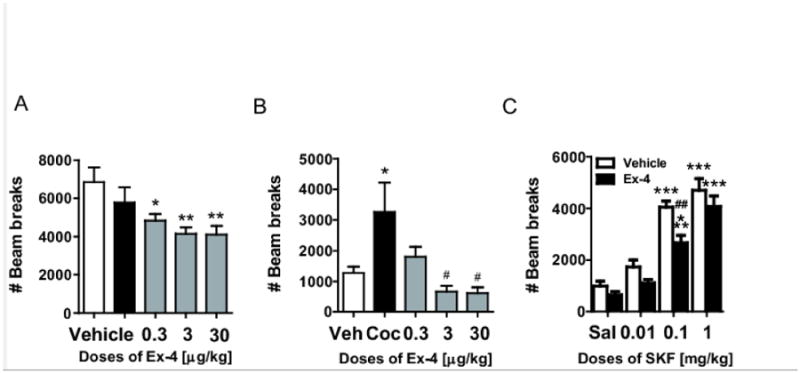
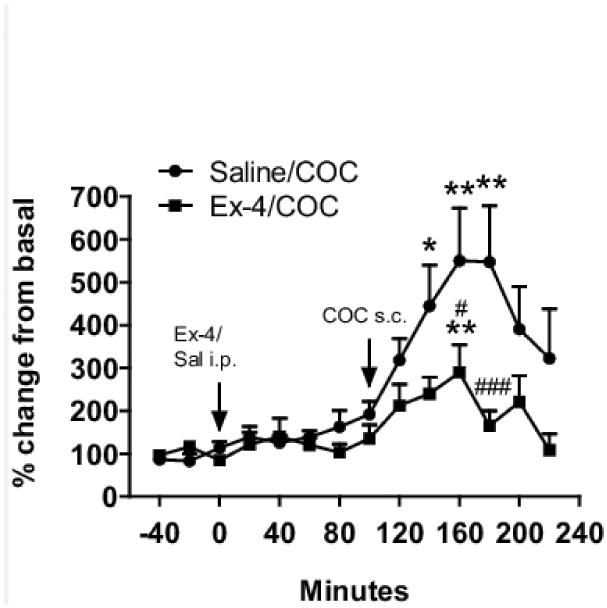
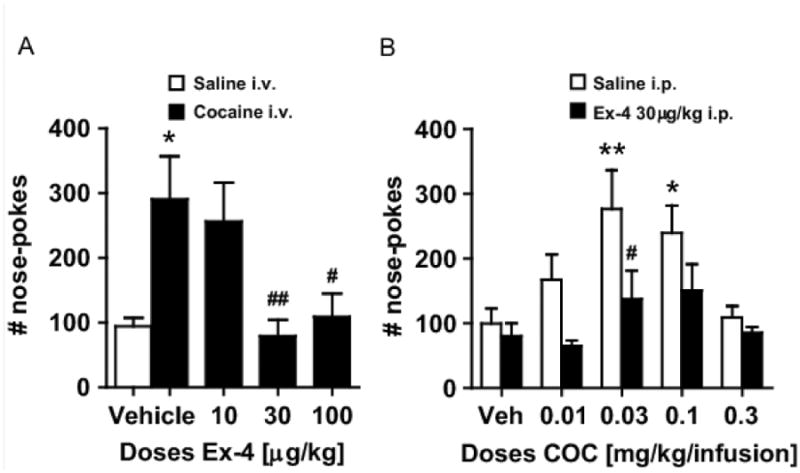
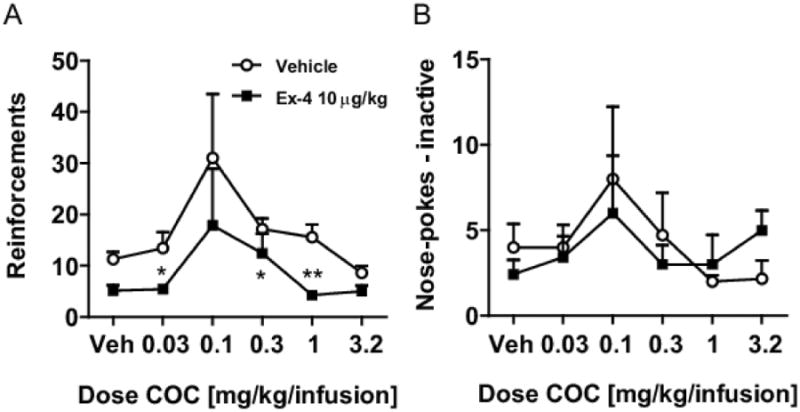
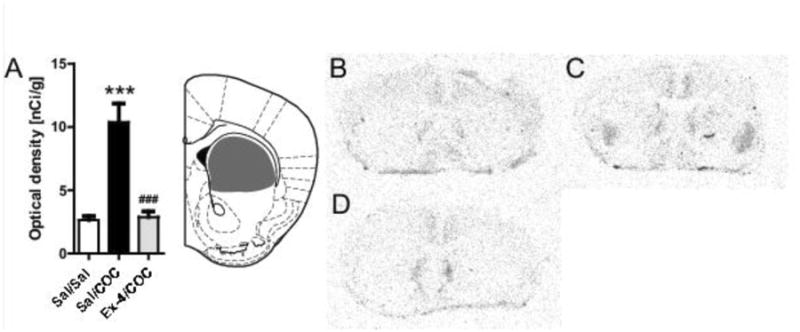
Glucagon-like peptide 1 (GLP-1) analogues are used for the treatment of type 2 diabetes. The ability of the GLP-1 system to decrease food intake in rodents has been well described and parallels results from clinical trials. GLP-1 receptors are expressed in the brain, including within the ventral tegmental area (VTA) and the nucleus accumbens (NAc). Dopaminergic neurons in the VTA project to the NAc, and these neurons play a pivotal role in the rewarding effects of drugs of abuse. Based on the anatomical distribution of GLP-1 receptors in the brain and the well-established effects of GLP-1 on food reward, we decided to investigate the effect of the GLP-1 analogue exendin-4 on cocaine- and dopamine D1-receptor agonist-induced hyperlocomotion, on acute and chronic cocaine self-administration, on cocaine-induced striatal dopamine release in mice and on cocaine-induced c-fos activation. Here, we report that GLP-1 receptor stimulation reduces acute and chronic cocaine self-administration and attenuates cocaine-induced hyperlocomotion. In addition, we show that peripheral administration of exendin-4 reduces cocaine-induced elevation of striatal dopamine levels and striatal c-fos expression implicating central GLP-1 receptors in these responses. The present results demonstrate that the GLP-1 system modulates cocaine's effects on behavior and dopamine homeostasis, indicating that the GLP-1 receptor may be a novel target for the pharmacological treatment of drug addiction.
胰高血糖素样肽1(GLP-1)类似物用于治疗2型糖尿病。GLP-1系统在啮齿动物中减少食物摄入的能力已得到充分描述,且与临床试验结果相似。GLP-1受体在大脑中表达,包括腹侧被盖区(VTA)和伏隔核(NAc)内。VTA中的多巴胺能神经元投射到NAc,这些神经元在滥用药物的奖赏效应中起关键作用。基于GLP-1受体在大脑中的解剖分布以及GLP-1对食物奖赏的既定作用,我们决定研究GLP-1类似物艾塞那肽-4对可卡因和多巴胺D1受体激动剂诱导的运动亢进、对急性和慢性可卡因自我给药、对可卡因诱导的小鼠纹状体多巴胺释放以及对可卡因诱导的c-fos激活的影响。在此,我们报告GLP-1受体刺激可减少急性和慢性可卡因自我给药,并减轻可卡因诱导的运动亢进。此外,我们表明外周给予艾塞那肽-4可降低可卡因诱导的纹状体多巴胺水平升高和纹状体c-fos表达,提示中枢GLP-1受体参与了这些反应。目前的结果表明,GLP-1系统调节可卡因对行为和多巴胺稳态的影响,表明GLP-1受体可能是药物成瘾药理学治疗的新靶点。