Borek Weronika E, Zou Juan, Rappsilber Juri, Sawin Kenneth E
Wellcome Trust Centre for Cell Biology, School of Biological Sciences, University of Edinburgh, Edinburgh, United Kingdom.
Wellcome Trust Centre for Cell Biology, School of Biological Sciences, University of Edinburgh, Edinburgh, United Kingdom; Department of Bioanalytics, Institute of Biotechnology, Technische Universität Berlin, Berlin, Germany.
PLoS One. 2015 Jun 15;10(6):e0129548. doi: 10.1371/journal.pone.0129548. eCollection 2015.
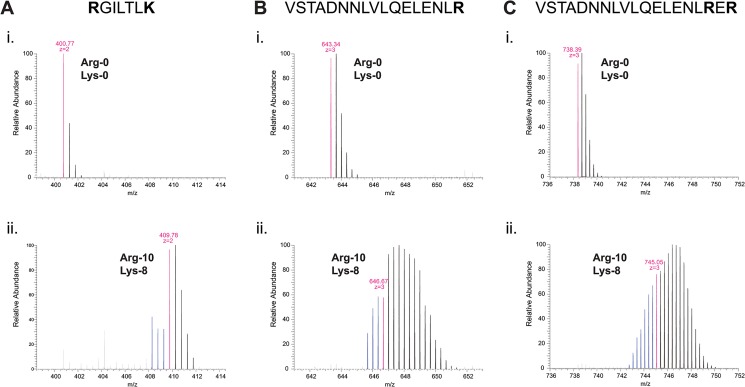
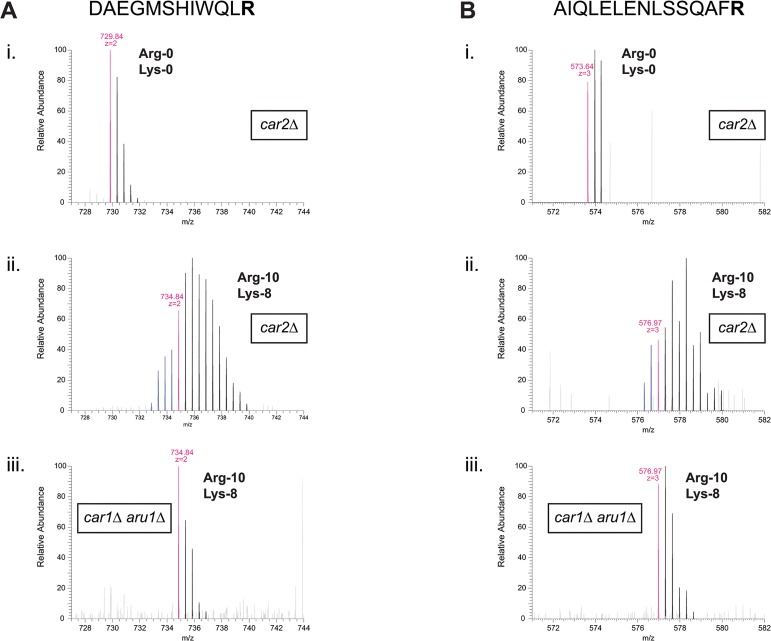
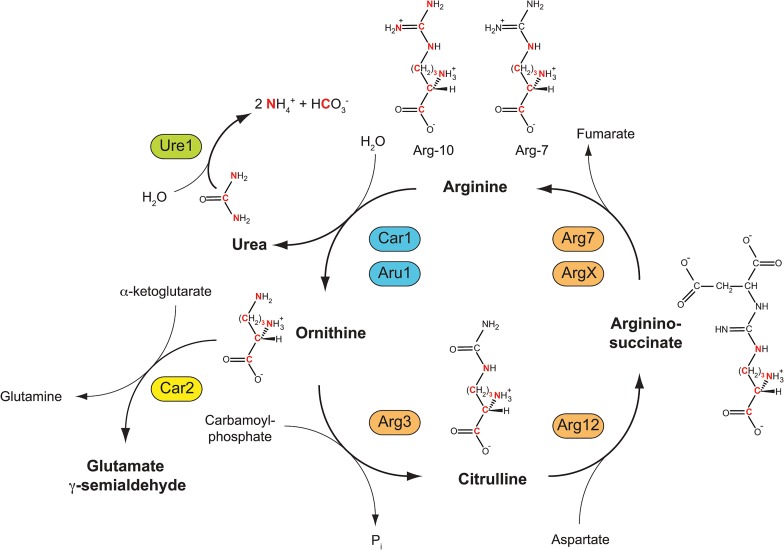
The use of "heavy" isotope-labeled arginine for stable isotope labeling by amino acids in cell culture (SILAC) mass spectrometry in the fission yeast Schizosaccharomyces pombe is hindered by the fact that under normal conditions, arginine is extensively catabolized in vivo, resulting in the appearance of "heavy"-isotope label in several other amino acids, most notably proline, but also glutamate, glutamine and lysine. This "arginine conversion problem" significantly impairs quantification of mass spectra. Previously, we developed a method to prevent arginine conversion in fission yeast SILAC, based on deletion of genes involved in arginine catabolism. Here we show that although this method is indeed successful when (13)C6-arginine (Arg-6) is used for labeling, it is less successful when (13)C6(15)N4-arginine (Arg-10), a theoretically preferable label, is used. In particular, we find that with this method, "heavy"-isotope label derived from Arg-10 is observed in amino acids other than arginine, indicating metabolic conversion of Arg-10. Arg-10 conversion, which severely complicates both MS and MS/MS analysis, is further confirmed by the presence of (13)C5(15)N2-arginine (Arg-7) in arginine-containing peptides from Arg-10-labeled cells. We describe how all of the problems associated with the use of Arg-10 can be overcome by a simple modification of our original method. We show that simultaneous deletion of the fission yeast arginase genes car1+ and aru1+ prevents virtually all of the arginine conversion that would otherwise result from the use of Arg-10. This solution should enable a wider use of heavy isotope-labeled amino acids in fission yeast SILAC.
在裂殖酵母粟酒裂殖酵母中,使用“重”同位素标记的精氨酸进行细胞培养中氨基酸稳定同位素标记(SILAC)质谱分析受到阻碍,原因是在正常条件下,精氨酸在体内会被广泛分解代谢,导致几种其他氨基酸中出现“重”同位素标记,最显著的是脯氨酸,还有谷氨酸、谷氨酰胺和赖氨酸。这种“精氨酸转化问题”严重损害了质谱的定量分析。此前,我们基于删除参与精氨酸分解代谢的基因,开发了一种在裂殖酵母SILAC中防止精氨酸转化的方法。在此我们表明,虽然当使用(13)C6 - 精氨酸(Arg - 6)进行标记时该方法确实成功,但当使用理论上更优的标记(13)C6(15)N4 - 精氨酸(Arg - 10)时,效果则较差。特别是,我们发现使用这种方法时,除精氨酸外的其他氨基酸中观察到了源自Arg - 10的“重”同位素标记,表明存在Arg - 10的代谢转化。Arg - 10的转化使质谱和串联质谱分析都严重复杂化,来自Arg - 10标记细胞的含精氨酸肽段中存在(13)C5(15)N2 - 精氨酸(Arg - 7)进一步证实了这一点。我们描述了如何通过对我们原来的方法进行简单修改来克服与使用Arg - 10相关的所有问题。我们表明,同时删除裂殖酵母的精氨酸酶基因car1 + 和aru1 + 几乎可以防止使用Arg - 10时原本会发生的所有精氨酸转化。这种解决方案应能使重同位素标记的氨基酸在裂殖酵母SILAC中得到更广泛的应用。