Hsu Kai-Cheng, Sung Tzu-Ying, Lin Chih-Ta, Chiu Yi-Yuan, Hsu John T-A, Hung Hui-Chen, Sun Chung-Ming, Barve Indrajeet, Chen Wen-Liang, Huang Wen-Chien, Huang Chin-Ting, Chen Chun-Hwa, Yang Jinn-Moon
Institute of Bioinformatics and Systems Biology, National Chiao Tung University, Hsinchu, Taiwan.
1] Department of Biological Science and Technology, National Chiao Tung University, Hsinchu, Taiwan [2] Institute of Biotechnology and Pharmaceutical Research, National Health Research Institutes, Miaoli, Taiwan.
Sci Rep. 2015 Jun 16;5:10938. doi: 10.1038/srep10938.
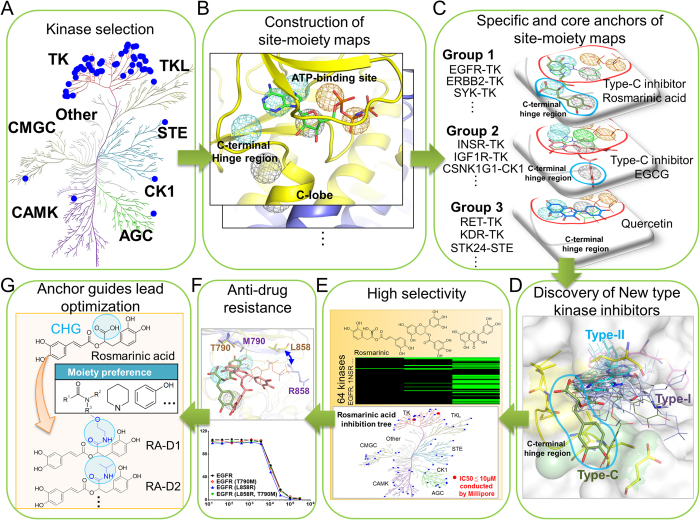
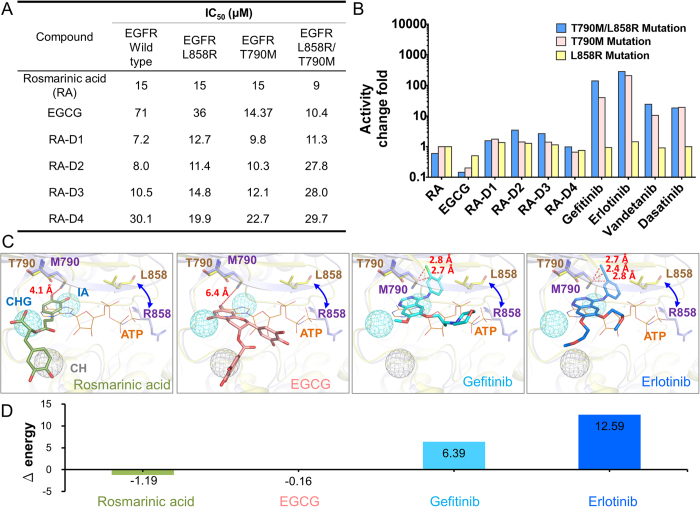
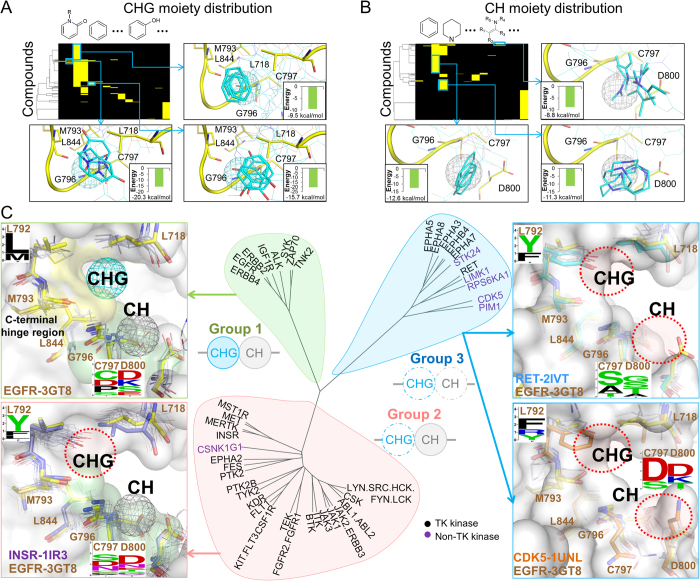
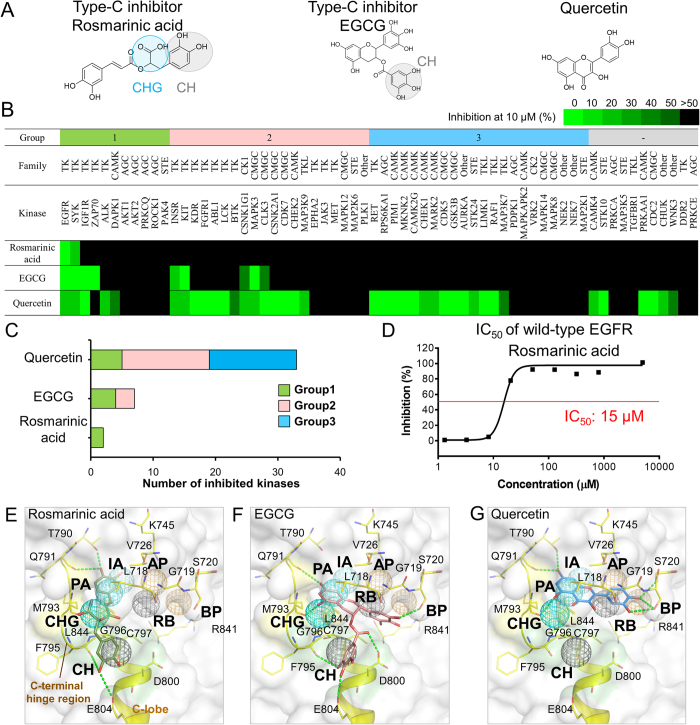
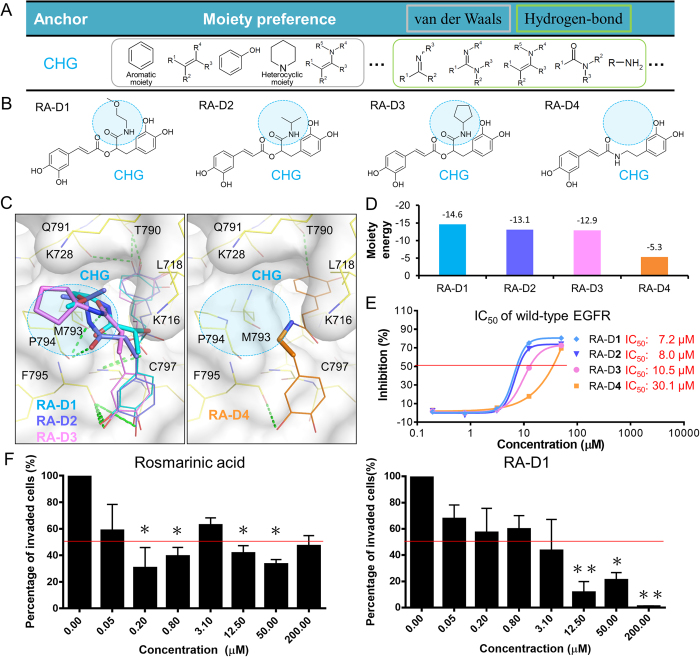
Tyrosine kinases regulate various biological processes and are drug targets for cancers. At present, the design of selective and anti-resistant inhibitors of kinases is an emergent task. Here, we inferred specific site-moiety maps containing two specific anchors to uncover a new binding pocket in the C-terminal hinge region by docking 4,680 kinase inhibitors into 51 protein kinases, and this finding provides an opportunity for the development of kinase inhibitors with high selectivity and anti-drug resistance. We present an anchor-based classification for tyrosine kinases and discover two type-C inhibitors, namely rosmarinic acid (RA) and EGCG, which occupy two and one specific anchors, respectively, by screening 118,759 natural compounds. Our profiling reveals that RA and EGCG selectively inhibit 3% (EGFR and SYK) and 14% of 64 kinases, respectively. According to the guide of our anchor model, we synthesized three RA derivatives with better potency. These type-C inhibitors are able to maintain activities for drug-resistant EGFR and decrease the invasion ability of breast cancer cells. Our results show that the type-C inhibitors occupying a new pocket are promising for cancer treatments due to their kinase selectivity and anti-drug resistance.
酪氨酸激酶调节多种生物学过程,是癌症的药物靶点。目前,设计激酶的选择性和抗耐药性抑制剂是一项紧迫任务。在此,我们通过将4680种激酶抑制剂对接至51种蛋白激酶中,推断出包含两个特定锚定基团的特定位点-基团图谱,以揭示C末端铰链区的一个新结合口袋,这一发现为开发具有高选择性和抗耐药性的激酶抑制剂提供了契机。我们提出了一种基于锚定基团的酪氨酸激酶分类方法,并通过筛选118759种天然化合物,发现了两种C型抑制剂,即迷迭香酸(RA)和表没食子儿茶素没食子酸酯(EGCG),它们分别占据两个和一个特定锚定基团。我们的分析表明,RA和EGCG分别选择性抑制64种激酶中的3%(表皮生长因子受体和脾酪氨酸激酶)和14%。根据我们的锚定基团模型指导,我们合成了三种活性更强的RA衍生物。这些C型抑制剂能够维持对耐药表皮生长因子受体的活性,并降低乳腺癌细胞的侵袭能力。我们的结果表明,由于其激酶选择性和抗耐药性,占据新口袋的C型抑制剂在癌症治疗方面具有潜力。