Domagala Pawel, Jakubowska Anna, Jaworska-Bieniek Katarzyna, Kaczmarek Katarzyna, Durda Katarzyna, Kurlapska Agnieszka, Cybulski Cezary, Lubinski Jan
Department of Pathology, Pomeranian Medical University, Szczecin, Poland.
Department of Genetics and Pathology, International Hereditary Cancer Center, Pomeranian Medical University, Szczecin, Poland.
PLoS One. 2015 Jun 17;10(6):e0130393. doi: 10.1371/journal.pone.0130393. eCollection 2015.
This study sought to assess the prevalence of common germline mutations in several genes engaged in the repair of DNA double-strand break by homologous recombination in patients with triple-negative breast cancers and hereditary non-triple-negative breast cancers. Tumors deficient in this type of DNA damage repair are known to be especially sensitive to DNA cross-linking agents (e.g., platinum drugs) and to poly(ADP-ribose) polymerase (PARP) inhibitors.
Genetic testing was performed for 36 common germline mutations in genes engaged in the repair of DNA by homologous recombination, i.e., BRCA1, BRCA2, CHEK2, NBN, ATM, PALB2, BARD1, and RAD51D, in 202 consecutive patients with triple-negative breast cancers and hereditary non-triple-negative breast cancers.
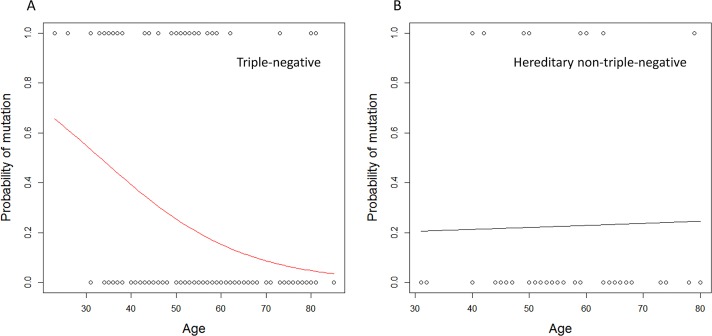
Thirty five (22.2%) of 158 patients in the triple-negative group carried mutations in genes involved in DNA repair by homologous recombination, while 10 (22.7%) of the 44 patients in the hereditary non-triple-negative group carried such mutations. Mutations in BRCA1 were most frequent in patients with triple-negative breast cancer (18.4%), and mutations in CHEK2 were most frequent in patients with hereditary non-triple-negative breast cancers (15.9%). In addition, in the triple-negative group, mutations in CHEK2, NBN, and ATM (3.8% combined) were found, while mutations in BRCA1, NBN, and PALB2 (6.8% combined) were identified in the hereditary non-triple-negative group.
Identifying mutations in genes engaged in DNA damage repair by homologous recombination other than BRCA1/2 can substantially increase the proportion of patients with triple-negative breast cancer and hereditary non-triple-negative breast cancer who may be eligible for therapy using PARP inhibitors and platinum drugs.
本研究旨在评估三阴性乳腺癌患者和遗传性非三阴性乳腺癌患者中,参与通过同源重组修复DNA双链断裂的几个基因的常见种系突变的患病率。已知缺乏这种类型DNA损伤修复的肿瘤对DNA交联剂(如铂类药物)和聚(ADP-核糖)聚合酶(PARP)抑制剂特别敏感。
对202例连续的三阴性乳腺癌患者和遗传性非三阴性乳腺癌患者进行基因检测,检测参与通过同源重组修复DNA的基因(即BRCA1、BRCA2、CHEK2、NBN、ATM、PALB2、BARD1和RAD51D)中的36种常见种系突变。
三阴性组158例患者中有35例(22.2%)携带参与通过同源重组修复DNA的基因突变,而遗传性非三阴性组44例患者中有10例(22.7%)携带此类突变。BRCA1突变在三阴性乳腺癌患者中最为常见(18.4%),CHEK2突变在遗传性非三阴性乳腺癌患者中最为常见(15.9%)。此外,在三阴性组中发现了CHEK2、NBN和ATM的突变(合计3.8%),而在遗传性非三阴性组中鉴定出了BRCA1、NBN和PALB2的突变(合计6.8%)。
识别除BRCA1/2之外参与通过同源重组修复DNA损伤的基因突变,可大幅增加可能有资格接受PARP抑制剂和铂类药物治疗的三阴性乳腺癌患者和遗传性非三阴性乳腺癌患者的比例。