Ewing Victoria L, Tolhurst Rachel, Kapinda Andrew, SanJoaquin Miguel, Terlouw Dianne J, Richards Esther, Lalloo David G
Malawi-Liverpool-Wellcome Trust Clinical Research Programme, Blantyre, Malawi; Liverpool School of Tropical Medicine, Liverpool, United Kingdom.
Liverpool School of Tropical Medicine, Liverpool, United Kingdom.
PLoS One. 2015 Jun 18;10(6):e0125439. doi: 10.1371/journal.pone.0125439. eCollection 2015.
Universal access to, and community uptake of malaria prevention and treatment strategies are critical to achieving current targets for malaria reduction. Each step in the treatment-seeking pathway must be considered in order to establish where opportunities for successful engagement and treatment occur. We describe local classifications of childhood febrile illnesses, present an overview of treatment-seeking, beginning with recognition of illness, and suggest how interventions could be used to target the barriers experienced.
Qualitative data were collected between September 2010 and February 2011. A total of 12 Focus Group Discussions and 22 Critical Incident Interviews were conducted with primary caregivers who had reported a recent febrile episode for one of their children.
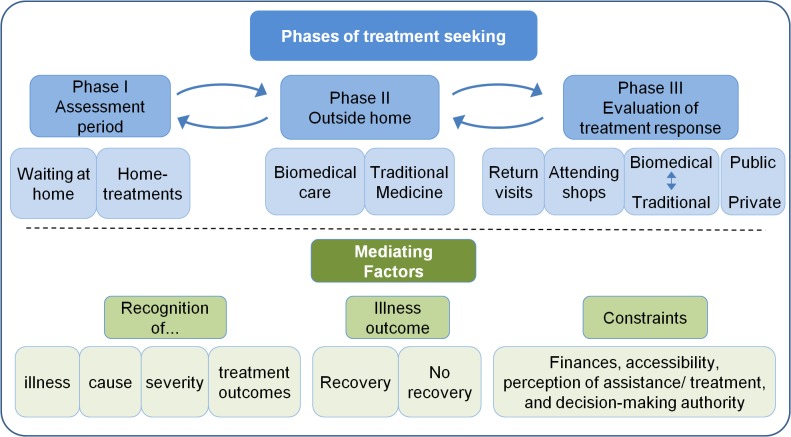
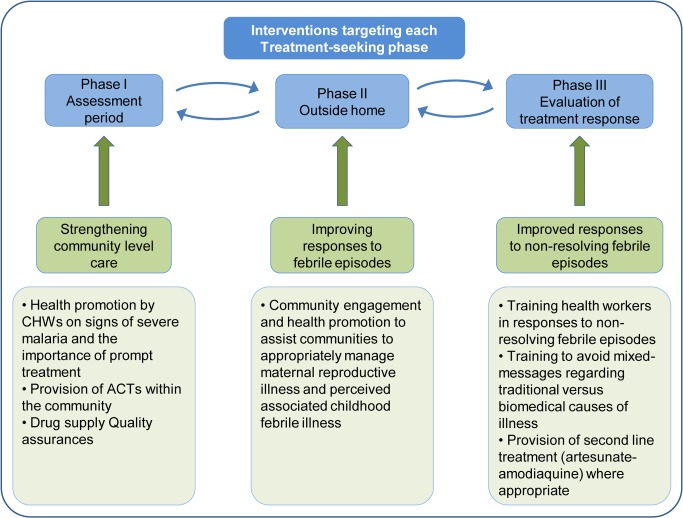
The phrase 'kutentha thupi', or 'hot body' was used to describe fever, the most frequently mentioned causes of which were malungo (translated as 'malaria'), mauka, nyankhwa and (m)tsempho. Differentiating the cause was challenging because these illnesses were described as having many similar non-specific symptoms, despite considerable differences in the perceived mechanisms of illness. Malungo was widely understood to be caused by mosquitoes. Commonly described symptoms included: fever, weakness, vomiting, diarrhoea and coughing. These symptoms matched well with the biomedical definition of malaria, although they also overlapped with symptoms of other illnesses in both the biomedical model and local illness classifications. In addition, malungo was used interchangeably to describe malaria and fever in general. Caregivers engaged in a three-phased approach to treatment seeking. Phase 1-Assessment; Phase 2-Seeking care outside the home; Phase 3-Evaluation of treatment response. Within this paper, the three-phased approach is explored to identify potential interventions to target barriers to appropriate treatment. Community engagement and health promotion, the provision of antimalarials at community level and better training health workers in the causes and treatment of non-malarial febrile illnesses may improve access to appropriate treatment and outcomes.
普及疟疾预防和治疗策略并提高社区对其的接受程度对于实现当前的疟疾减少目标至关重要。为了确定成功参与治疗的机会所在,必须考虑寻求治疗途径中的每一个步骤。我们描述了儿童发热性疾病的当地分类,概述了从疾病识别开始的寻求治疗情况,并提出了如何利用干预措施来针对所遇到的障碍。
在2010年9月至2011年2月期间收集定性数据。对报告其子女近期有发热发作的主要照顾者进行了总共12次焦点小组讨论和22次关键事件访谈。
“kutentha thupi”(即“热身体”)一词用于描述发热,最常提到的病因是malungo(翻译为“疟疾”)、mauka、nyankhwa和(m)tsempho。区分病因具有挑战性,因为尽管这些疾病在被感知的发病机制上有很大差异,但都被描述为有许多相似的非特异性症状。人们普遍认为malungo是由蚊子引起的。常见症状包括:发热、虚弱、呕吐、腹泻和咳嗽。这些症状与疟疾的生物医学定义非常吻合,尽管它们在生物医学模型和当地疾病分类中也与其他疾病的症状重叠。此外,malungo通常可互换使用来描述一般的疟疾和发热。照顾者采取三阶段方法寻求治疗。第一阶段——评估;第二阶段——在家外寻求护理;第三阶段——评估治疗反应。在本文中,探讨了这种三阶段方法,以确定针对适当治疗障碍的潜在干预措施。社区参与和健康促进、在社区层面提供抗疟药以及对卫生工作者进行关于非疟疾发热性疾病病因和治疗的更好培训,可能会改善获得适当治疗的机会和治疗效果。