Qin Shukui, Bi Feng, Jin Jie, Cheng Ying, Guo Jun, Ren Xiubao, Huang Yiran, Tarazi Jamal, Tang Jie, Chen Connie, Kim Sinil, Ye Dingwei
Department of Medical Oncology, PLA Cancer Center, Nanjing Bayi Hospital, Nanjing, Jiangsu, People's Republic of China.
Department of Medical Oncology, West China Hospital of Sichuan University, Chengdu, Sichuan Province, People's Republic of China.
Onco Targets Ther. 2015 Jun 8;8:1363-73. doi: 10.2147/OTT.S83302. eCollection 2015.
This registrational trial evaluated the efficacy, safety, and patient-reported outcomes of axitinib versus sorafenib as a second-line treatment in Asian patients with clear-cell metastatic renal cell carcinoma (mRCC).
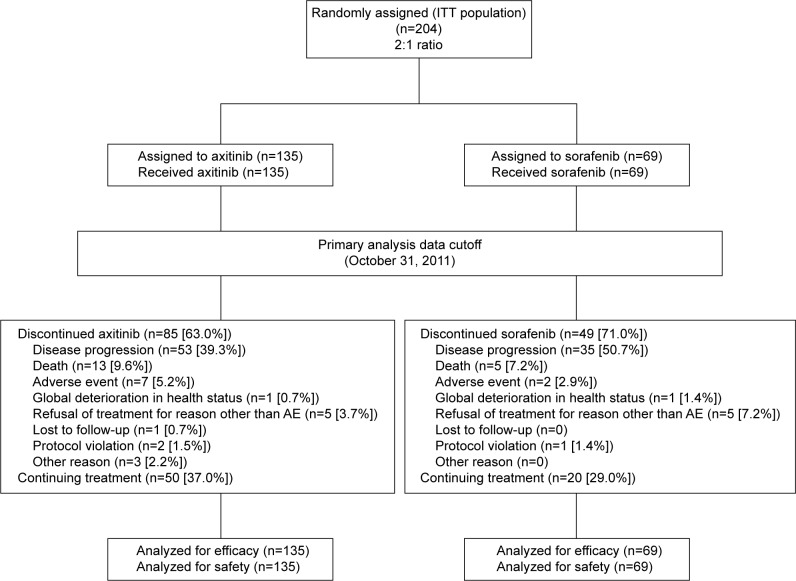
In this open-label, multicenter study, previously treated Asian patients with clear-cell mRCC were stratified by Eastern Cooperative Oncology Group performance status and prior therapy and randomized in a 2:1 ratio to receive axitinib (5 mg twice daily) or sorafenib (400 mg twice daily). The primary end point was progression-free survival (PFS) assessed by a masked independent review committee.
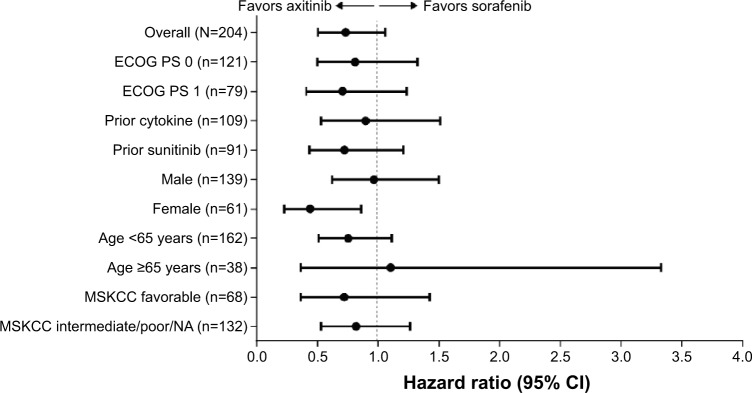
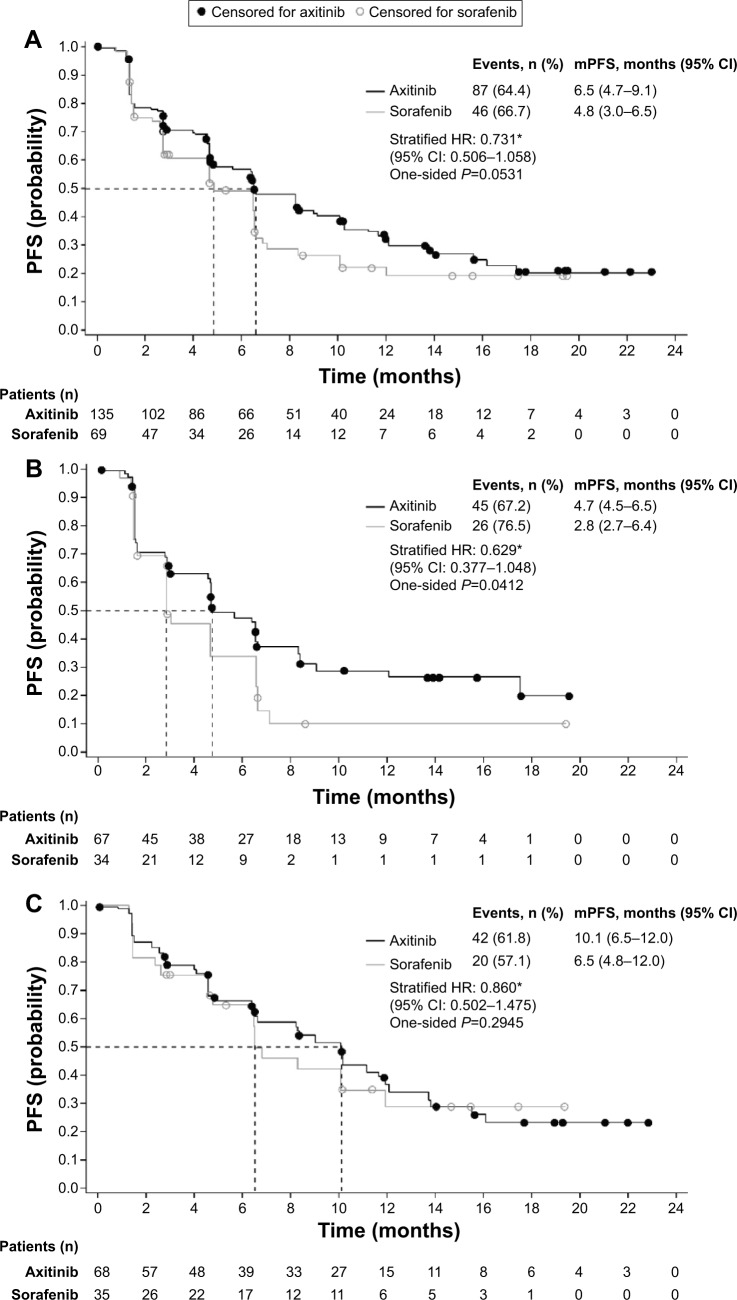
A total of 204 Asian patients received axitinib (n=135) or sorafenib (n=69). Median PFS (95% confidence interval [CI]) was 6.5 (4.7-9.1) months with axitinib versus 4.8 (3.0-6.5) months with sorafenib (hazard ratio, 0.731; 95% CI, 0.506-1.058; one-sided P=0.0531). The objective response rate (95% CI) was 23.7% (16.8%-31.8%) with axitinib versus 10.1% (4.2%-19.8%) with sorafenib. Common, grade ≥3, all-causality adverse events were hypertension (19.3%), weight decrease (5.2%), and proteinuria (5.2%) with axitinib and hypertension (8.7%) and palmar-plantar erythrodysesthesia (7.2%) with sorafenib. In a time-to-deterioration composite end point of death, progression, and worsening of Functional Assessment of Cancer Therapy Kidney Symptom Index score, patients treated with axitinib demonstrated a 17%-24% risk reduction compared with sorafenib-treated patients.
Axitinib is clinically active and well tolerated in previously treated Asian patients with mRCC, consistent with the results from the global Phase III trial. These results establish axitinib as a second-line treatment option for Asian patients with mRCC.
本注册试验评估了阿昔替尼与索拉非尼作为亚洲透明细胞转移性肾细胞癌(mRCC)患者二线治疗的疗效、安全性及患者报告的结局。
在这项开放标签、多中心研究中,既往接受过治疗的亚洲透明细胞mRCC患者按东部肿瘤协作组体能状态和既往治疗情况进行分层,以2:1的比例随机分组,分别接受阿昔替尼(每日两次,每次5 mg)或索拉非尼(每日两次,每次400 mg)治疗。主要终点为由独立盲态审查委员会评估的无进展生存期(PFS)。
共有204例亚洲患者接受了阿昔替尼(n = 135)或索拉非尼(n = 69)治疗。阿昔替尼组的中位PFS(95%置信区间[CI])为6.5(4.7 - 9.1)个月,索拉非尼组为4.8(3.0 - 6.5)个月(风险比,0.731;95% CI,0.506 - 1.058;单侧P = 0.0531)。阿昔替尼组的客观缓解率(95% CI)为23.7%(16.8% - 31.8%),索拉非尼组为10.1%(4.2% - 19.8%)。常见的、≥3级的、所有原因引起的不良事件在阿昔替尼组为高血压(19.3%)、体重减轻(5.2%)和蛋白尿(5.2%),在索拉非尼组为高血压(8.7%)和手足红斑性感觉异常(7.2%)。在死亡、进展和癌症治疗功能评估肾脏症状指数评分恶化的时间至恶化复合终点方面,与索拉非尼治疗的患者相比,接受阿昔替尼治疗的患者风险降低了17% - 24%。
阿昔替尼在既往接受过治疗的亚洲mRCC患者中具有临床活性且耐受性良好,与全球III期试验结果一致。这些结果确立了阿昔替尼作为亚洲mRCC患者二线治疗选择的地位。