Zimmer Eduardo R, Torrez Vitor R, Kalinine Eduardo, Augustin Marina C, Zenki Kamila C, Almeida Roberto F, Hansel Gisele, Muller Alexandre P, Souza Diogo O, Machado-Vieira Rodrigo, Portela Luis V
Department of Biochemistry, Universidade Federal do Rio Grande do Sul Porto Alegre, Brazil.
Department of Biochemistry, Universidade Federal do Rio Grande do Sul Porto Alegre, Brazil ; Department of Physiology, Universidade Federal de Sergipe São Cristovão, Brazil.
Front Cell Neurosci. 2015 Jun 3;9:219. doi: 10.3389/fncel.2015.00219. eCollection 2015.
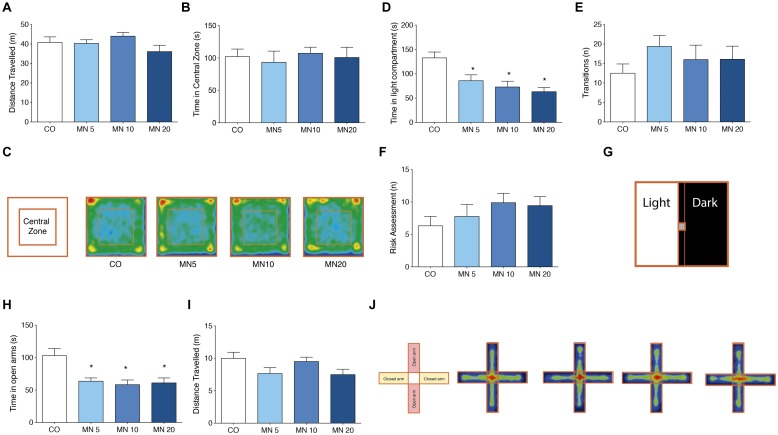
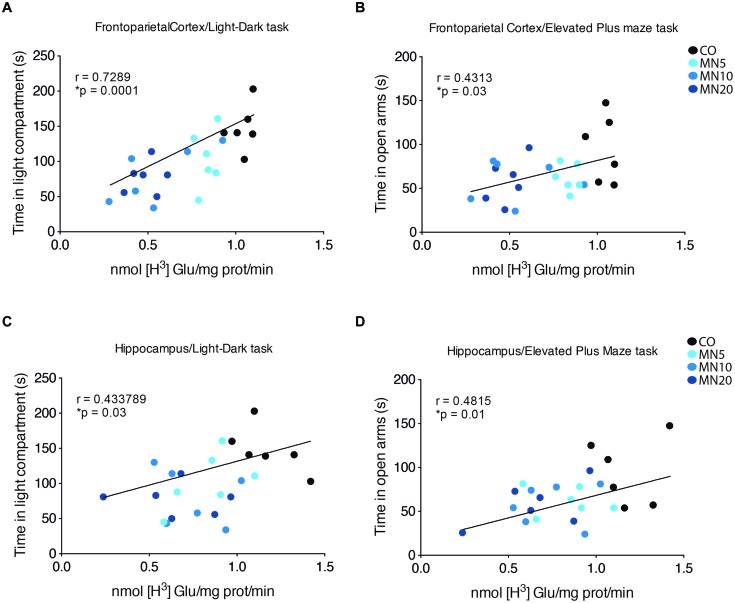
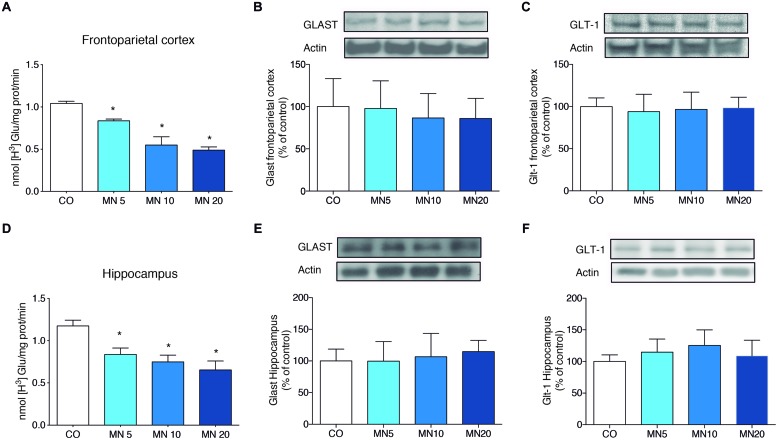
The role of glutamate N-methyl-D-aspartate receptor (NMDAR) hypofunction has been extensively studied in schizophrenia; however, less is known about its role in anxiety disorders. Recently, it was demonstrated that astrocytic GLT-1 blockade leads to an anxiety-like phenotype. Although astrocytes are capable of modulating NMDAR activity through glutamate uptake transporters, the relationship between astrocytic glutamate uptake and the development of an anxiety phenotype remains poorly explored. Here, we aimed to investigative whether long-term antagonism of NMDAR impacts anxiety-related behaviors and astrocytic glutamate uptake. Memantine, an NMDAR antagonist, was administered daily for 24 days to healthy adult CF-1 mice by oral gavage at doses of 5, 10, or 20 mg/kg. The mice were submitted to a sequential battery of behavioral tests (open field, light-dark box and elevated plus-maze tests). We then evaluated glutamate uptake activity and the immunocontents of glutamate transporters in the frontoparietal cortex and hippocampus. Our results demonstrated that long-term administration of memantine induces anxiety-like behavior in mice in the light-dark box and elevated plus-maze paradigms. Additionally, the administration of memantine decreased glutamate uptake activity in both the frontoparietal cortex and hippocampus without altering the immunocontent of either GLT-1 or GLAST. Remarkably, the memantine-induced reduction in glutamate uptake was correlated with enhancement of an anxiety-like phenotype. In conclusion, long-term NMDAR antagonism with memantine induces anxiety-like behavior that is associated with reduced glutamate uptake activity but that is not dependent on GLT-1 or GLAST protein expression. Our study suggests that NMDAR and glutamate uptake hypofunction may contribute to the development of conditions that fall within the category of anxiety disorders.
谷氨酸N-甲基-D-天冬氨酸受体(NMDAR)功能减退在精神分裂症中的作用已得到广泛研究;然而,其在焦虑症中的作用却鲜为人知。最近,有研究表明星形胶质细胞谷氨酸转运体1(GLT-1)阻断会导致焦虑样表型。尽管星形胶质细胞能够通过谷氨酸摄取转运体调节NMDAR活性,但星形胶质细胞谷氨酸摄取与焦虑表型发展之间的关系仍有待深入探究。在此,我们旨在研究长期拮抗NMDAR是否会影响焦虑相关行为和星形胶质细胞谷氨酸摄取。美金刚是一种NMDAR拮抗剂,以5、10或20mg/kg的剂量通过口服灌胃法每日给健康成年CF-1小鼠给药24天。将小鼠依次进行一系列行为测试(旷场试验、明暗箱试验和高架十字迷宫试验)。然后,我们评估了额顶叶皮质和海马体中的谷氨酸摄取活性以及谷氨酸转运体的免疫含量。我们的结果表明,长期给予美金刚会使小鼠在明暗箱试验和高架十字迷宫试验范式中出现焦虑样行为。此外,给予美金刚会降低额顶叶皮质和海马体中的谷氨酸摄取活性,而不会改变GLT-1或谷氨酸转运体兴奋性氨基酸载体(GLAST)的免疫含量。值得注意的是,美金刚诱导的谷氨酸摄取减少与焦虑样表型的增强相关。总之,长期用美金刚拮抗NMDAR会诱导焦虑样行为,这与谷氨酸摄取活性降低有关,但不依赖于GLT-1或GLAST蛋白表达。我们的研究表明,NMDAR和谷氨酸摄取功能减退可能促成了焦虑症范畴内病症的发展。