Kavanaugh Arthur, Puig Lluís, Gottlieb Alice B, Ritchlin Christopher, Li Shu, Wang Yuhua, Mendelsohn Alan M, Song Michael, Zhu Yaowei, Rahman Proton, McInnes Iain B
University of California, San Diego, La Jolla, California.
Universitat Autònoma de Barcelona, Barcelona, Spain.
Arthritis Care Res (Hoboken). 2015 Dec;67(12):1739-49. doi: 10.1002/acr.22645.
To evaluate the efficacy and safety of ustekinumab through 2 years in adult patients with active psoriatic arthritis (PsA).
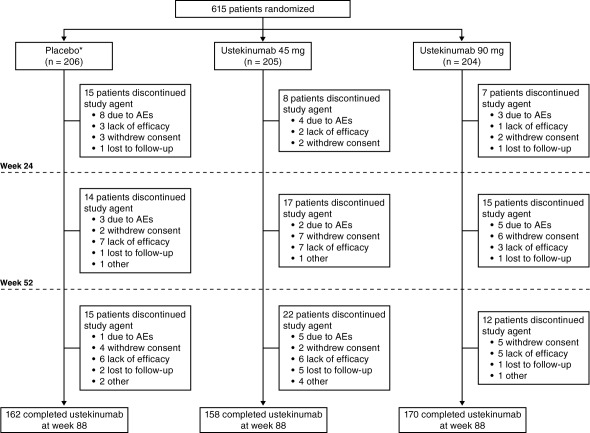
A total of 615 adult patients with active PsA were randomized to placebo, ustekinumab 45 mg, or ustekinumab 90 mg, at weeks 0, 4, and every 12 weeks through week 88 (last dose). At week 16, patients with <5% improvement in both tender and swollen joint counts entered blinded early escape (placebo to 45 mg, 45 mg to 90 mg, and 90 mg to 90 mg). All remaining placebo patients crossed over to ustekinumab 45 mg at week 24. Clinical efficacy measures included American College of Rheumatology criteria for 20% improvement (ACR20), Disease Activity Score in 28 joints using the C-reactive protein level (DAS28-CRP), and ≥75% improvement in the Psoriasis Area and Severity Index (PASI75). Radiographic progression was evaluated using the modified Sharp/van der Heijde score (SHS).
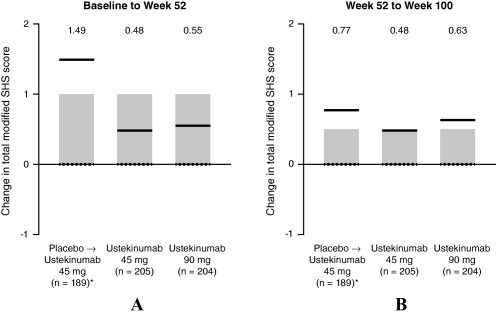
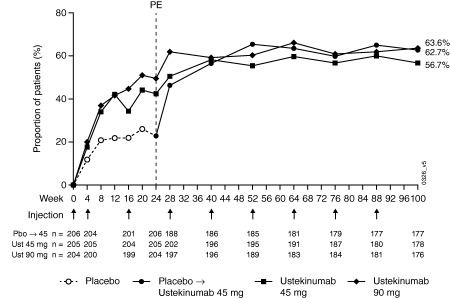
At week 100, ACR20, DAS28-CRP moderate/good response, and PASI75 rates ranged from 56.7-63.6%, 71.9-76.7%, and 63.9-72.5%, respectively, across the 3 treatment groups. In both ustekinumab groups, the median percent improvement in dactylitis and enthesitis was 100% at week 100. The mean changes in SHS score from week 52 to week 100 were similar to those observed from week 0 to week 52 in the ustekinumab groups. Through week 108, 70.7% and 9.7% of patients had an adverse event (AE) or serious AE, respectively. The rates and type of AEs were similar between the dose groups.
Clinical and radiographic benefits from ustekinumab treatment were maintained through week 100 in the PSUMMIT 1 study. No unexpected safety events were observed; the safety profile of ustekinumab in this population was similar to that previously observed in psoriasis patients treated with ustekinumab.
评估优特克单抗治疗活动性银屑病关节炎(PsA)成年患者两年的疗效和安全性。
总共615例活动性PsA成年患者在第0、4周以及第88周(最后一剂)前每12周随机分为安慰剂组、45毫克优特克单抗组或90毫克优特克单抗组。在第16周时,压痛关节数和肿胀关节数改善均不到5%的患者进入盲态早期退出阶段(安慰剂组换为45毫克组,45毫克组换为90毫克组,90毫克组维持90毫克剂量)。所有剩余的安慰剂组患者在第24周时换用45毫克优特克单抗。临床疗效指标包括美国风湿病学会20%改善标准(ACR20)、采用C反应蛋白水平的28个关节疾病活动评分(DAS28-CRP)以及银屑病面积和严重程度指数改善≥75%(PASI75)。采用改良Sharp/van der Heijde评分(SHS)评估影像学进展。
在第100周时,3个治疗组的ACR20、DAS28-CRP中度/良好反应率以及PASI75率分别为56.7% - 63.6%、71.9% - 76.7%和63.9% - 72.5%。在两个优特克单抗组中,第100周时指(趾)炎和附着点炎的中位改善百分比均为100%。在优特克单抗组中,SHS评分从第52周到第100周的平均变化与从第0周到第52周观察到的相似。到第108周时,分别有70.7%和9.7%的患者发生不良事件(AE)或严重AE。各剂量组AE的发生率和类型相似。
在PSUMMIT 1研究中,优特克单抗治疗的临床和影像学益处持续到第100周。未观察到意外的安全事件;优特克单抗在该人群中的安全性与先前在接受优特克单抗治疗的银屑病患者中观察到的相似。