Garg Sakshi Anurag, Thosar Nilima Ramdas, Baliga Sudhindra M, Bhatiya Poonam Vidyaanand
Department of Pedodontics and Preventive Dentistry, Sharad Pawar Dental College and Hospital, Wardha, Maharashtra, India.
Indian J Dent. 2015 Apr-Jun;6(2):65-8. doi: 10.4103/0975-962X.155881.
Oral health problems, especially dental caries are known to be common in children with severe heart disease, especially at early ages. The role of nitric oxide (NO) in protection against oral diseases owing to its strong antimicrobial action has been a topic of interest.
The current study was carried out to estimate the NO levels in the salivary samples of children diagnosed with congenital heart diseases (CHDs) and to determine whether salivary NO can serve as a potential biomarker for the evaluation of dental caries-risk.
This prospective study was performed on 50 children suffering from CHDs who reported to the department of pediatrics and the levels were compared with those of 50 healthy caries-free children. NO levels in the collected salivary levels were determined spectrophotometrically using the Griess reaction method.
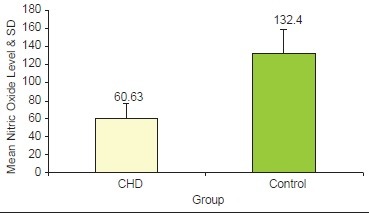
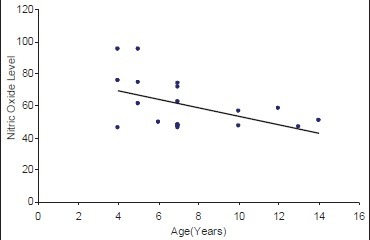
Subjects between the age group of 6 and 12 years had maximum decayed teeth (20.95%). The mean NO level in children in study group (60.63) was decreased in comparison to the control group (132.40), which was statistically significant (P value of 0.001). The mean age of the subjects in the study group was 7.24 and the salivary NO levels decreased with age, which was statistically significant.
Children are suffering from medically compromising conditions such as CHDs are at a higher risk for dental caries and decreased salivary NO levels in these patients may prove as a critical indicator of the same. Saliva can be further utilized as an important biomarker for the determination of the relationship between salivary NO levels and development of dental caries.
口腔健康问题,尤其是龋齿,在患有严重心脏病的儿童中很常见,尤其是在早期。由于一氧化氮(NO)具有强大的抗菌作用,其在预防口腔疾病中的作用一直是一个备受关注的话题。
本研究旨在评估被诊断患有先天性心脏病(CHD)的儿童唾液样本中的NO水平,并确定唾液NO是否可作为评估龋齿风险的潜在生物标志物。
本前瞻性研究对50名到儿科就诊的患有CHD的儿童进行,其水平与50名无龋健康儿童的水平进行比较。使用格里斯反应法通过分光光度法测定收集的唾液样本中的NO水平。
6至12岁年龄组的受试者龋齿最多(20.95%)。研究组儿童的平均NO水平(60.63)低于对照组(132.40),差异具有统计学意义(P值为0.001)。研究组受试者的平均年龄为7.24岁,唾液NO水平随年龄降低,差异具有统计学意义。
患有CHD等医学上有缺陷疾病的儿童患龋齿的风险更高,这些患者唾液NO水平降低可能是龋齿的关键指标。唾液可进一步用作确定唾液NO水平与龋齿发展之间关系的重要生物标志物。