Li Tao, Heuvelink Ep, Marcelis Leo F M
Horticulture and Product Physiology Group, Department of Plant Sciences, Wageningen University, Wageningen Netherlands ; Institute of Environment and Sustainable Development in Agriculture, Chinese Academy of Agriculture Science, Beijing China.
Horticulture and Product Physiology Group, Department of Plant Sciences, Wageningen University, Wageningen Netherlands.
Front Plant Sci. 2015 Jun 5;6:416. doi: 10.3389/fpls.2015.00416. eCollection 2015.
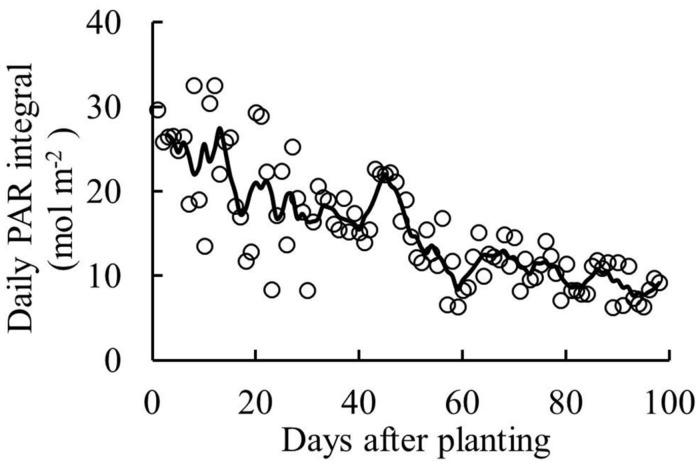
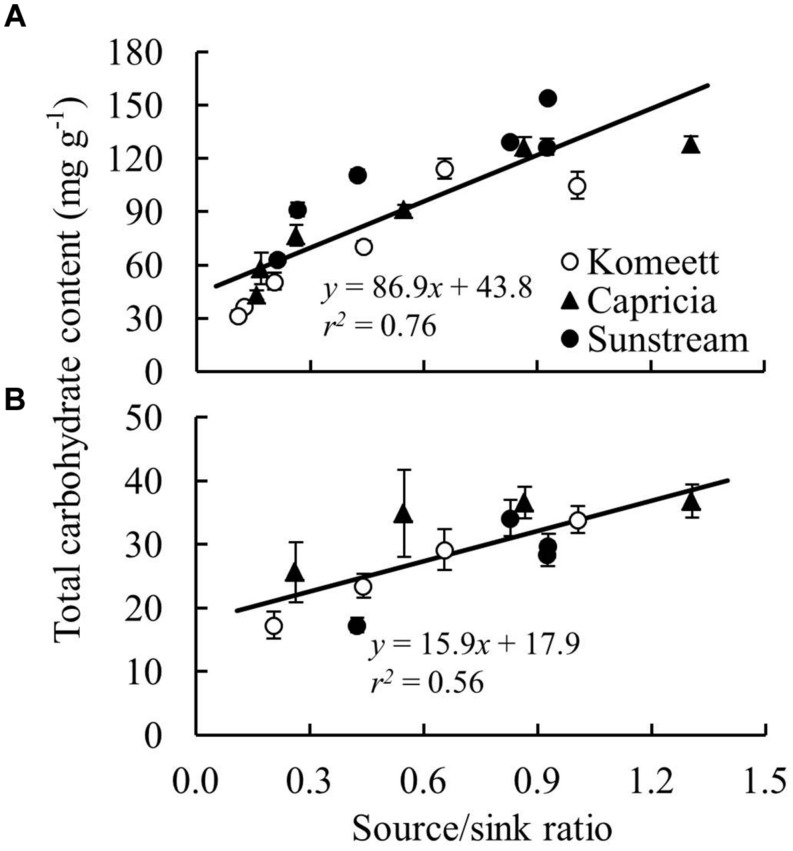
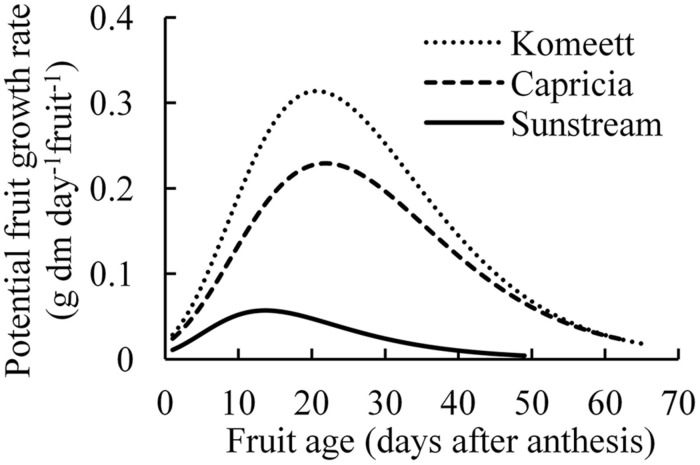
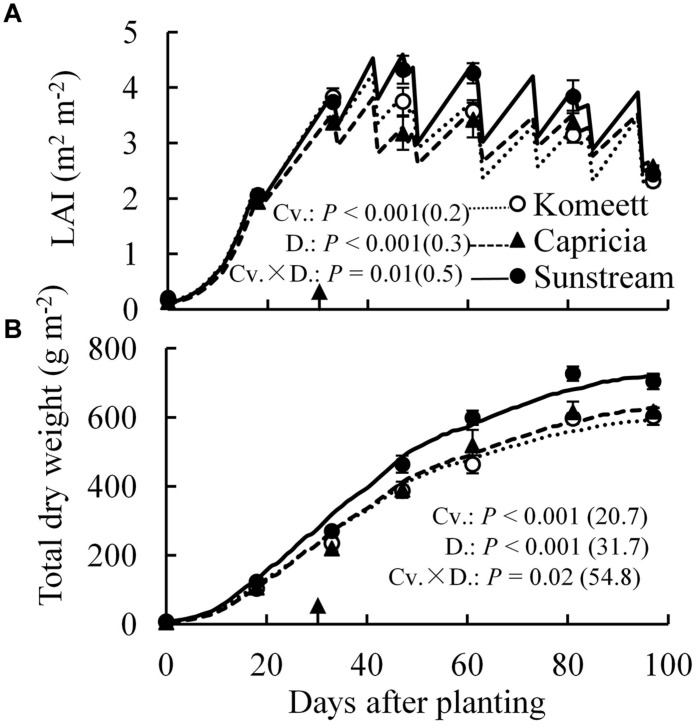
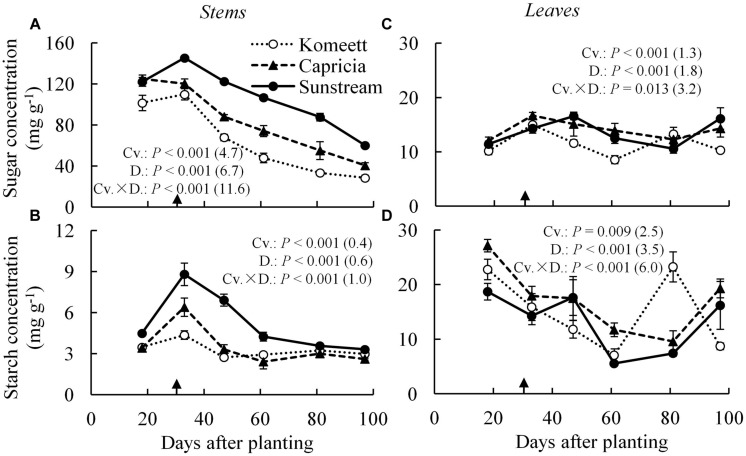
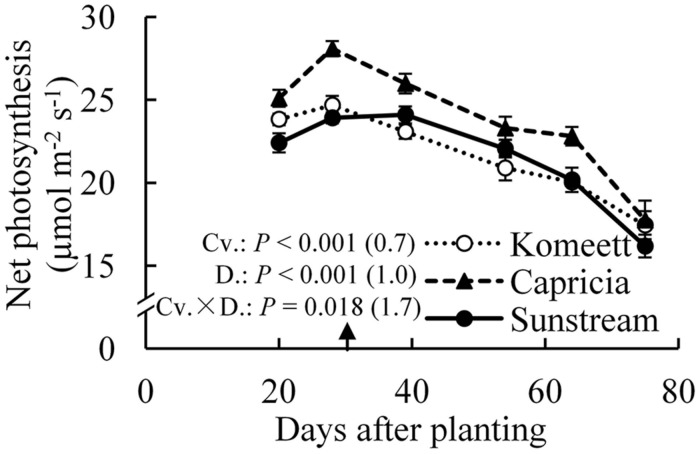
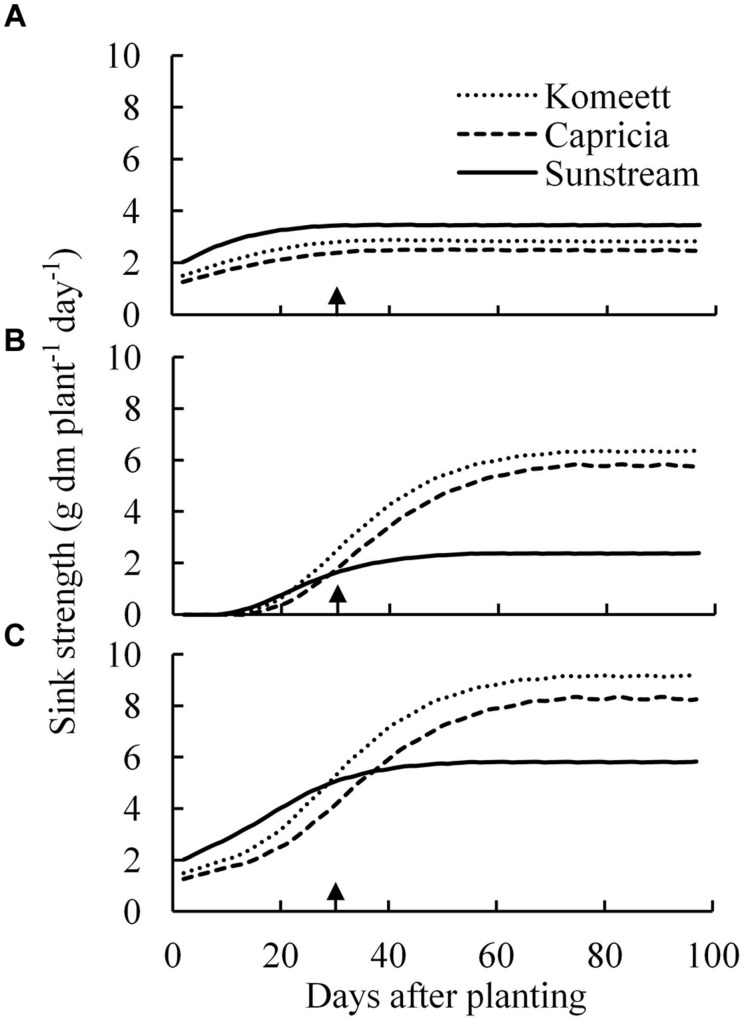
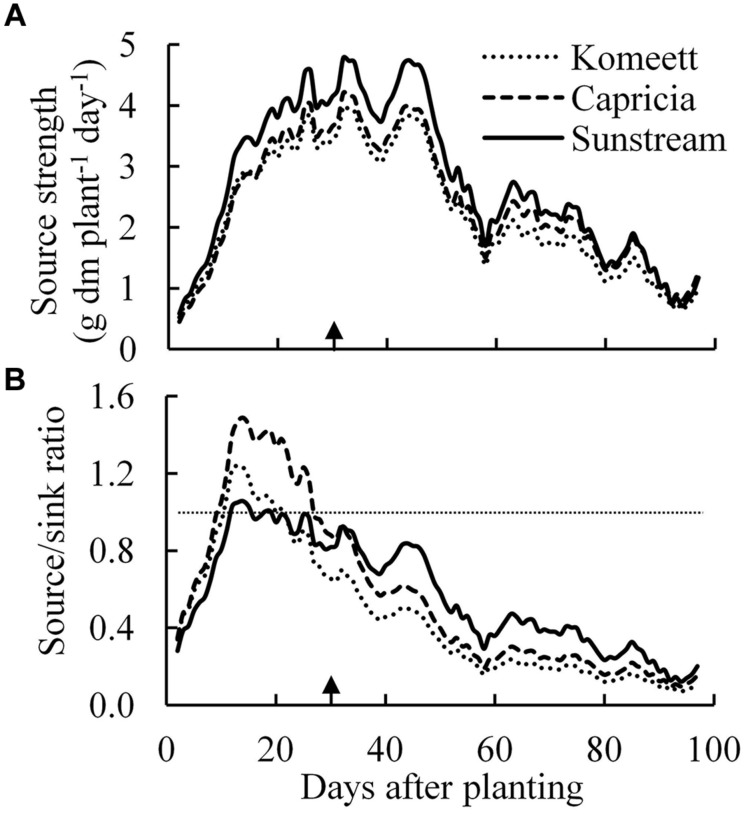
Supplementary lighting is frequently applied in the winter season for crop production in greenhouses. The effect of supplementary lighting on plant growth depends on the balance between assimilate production in source leaves and the overall capacity of the plants to use assimilates. This study aims at quantifying the source-sink balance and carbohydrate content of three tomato cultivars differing in fruit size, and to investigate to what extent the source/sink ratio correlates with the potential fruit size. Cultivars Komeet (large size), Capricia (medium size), and Sunstream (small size, cherry tomato) were grown from 16 August to 21 November, at similar crop management as in commercial practice. Supplementary lighting (High Pressure Sodium lamps, photosynthetic active radiation at 1 m below lamps was 162 μmol photons m(-2) s(-1); maximum 10 h per day depending on solar irradiance level) was applied from 19 September onward. Source strength was estimated from total plant growth rate using periodic destructive plant harvests in combination with the crop growth model TOMSIM. Sink strength was estimated from potential fruit growth rate which was determined from non-destructively measuring the fruit growth rate at non-limiting assimilate supply, growing only one fruit on each truss. Carbohydrate content in leaves and stems were periodically determined. During the early growth stage, 'Komeet' and 'Capricia' showed sink limitation and 'Sunstream' was close to sink limitation. During this stage reproductive organs had hardly formed or were still small and natural irradiance was high (early September) compared to winter months. Subsequently, during the fully fruiting stage all three cultivars were strongly source-limited as indicated by the low source/sink ratio (average source/sink ratio from 50 days after planting onward was 0.17, 0.22, and 0.33 for 'Komeet,' 'Capricia,' and 'Sunstream,' respectively). This was further confirmed by the fact that pruning half of the fruits hardly influenced net leaf photosynthesis rates. Carbohydrate content in leaves and stems increased linearly with the source/sink ratio. We conclude that during the early growth stage under high irradiance, tomato plants are sink-limited and that the level of sink limitation differs between cultivars but it is not correlated with their potential fruit size. During the fully fruiting stage tomato plants are source-limited and the extent of source limitation of a cultivar is positively correlated with its potential fruit size.
在冬季,温室作物生产中经常采用补光措施。补光对植物生长的影响取决于源叶中同化物的生产与植物利用同化物的整体能力之间的平衡。本研究旨在量化三种果实大小不同的番茄品种的源 - 库平衡和碳水化合物含量,并研究源/库比与潜在果实大小的相关程度。品种Komeet(大果型)、Capricia(中果型)和Sunstream(小果型,樱桃番茄)于8月16日至11月21日种植,采用与商业生产相似的作物管理方式。从9月19日起进行补光(高压钠灯,灯下1米处光合有效辐射为162 μmol光子·m⁻²·s⁻¹;根据太阳辐照度水平,每天最多补光10小时)。通过定期破坏性收获植株并结合作物生长模型TOMSIM,根据植株总生长速率估算源强。通过在非限制同化物供应条件下非破坏性测量果实生长速率(每个果穗仅留一个果实)来确定潜在果实生长速率,从而估算库强。定期测定叶片和茎中的碳水化合物含量。在生长初期,“Komeet”和“Capricia”表现出库限制,“Sunstream”接近库限制。在此阶段,生殖器官几乎未形成或仍较小,且与冬季月份相比,自然光照充足(9月初)。随后,在结果盛期,所有三个品种均受到强烈的源限制,这表现为源/库比低(种植后50天起,“Komeet”“Capricia”和“Sunstream”的平均源/库比分别为0.17、0.22和0.33)。修剪一半果实几乎不影响净叶片光合速率这一事实进一步证实了这一点。叶片和茎中的碳水化合物含量随源/库比呈线性增加。我们得出结论,在高光照下的生长初期,番茄植株受库限制,且库限制水平因品种而异,但与它们的潜在果实大小无关。在结果盛期,番茄植株受源限制,品种的源限制程度与其潜在果实大小呈正相关。