Didier Alain, Malling Hans-Jørgen, Worm Margitta, Horak Friedrich, Sussman Gordon L
Rangueil-Larrey Hospital, Department of Respiratory Diseases, 24 Chemin de Pouvourville, TSA 30030 31059 Toulouse, Cedex 9 France.
Allergy Clinic, Copenhagen University Hospital, Gentofte, Denmark.
Clin Transl Allergy. 2015 May 22;5:12. doi: 10.1186/s13601-015-0057-8. eCollection 2015.
The 300IR (index of reactivity) 5-grass pollen tablet has favorable short-term and sustained clinical efficacy in patients with grass pollen-induced allergic rhinoconjunctivitis (ARC). Here, we report maintenance of efficacy and safety over 2 years following treatment discontinuation.
Randomized, double-blind, placebo-controlled, parallel-group, multicenter Phase 3 trial in patients aged 18-50 years with ARC. During study years 1-3, patients received a daily sublingual tablet containing either 300IR 5-grass pollen extract or placebo, according to a discontinuous pre- and coseasonal protocol. Study years 4 and 5 were treatment-free. In response to health authorities' recommendations, the daily combined score (DCS) was assessed in a post-hoc analysis as the efficacy endpoint. Components of the DCS were daily rhinoconjunctivitis total symptom score (DRTSS) and daily rescue medication score (DRMS).
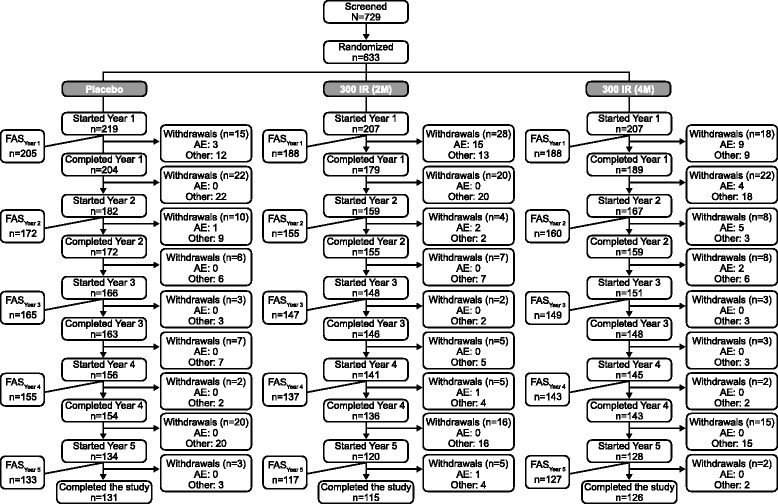
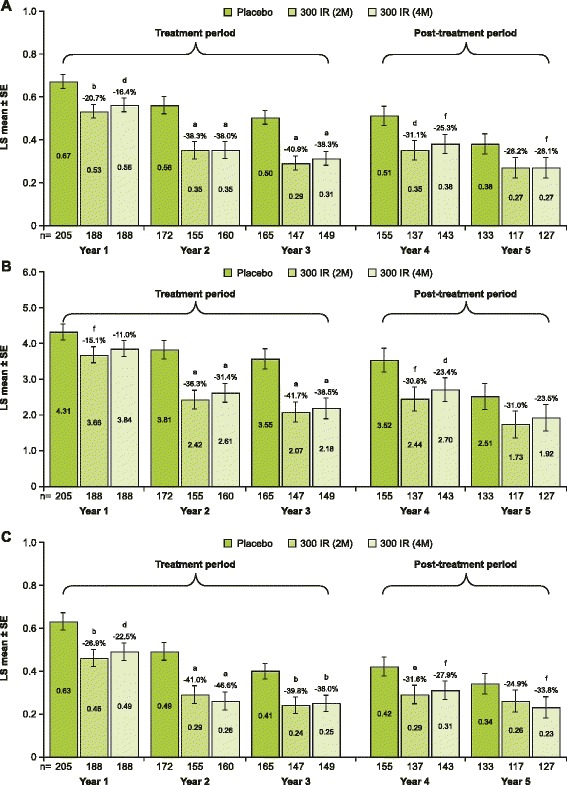
633 patients with ARC were randomized to placebo (n = 219) or 300IR 5-grass pollen tablet, beginning 4 months (4 M, n = 207) or 2 months (2 M, n = 207) prior to the estimated start of the grass pollen season and continuing until season's end. During the first post-treatment year, a statistically significant difference versus placebo in least squares (LS) mean DCS was noted in patients previously receiving active treatment (300IR (2 M) point estimate: -0.16, 95% confidence interval (CI95%): [-0.26, -0.06], p = 0.0019; -31.1%; 300IR (4 M) point estimate: -0.13, CI95%: [-0.23, -0.03], p = 0.0103, -25.3%). During the second post-treatment year, patients in the 300IR (4 M) group, but not the 300IR (2 M) group, showed a statistically significant difference in LS mean DCS versus placebo (point estimate: -0.11, CI95%: [-0.21; 0.00], p = 0.0478, -28.1%). This significant efficacy seen during the post-treatment years in patients previously treated with 5-grass pollen tablet compared favorably with that during the 3 prior years of active treatment. A statistically significant difference versus placebo was also noted in secondary efficacy measures in both post-treatment years (except for DRTSS in year 5). In the absence of any active treatment, the safety profile was similar in the active groups versus placebo group during either post-treatment year.
In adults with grass pollen-associated ARC, 5-grass pollen tablet therapy beginning 4 months before the pollen season and continuing to season's end demonstrated efficacy across all variables during active treatment, and this effect was prolonged for up to 2 years post-treatment.
ClinicalTrials.gov identifier: NCT00418379.
300IR(反应性指数)5草花粉片对草花粉诱发的变应性鼻结膜炎(ARC)患者具有良好的短期和持续临床疗效。在此,我们报告了停药后2年的疗效和安全性维持情况。
对年龄在18至50岁的ARC患者进行随机、双盲、安慰剂对照、平行组、多中心3期试验。在研究的第1至3年,患者根据间断的季前和季中方案,每日舌下含服一片含有300IR 5草花粉提取物或安慰剂的片剂。第4年和第5年不进行治疗。根据卫生当局的建议,在事后分析中将每日综合评分(DCS)评估为疗效终点。DCS的组成部分为每日鼻结膜炎总症状评分(DRTSS)和每日急救药物评分(DRMS)。
633例ARC患者被随机分为安慰剂组(n = 219)或300IR 5草花粉片组,在预计草花粉季节开始前4个月(4M,n = 207)或2个月(2M,n = 207)开始用药,并持续至季节结束。在治疗后的第一年,先前接受活性治疗的患者的最小二乘(LS)平均DCS与安慰剂相比有统计学显著差异(300IR(2M)点估计值:-0.16,95%置信区间(CI95%):[-0.26,-0.06],p = 0.0019;-31.1%;300IR(4M)点估计值:-0.13,CI95%:[-0.23,-0.03],p = 0.0103,-25.3%)。在治疗后的第二年,300IR(4M)组患者的LS平均DCS与安慰剂相比有统计学显著差异,但300IR(2M)组没有(点估计值:-0.11,CI95%:[-0.21;0.00],p = 0.0478,-28.1%)。在先前用5草花粉片治疗的患者中,治疗后几年观察到的这种显著疗效与活性治疗的前3年相比具有优势。在两个治疗后年份的次要疗效指标中也观察到与安慰剂有统计学显著差异(第5年的DRTSS除外)。在没有任何活性治疗的情况下,活性组与安慰剂组在任何一个治疗后年份的安全性概况相似。
在患有草花粉相关ARC的成年人中,在花粉季节前4个月开始并持续至季节结束的5草花粉片治疗在活性治疗期间对所有变量均显示出疗效,并且这种效果在治疗后长达2年仍持续存在。
ClinicalTrials.gov标识符:NCT00418379。